Where’s the Beef?

I didn’t plan for this week to be so light on content, folks, it just sorta turned out that way. I got behind on work, which threw off my baking schedule, and well…the you are. Next week’s going to be a little hit-or-miss as well since I’ll be traveling on business, but I’ll see if […]

READ ON

On the Many Uses of Gelatinized Starch

Reader Eric writes:

Following on your melon pan recipe, I was wondering if during your research you came across any recipes that called for a tangzhong or a water roux. It’s touted as an anti-staling method, or a softness improver.

Wondering if you’ve tried it yourself. My personal experience with East Asian pastries and breads is that they are generally soft and don’t go stale quickly, which might be because of the preservatives and conditioners that are added.

READ ON

Frosting Freaks Unite!

Who knew there were so many people in the world who don’t like buttercream? Following Monday’s post on Heritage frosting I’ve received a deluge of emails asking for alternatives to buttercream. Of course I never deny my readers anything (ehem). Hang on while I whip something up.

READ ON

How does flour thicken?

Good question, reader Luther! It’s commonly said that flour granules “pop” in a hot, wet environment, releasing their starches and creating thickening. But that’s not quite right. Think of a flour granule as a tightly-bound bundle of reeds and branches (amylose and amylopectin [starch] molecules), a broken-off chunk of wheat berry endosperm. Immerse that granule […]

READ ON

“Heritage” a.k.a. “Boiled” a.k.a. “Flour” a.k.a. “Cooked Flour” a.k.a. “Gravy” a.k.a. “Cloudburst” Frosting

Did I forget to mention it’s also called “mock buttercream”? This is something that a handful of readers have asked me about lately. It was little Jo’s turn to submit a cake for the cake wheel at last Friday’s fish fry, so it seemed like a good time to make it.

READ ON

Old is Gold

Reader Jay writes:

When you were talking about macarons, you said that old egg whites are better. Does the rule hold true for floating islands?

It does. Older eggs are better when it comes to making any sort of foam. Why? Simply because older eggs have runnier whites, and when egg whites are runny it’s easier to put the hurt on the proteins they contain. Think of it like this: a whip cuts through a bowl of water with much more force than it does through a bowl of, say, honey. The result is that older whites are not only easier to whip, they whip up higher.

READ ON

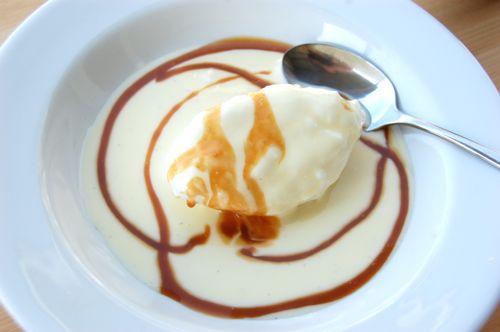
Making Floating Islands

My daughters, my neighbors’ daughter, my neighbors and my wife were all stunned at how good this dessert was. On the face of it, it just doesn’t sound all that interesting. Meringue poached in milk? Oh, yippee. You really have to try this to understand how remarkable it is. With your caramel sauce and crème anglaise at-the-ready, start making your islands. Pour the milk into a saucepan and set it on to simmer.

READ ON

What about plastic bowls?

I’ve heard you can’t make a decent egg white foam in them.

…writes reader Owen. That’s another well-worn myth in the world of foams: that it’s impossible to whip up a good foam in a plastic bowl, or using plastic implements. The logic is that because plastics are so similar chemically to fats and soaps, they tend to hang on to trace amounts of them, foiling future attempts at foamery. There’s some truth in this. Plastic, fat and soap all share certain structural similarities. It’s also true that they tend to want to hang on to one another when they’re in close proximity, as anyone who’s ever tried to wash out a plastic salad bowl coated with oil can attest (it takes lots of soap and scrubbing, and even then you probably can’t get rid of it all). But unless the bowl in question is actually greasy to the touch, those minute amounts of fat won’t adversely affect the foam.

READ ON