Spit cake: tastes better than you might think.

Originally chimney cake was known as Kürt?skalács, but I have to be honest here and say that I have absolutely no idea how to pronounce that word. I’m told that it literally means “chimney cake” in Hungarian, and that’s good enough for me.

So chimney cake is Hungarian, then? Yes, but not exactly. It hails from Transylvania, which once made up the eastern portion of Hungary, but ever since 1945 has made up western portion of Romania. Which I suppose makes it technically Romanian, but then hundreds of thousands — if not millions — of Hungarian-speaking people still live in Transylvania. For them not much has changed other than the location of the border. Which I guess really makes it Hungarian. I dunno, it’s a tough call.

READ ON
Chimney Cake Recipe

A chimney cake is an odd thing in that it’s an enriched yeast bread that’s wound onto a thick wooden spit, then roasted over a charcoal fire. The hardest part of this recipe is constructing the implement you need. More on that as the week progresses.

For the dough:

8.5 ounces (1 3/4 cups) flour
2 1/4 teaspoons (1 packet) instant yeast
1 ounce (2 tablespoons) sugar
1/8 teaspoons salt
2 egg yolks, room-temperature
1.5 ounces (3 tablespoons) melted butter
4 ounces (1/2 cup) milk, room temperature

READ ON

Paul Bunyan Weekend

I usually spend my weekends chasing children and plotting the next baking exploit. This last one was a bit different. We had a break in the weather so I spent most of my free time working out in the yard, chopping holes for fence posts out of the extremely woody ground along the south edge of our lot. It was extremely hard work but it felt great — the perfect antidote to a week spent obsessing over a fussy pastry. I sorely need something to make me feel more…how can I say this…man-like.

However I’m not sure I’m fully recovered. Which is why this week I’m going to take on a baking project that takes tools: a circular saw, vise and a power drill with nice, fat 3/4″ flat bit. Oh yes. Just writing that is helping the masculinity flow back. Much better…definitely much better…

READ ON

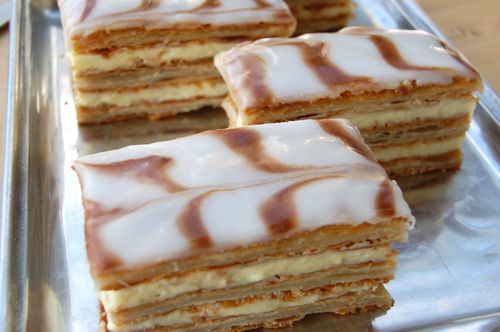
Making Napoleons (Mille-Feuille)

Napoleons seem tough, but it’s only the topping that can be tricky. If the marbled sugar is what’s stopping you from attempting these, console yourself that a simple dusting of powdered sugar is more than acceptable. In fact it’s it the standard in many quarters. The zebra-striped crown is something we Americans have come to expect on top of our mille feuilles. The truth is that homemade Napoleons are terrific either way.

READ ON

Large-Scale Butter Making

Readers Sandra asks if all butter is still made in the way I described a couple of posts below. In fact, no. These days the starting point for most commercial butter isn’t cream, it’s leftover whey from the cheese making process. Whey still has milk fat left in it that didn’t coalesce into cheese curds, and whereas the amount of fat in liquid whey would have been far too little for creameries of old to reclaim efficiently, today centrifuges spin it out in minutes. Sure, it’s an “industrial” process, but it keeps all that milk fat from going to waste, and that seems like a good thing to me.

READ ON

How is butter made?

On a microscopic level, butter is fascinating stuff. It’s been called an “inside out” emulsion since it starts out as dispersion of fat globules in a continuous phase of water (cream) and ends up as a dispersion of water droplets in a continuous phase of fat (butter). Pretty funny, eh?

I said pretty funny, eh???

(Sound of crickets chirping.)

Ehem. So how does this miracle happen? Well it all starts with preparing the cream. The first thing that happens is it’s pasteurized, i.e. heated to 185 or so degrees Fahrenheit. After that the cream is slowly cooled to about 40, at which point something very interesting happens: fat crystals start to form in the mixture. This is an important step for the ultimate texture of the butter, which depends on a careful balance of fat crystals and “free” liquid fat. Too many crystals and the butter will be brittle, too few and the butter will leak liquid fat and be overly soft and “greasy.”

READ ON

How does seasonality affect butter?

That from reader Trish, and it’s an interesting question. I’m not up on the finer points of cow metabolism, however I do know that cows that are grazed on open pastures tend to give milk that makes soft butter. Something about what happens when polyunsaturated fats are processed into milk inside the cow…I’m hazy on […]

READ ON

Rain, rain, go away…

The operative word here in the Midwest has been rain. Storm clouds have frustrated my attempts at photography and moistened our basement, but if that’s all they do to us we’ll be lucky. The mighty Ohio is starting to creep inland. Flood wall closures are being shut and dams are being eyed suspiciously as the wet stuff keeps falling in sheets. Our neighborhood here in Louisville is called the Highlands, and as I explain to my young daughters, it’s because it sits on high lands. That means we’ll only be inconvenienced by the storms. But right now there are a lot of families who are are discovering what nature can do despite the best efforts of civil engineers. Say a prayer for them over the course of your busy day if you can.

READ ON