Egg Yolks: The Enzyme Problem

I confess I’ve been saving this question since the weekend, as it dovetails beautifully with today’s discussion on the subject of egg yolks. Reader Peet writes (wrote):

Hi Joe! I’m having a problem with my pastry creams, i.e. they’re too thin. I cook them but have never been comfortable with bringing them to a boil since I’m afraid of curdling, and anyway egg proteins thicken at a much lower temperature. Which means there’s no reason the creams shouldn’t be thick, but they start out thick and eventually turn to soup in the refrigerator. Is boiling really the key to a thick pastry cream? And if so, why?

I think I see the problem, Peet. The heart of it is that pastry cream isn’t a protein-thickened custard (at least not primarily), but rather a starch-thickened custard. But this poses an excellent question: why must starch-thickened custards be boiled? The answer has to do with an enzyme called amylase that’s present in egg yolks. If you remember how flour thickens watery mixtures, it does so when it warms enough that the individual starch molecules — long, string-like amylose molecules and branch-like amylopectin molecules — start to separate from the flour granules. They float off and get tangled up with one another, restricting the flow of the water around them.

READ ON

Egg Yolk

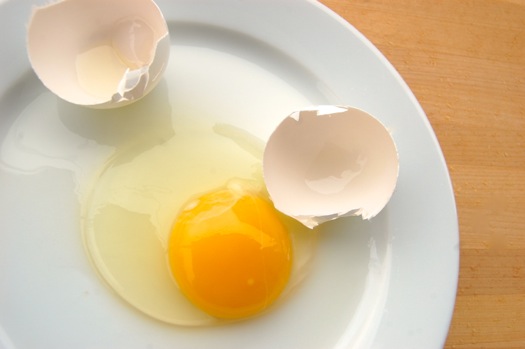
That’s a very pretty, upstanding yolk, no? It’s the mark of a fresh egg. If you’re ever in a position where you need to evaluate the relative age of an egg, a yolk is a good place to start. If it’s fairly roundish and bright yellow, and is sitting high atop a slightly milky-looking mound of almost gel-like egg white, your egg is extremely fresh. Make cake, cookies or muffins out of it. Or better still cook it up, because fresh eggs make mighty good eatin’.

Old eggs are very different in their appearance just out of the shell. The white becomes very clear and watery due to a progressive change in the pH of the egg, which begins as soon as the egg is laid. That change in pH causes the proteins in the white to drift away from each other, dispersing the large aggregations that formerly made the egg white jelly-thick and whitish. As that happens the membrane around the yolk starts to weaken. More water from the white enters the yolk, diluting its pigments and giving it a pale appearance. As that happens the yolk membrane stretches out, causing the yolk to lie almost flat. If you’ve ever tried to separate an old egg, you know just how weak that membrane is after many weeks of sitting. If the egg is sitting at room temperature, the pH change happens many times faster.

READ ON

Egg (Whole)

A post on eggs could go on almost indefinitely. However since I want to focus on the egg as ingredient, I’ll do my best to keep this short and useful. The logical place to start is: how are eggs used in the pastry kitchen? I can think of three main categories of use: as a structural component in cakes, as a thickener in custards and creams and as a foam in batters, meringues, frostings and the like. It’s a pretty crude taxonomy when you consider how much eggs offer the pastry cook in terms of flavor, enrichment and color, but it seems functional to me.

Eggs come in different colors, sizes and grades. For our purposes I’ll focus on the basic white, large (as opposed to “peewee”, “small”, “medium”, “extra large” or “jumbo” as defined by the US Department of Agriculture) chicken egg, since that’s what most pastry recipes printed in the States call for. They’re also the most commonly available egg for home bakers and commercial bakers alike. Those that use shell eggs, anyway. Large eggs weigh about two ounces. The white weighs about an ounce, the yolk about half an ounce and the shell accounts for the rest.

READ ON

Tell Me About Eggs

Ever since the egg wash post, there’s been a surge in requests for a short section on eggs to complement the sections on fats, sugars and syrups in the Ingredient Basics section. Rest assured the potica project is proceeding, however since I’m not particularly flush with content for this particular pastry, I thought I’d put […]

READ ON

A Roll That Knows No Borders

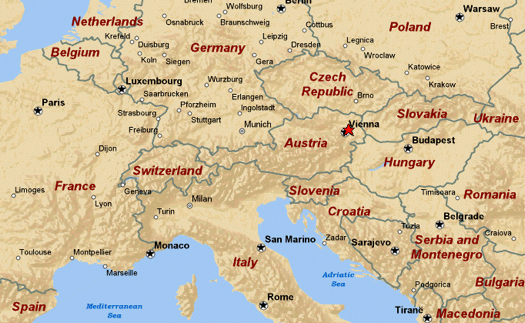
I’ve received a few really fun emails from readers saying things like: “I’m Irish but my grandmother made potica. I had no idea it was Slovenian!” Just another reminder that good ideas — especially when they’re based on butter and ground nuts — spread quickly from culture to culture. I mentioned below that you can find versions of potica all through Central Europe. The reason for this is because Slovenia was once part of Austria. What interest did Austria have in Slovenia? It’s fairly obvious if you look at a map. Landlocked Austria was the seat of an empire, one which needed access to the sea (it’s right there at the tip top of the Adriatic, next to Italy). Slovenia was that access. And since empires assimilate cultures as much as they do geographies and economies, potica became part of the imperial baking repertoire. So a lot of Central European immigrants to America knew how to make potica before the ever got here.

READ ON

What is Potica?

It’s a rolled-up cake made with a very thin yeast dough, and filled with a sweet walnut filling. Or at any rate that’s its most common form in and around Slovenia. But that’s not to say that nut paste is the beginning and end of potica. Potica’s name derives from a Slovenian word meaning “to wrap up” or “to roll up”, or so I understand, and in that region of the world they wrap and/or roll quite a few different things.

Poppyseed paste, for example. Also cooked apples, sweet farmer’s cheese, honey, raisin filling, cooked cherries, chocolate filling…and those are just the sweet varieties. Tarragon and egg potica is an old Slovenian classic. Chive and

READ ON

Potica Recipe

As with all the age old trans-cultural, trans-national classics I’ve attempted here on joepastry.com, there is no way a single recipe can encompass the totality of potica/povitica…gestalt, shall we say. Fillings vary, doughs vary, techniques vary. This one is more Slovenian (southeastern European) in its orientation, though I realize that even in this region interpretations vary (sorry to those who were hoping for a strudel-type povitica (though I do have strudel dough on the site should you want to venture out on your own!). I offer this will all due pleasure and apologias.

The Dough

1 lb. (3 cups) bread flour or all-purpose flour
2 1/4 teaspoons instant yeast
3/4 teaspoon salt
1.75 ounces (1/4 cup) sugar
8 ounces (1 cup) whole milk, room temperature
2 ounces (1/2 stick) very soft butter

READ ON

On Egg Wash

Several readers have asked that I go a bit in-depth on egg washes. I’m happy to oblige, though I have to confess up front that I’m not a big believer in the alchemy of egg washes. Unless you’re very much into the minute details of presentation — and I’m clearly not — a simple wash made of well-beaten whole egg will do you for most any job. Multi-ingredient washes made from egg, cream, water with a dash of sugar…homey don’t play dat.

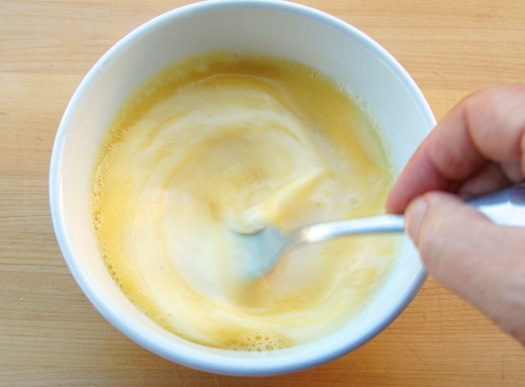
Making sure the egg really is well-beaten and not merely scrambled in the bowl is the real key to a good wash, i.e. one that gives you a smooth and even finish. Blobs of egg white on the brush will not only give you an uneven glaze, the pockets of albumen will actually prevent the wash from adhering to the pastry’s surface. I use a fork (sometimes a mini whisk) to mix up an egg wash. I whip briskly until I can’t force myself to do it any longer (about 2-3 minutes, which is a long time when you’re just standing there over a tiny bowl…whipping).

READ ON