Good Vanillin, Bad Vanillin

It’s worth noting that the original Cook’s Illustrated article on imitation vanilla drew a distinction between high and low quality imitation vanilla, and stressed that you should go for the good stuff. But that raises the question: what’s the difference? Primarily, in the types of vanillin the extract includes.

READ ON

Vanilla and Vanillin

Reader Joey asks: why do we need imitation vanilla extract, and where does it come from? Both very good questions. The reason we need imitation vanilla is because demand for vanilla flavor exceeds the total quantity of naturally-produced vanilla by something like 750%. So, if we didn’t have imitation vanilla extract, a typical $2 vanilla bean would cost about fifteen bucks. Which would make one heck of a pricey pot de crème, n’est-ce pas?

READ ON

“Beaver Butt” My Eye

Remember the schoolyard rumors from all those years ago about ground worms in McDonald’s hamburgers? Spider eggs in chewing gum? Well over the past couple of years there’s been another one: beaver anal gland exudate, a material called castoreum, in imitation vanilla. The stuff was once described by a cosmetics formulator as having some “vanilla-like” notes. Once those words were uttered it wasn’t long before the vanilla extract rumor hit the streets. Given its patent absurdity, it’s achieved surprising traction. No less a person than Jamie Oliver repeated it on the David Letterman show in 2011.

READ ON

Imitation Vanilla???!!!

Yes, yes it’s true that I do indeed use imitation vanilla more often than any other type of vanilla. Why? Well, many of you out there may remember about eight years ago when Cooks Illustrated released the results of a blind taste test in which a panel of bakers and pastry chefs picked imitation vanilla over real vanilla as being more vanilla-y in applications like cookies and cakes. I was amused by that but never really believed it until one fateful month when my revenues were down and I couldn’t quite rationalize another $120 jug of real vanilla emulsion. I felt guilty, but I ordered a $29 jug of imitation vanilla instead and put some of it in my doughnuts.

READ ON

Cornstarch-Thickened Liquids: Why They Thin When They Cool

Reader Zavia wants to know why corstarch-thickened soup sometimes thins out as it cools. The answer is that it depends on what’s in the soup. If there’s much fat, it could have prevented the cornstarch granules from absorbing enough water to begin with. Which is to say, the starch granules didn’t get a chance to fully swell, and then released the little bit of water they had when the mixture cooled. The result: thinning. Try stirring in a little more water into the cold soup, and see if that helps it thicken. If it works add a little more water until the soup is back to the texture you want.

READ ON

Here’s what I learned today…

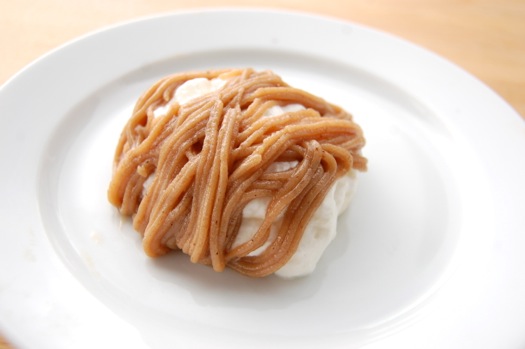
Chestnut paste is heavy, whipped cream is light. Put one on top of the other in any quantity and the result will be…this. Hm…this is going to mean a re-think of the recipe since I don’t much care for the idea of a giant, shambling mound of chestnut paste on a base. I like it, just not that much. Also, after all that hassle I ended up receiving chestnut spread in the mail, not chestnut paste, and there’s a difference. Man, my projects are getting the best of me in the dog days of summer, aren’t they?

READ ON

Why do star chefs love flake salt so much?

So asks reader Brandi. Part of the reason, Brandi, is merely caché. Yet there are some good reasons why many cooking show chefs prefer to work with flake salt. For one, it’s easy to pick up. And I mean that literally. Granules of table salt run from between your fingers like tiny ball bearings when you try to pick up a pinch. Flake salt by comparison clumps and allows for easy grasping. It also dissolves quickly, which is nice when you’re trying to correct the seasoning of a food just prior to serving.

READ ON

Sally in the Galley

…is the most original food blog concept I’ve ever encountered lately. Though she’s not in range of wifi too terribly often, she does manage to post regularly as she travels from port to port, making the best of whatever she can find in the sea-going larder. Check her out, as I am now a follower!

READ ON

These days…

…almost all the edible chestnuts you see for sale in the States are imported. We bring in some 4,000 metric tons of chestnuts per year from Europe, mostly around the holidays. Chestnut paste, a very common spread on the Continent, is virtually unknown here for reasons that a surely obvious. Perhaps one day, if the chestnut forests ever come back, we’ll make some of our own…’cause it sure is good.

READ ON