Honey Madness

Reader Erica wonders why, if bees have evolved such an effective defense against microscpoic honey thieves, they couldn’t have evolved a more effective defense against larger ones like beekeepers. You know, Erica, I’m not entirely convinced that they aren’t working on that very thing right now. Since antiquity, honeys harvested from parts of northern Turkey have been notorious for their toxic effects. The reason, because they’re produced from the nectar either of of two species of rhododendron, R. luteum and R. ponticum which is known to contain compounds known as grayanotoxins.

READ ON
What, you kept bees?

Yes, Mrs. Pastry saw the movie Ulee’s Gold a few too many times and before I knew it I was at the University of Illinois taking a weekend bee husbandry course. We don’t keep them anymore (Mrs. Pastry eventually developed an allergy to stings) but it was one of the most interesting hobbies I’ve had. Bees are endlessly diverting as pets. You never know what those little suckers are going to do or why. Sting you, sure. But over time, as you start falling in love with your hives, you come to regard the stinging as nearly pleasurable.

READ ON

Bee Syrup

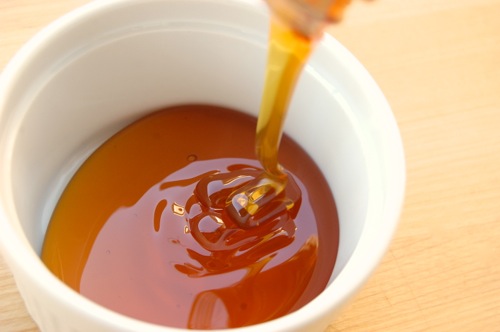
You can’t talk bee sting cake without talking honey and bees, now can you? Bees are hands down the world’s premier syrup manufacturers. It’s little wonder why, they’ve been refining their technique for about a hundred million years. The process they use is the same one we employ for making syrup out of tree sap or sugar cane: reduction. They start with a thin 80% water-to-sugar solution that they extract from flowers, then slowly reduce it down until it has a moisture content of right around 18%. At that point they deposit the syrup in a cell in the honey comb, cap it off with wax and await the winter (or the beekeeper).

READ ON

What about single-acting baking powder?

I’ve received a couple of questions on the subject this week. Honestly I didn’t know single-acting powder was still out there for anything other than commercial/industrial use. As I mentioned below, double acting baking powders deliver two “actions”, one that happens fast when the batter is being mixed, and another that happens slowly as the batter gets hot. The effect is achieved by combining two different acids with a specific quantity of baking soda (plus a little corn starch to keep the chemicals from reacting in the can). For the fast reaction baking powder manufacturers either use

READ ON

What about baking soda?

Reader Liam writes to ask whether a baking soda-leavened batter needs to be rushed into the oven as soon as it’s mixed, since that’s what he’s always heard. Another fabulous question. The answer is a rather unsatisfying “it depends”, Liam. A lot of bakers consider baking soda to be something of a chemical one-trick pony. You add it to a wet batter and it reacts, end of story. But that’s not the whole of it. True, if you combine baking soda with plenty of acid à la a baking soda volcano you are going to get a big chemical reaction that will be over almost immediately. However reacting baking soda with acid isn’t the only way to get it to leaven. You can also degrade it by applying heat. Those are two different processes and both

READ ON

Bienenstich Recipe

Lovers of pastry will notice that bee sting cake bears a striking resemblance to tarte Tropézienne. That makes sense since tarte Tropézienne is really a German cake adapted to French resort town living. What are the differences? The bee sting cake filling isn’t as rich, being more custard-y than buttercream-y. Then there’s the matter of the topping: a caramel and sliced almond combo that gives the appearance of a mass of bees on a honeycomb. Here’s what you need:

READ ON

Action and More Action

Reader Dan, who is working on financiers this week, has a very interesting question about baking powder:

If you’re using [baking powder], why rest the mix in the fridge? Surely the [baking powder] is activated, and loses its potency before you actually come to baking?

It’s very reasonable to assume that, Dan. Conventional wisdom holds that whenever you get baking powder wet you need to hurry it into the oven so you don’t lose any volume. That actually isn’t the case. It’s certainly true that you get a gas-producing “pop” when the baking powder gets wet. That’s the first “action” of double-acting baking powder. The second action happens when the baking powder gets hot.

READ ON

Are things feeling a little cozy in here?

March is always hell on my numbers, I assume because of spring break (if not I’m seriously losing my edge). I generally check analytics around the first of the month, and this morning I laughed out loud when I saw the trend line since the 8th. Given how few of us there are here today, […]

READ ON

Next up: Bienenstich

German “bee sting” cake is what this is, and I’ve been wanting, then forgetting, then wanting, then forgetting again to do this cake for years. Thankfully reader Bina got on may case about it a couple of weeks back. It’s high time I got this thing done!

READ ON