What is suet?

More than happy to tell you all about it, Lucy! Suet is beef fat, but not just any sort of beef fat. It’s fat taken from right near the kidneys of the steer. It’s the mildest-tasting, easiest-melting fat on the animal, which is why it’s used for an application like mincemeat. The equivalent fat on a pig is known as leaf lard, and by no coincidence whatsoever it has also been prized by bakers over the centuries (I’m a big fan of it myself). Here’s what fresh suet looks like:

READ ON

When do you eat a mince pie?

Good question, reader Nicole! In Britain, around Christmas (traditions vary as to the most auspicious time to consume one, before Christmas or after, during the 12 Days). However mincemeat itself was/is traditionally made around October so the mincemeat has time to age. Mincemeat is an Autumn – New Year’s tradition in America.

READ ON

What is Mincemeat?

I wrote a little about this last week, but now that mincemeat is an official project, the subject bears a little more scrutiny. Someone who’s never heard of the stuff before might be forgiven for thinking it’s simply minced meat. But of course it isn’t. At least not these days. Meat hasn’t been a common ingredient in mincemeat for over 100 years.

The “mince” part of the name, well, that’s still accurate. Although I should mention that on this side of the pond we don’t use the word “mince” very much. We employ words like “grind”, “chop” and “shred” to the same end.

So what’s “minced” in mince meat?

READ ON

Next up: Mince Pies

I promised mincemeat…but other than eating it by the spoonful — which I’m not averse to — what do you do with it? Make a mince pie, that’s what. I haven’t eaten one of these since I lived in Britain, lo these many years ago. But even that pie was of the modern, meatless variety. […]

READ ON

New Recipe Up

I know all this is moving painfully slowly. However I’ve got the below Cardinal slice recipe updated now with the new formula and process. I’ll try to post the result this afternoon. However it’s so darn gloomy here I don’t know how well my “hero shot” will turn out. I’ll do my best!

READ ON

Making Stabilized Whipped Cream

Sure, there are plenty of purists out there who don’t believe cream should be polluted with stabilizers. I’m with them…some of the time. The rest of the time I’m worried about my whipped cream holding up for long periods, on warm days or in the freezer. Then I’m looking for a little somethin’-somethin’ to help get me by.

That something is gelatin. Just a little will do wonders you whipped cream’s stability, and honestly, it barely impacts the taste or texture. Start by melting a little gelatin. For 2 cups of cream you’ll start with a 1/2 teaspoon of powdered gelatin and a little ice water. Yes, these are my little silicone Trudeau bowls again. I love them, that’s why I plug them. They’re wonderful:

READ ON

OK, Kiddos…

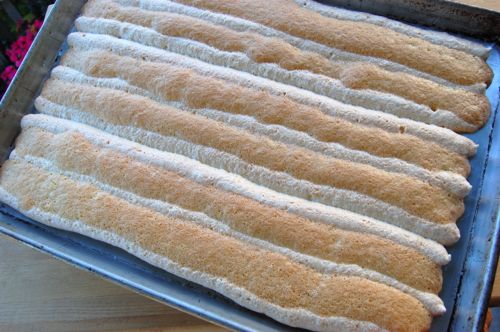
NOW we’re cookin’ with gas! Cardinal slices are a study in the effects of over-whipping. For that reason alone I recommend them. The ladyfinger batter is a very particular lady. She wants to be danced with, but not too much. If there’s too much agitation, the bubbles in the batter get too big, the rise gets too aggressive, and the sponge becomes so delicate that it can’t hold its own weight.

The same seems to be true with the meringue. I’ll confess it never occurred to me until today that meringue can be over-whipped. It appears that when it is, it can suffer from some of the same problems: over-puffing in the heat of the oven, then collapse when it cools. Fascinating…as Mr. Spock would say. Right…on to shaping and the most important part: eating. This is going to be good!

READ ON

Cardinal Slice Follies

So OK, this is a slow project. But let me tell you, this is a challenging pastry. I’ve done it maybe seven times now and I’m still not happy with where I am. I’m starting to see why there are so few recipes for this pastry in English.

There are several technical issues with the cake. First, it calls for two batters, baked in alternate stripes, right next to each other. Both are fussy: meringue and ladyfinger. One traditionally calls for low heat, the other for high heat. Formulated and baked just right, they coexist in beautiful harmony. But therein lies the rub. If you’ve ever seen a cardinal slice, you know the layers have a fluted appearance. Like so:

READ ON