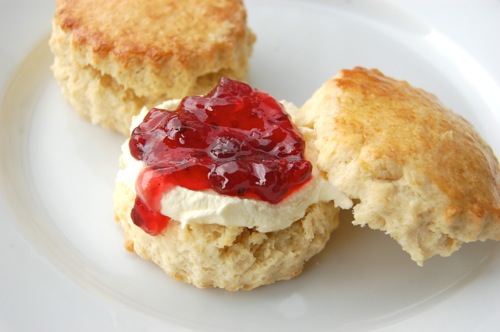
Making Clotted Cream
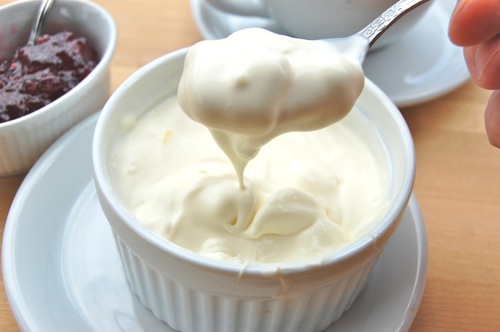
The texture of clotted cream is really unlike any other dairy product I’m aware of. It’s smooth, incredibly thick, full of big, curd-like blobs and just a little gooey. “Mud-like” is the term I usually use, and it’s apt.

For a one-time Devon resident like myself, the realization that I had the resources available to make my own clotted cream caused waves of both nostalgia and lust — butterfat lust — to wash over me. I had to rush out immediately and try it. If you have small, local dairy cream available to you (un-homogenized and especially un-stabilized) this recipe will be a snap. If not you probably won’t get quite the same result, but to my way of seeing things that’s no reason not to try. The potential rewards are simply too great.

READ ON

Does all this mean..

…you can’t make clotted cream with mass market cream? Reader Jools, I think it does. I have yet to try that, but it’s my belief that the stabilizing molecules in mass-market cream will prevent the dairy fat globules it contains from clumping up together in quite the same way. My belief is that you’ll get […]

READ ON

Hand-Skimmed Milk Question

Reader Ellen asks:

I’ve been trying to track down the answer to this one for a while…maybe you or some of your dairy chemist followers can [help]? I am looking for a (ballpark) estimate on the fat content of manually skimmed raw milk. That is, I let the cream separate in my half gallon of milk for a day or more, then I remove as much of the cream as is possible with a scoop of some kind. Any idea what the approximate fat content would be of the remaining milk? (The milk is from pastured cows, though I really don’t need that level of accuracy.)

READ ON

Homogenized, stabilized…

Reader Cici writes in to ask:

What is homogenization and why must all grocery store milk be homogenized and/or stabilized?

The trouble with cream for big commercial processors is that it separates easily. The fat globules that make up 36 (or more) percent of it tend to become attracted to one another and clump up into…well, you can see the results below. Homogenization — essentially hot, high-pressure spraying that tears large fat globules into teeny tiny pieces and distributes them evenly through the milk — helps to inhibit that natural separation.

READ ON

Joe’s Clotted Cream Adventure Begins

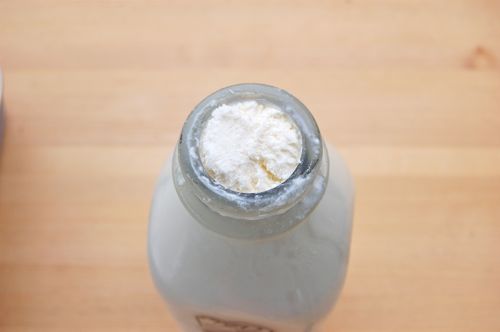
Most days I’m one of those cynics who thinks the local foods movement is overdone. Oversold, over-hyped, overwrought…over pretty much everything. But today is not one of those days. Why? Because this morning I opened up a glass bottle of locally-produced cream and found this:

READ ON

No Moo = Glue

Reader Kim, writes:

I have a couple lactose-intolerant folks in my house, and we sometimes bake with rice milk instead of cow’s milk. I’ve noticed a stark difference in the leavening and texture of pancakes and popovers when I use regular milk. With regular (cow’s) milk, the pancakes and popovers are fluffier and rise higher. With rice milk, they don’t rise as much, and have a gummier, gooey texture. Is it the magic of milk solids? The protein content? The fat? The type of sugars?

READ ON

Rising, Fast and Slow

Reader Anna wrote in late last week to ask why big heat (i.e. around 500 degrees Fahrenheit) helps shortbread-type cakes like scones and American biscuits rise higher. Anna, you’ve made me a very happy blogger this Monday morning. Leavening is a fascinating, fascinating subject.

READ ON

Making Cream Scones

Cream scones are the classic compliment to the Devon cream tea. They’re comparable in flavor to an American scone, but smaller, lighter of crumb and above all easier to slather with clotted cream and jam. Though the procedure and ingredients may be similar to American biscuits and/or Australian scones, they’re really their own animal. Try them and you’ll see.

READ ON

Whence the Scone?

That’s an awfully difficult question to answer. There’s no question that scones are descendants of Scottish oat and/or barley cakes. The word is actually Scottish in origin. “Skons” is how they pronounce them up that way. “Skoans” is the pronunciation I mostly heard down in Devon and Cornwall.

The barley cakes of old weren’t polite little circular scones like they have all over Britain today. A couple of hundred years ago they were made in one large, flat round which was placed on a hot griddle and flipped, sort of like a huge pancake. The finished cake was then cut into big wedges which were then buttered and eaten hot.

READ ON