Next Up: Potica/Povitica

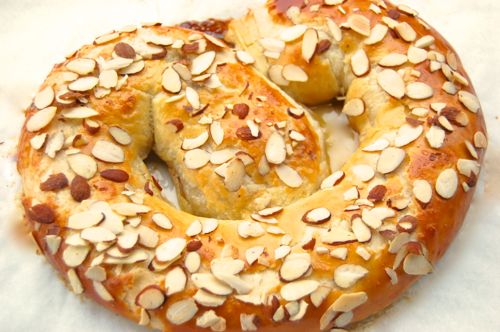
Most people call it “potica” (poh-TEET-sa) but “povitica” (poh-VAH-teet-sah) is the name I know the best. That’s the way my high school girlfriend’s mother pronounced it. It’s sort of a nut strudel baked in a loaf pan. This should be fun!

READ ON

Egg Wash as Super Glue

Reader Flip writes to say that his kringle had some large cracks down the middle. He also mentions that cracks are a recurring problem with his laminated pastries, especially croissants, and wonders what he might be doing wrong.

Flip, my guess is it’s an egg wash problem. Though you might not think it, egg wash is a very strong glue, at least once it’s heated. If you paint your wash too low on the pastry, trying to increase the amount of glossy real estate, there’s a good chance you’ll get some egg wash on the pan or parchment. That can be disastrous from a presentation perspective.

READ ON

Making Kringle…Again

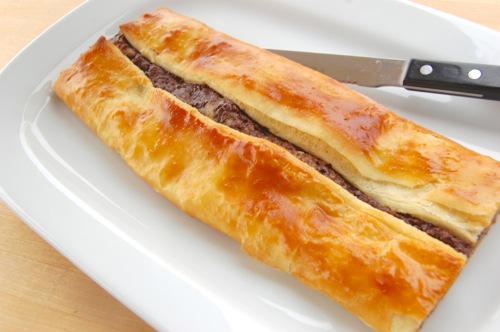
A strip-style kringle is more of an American (or at least a Racine, Wisconsinite) thing, though reader Jo recently sent me a link to a picture of a Danish chocolate kringle that was done this way (thanks, Jo!). As you can see it’s a whole different presentation, and kinda cool in its own way. You simply lay out your dough piece and spread your filling down the middle. You may need to roll it a little wider, just so everything fits.

READ ON

Yeast + Salt = ?

Reader Philip writes:

In the first picture [of the Making Kringle post] you seem to have put the sugar and salt on one side of the flour and the yeast on the other. Our British telly cooks tell us we must do it this way, as letting the salt come into contact with the yeast will kill the yeast. And yet once we switch the machine on the salt and the yeast are mixed together. Is this another kitchen myth?

Terrific question, Philip. Way to pick up on the details! It depends on the type of yeast. It’s true that concentrated sugar or salt will sap the moisture from live yeast and effectively kill it. Whether it has the same effect on dry, dormant yeast is open to question. Makers of instant yeast (the yeast I use almost exclusively) claim that you can pour their product on a heap of salt or sugar with no ill effects. That strikes me as

READ ON

The Baked Chocolate Double Bind

Reader Amy writes:

Joe — you said in your most recent post that chocolate goes grainy when you bake it, but that doesn’t seem to happen to chips in chocolate chip cookies. Maybe they’re an exception?

Nice, Amy! That’s correct to some extent. Different chocolates respond to heat differently. It all has to do with the amount of chocolate solids they contain. Chocolate chips are are loaded with non-chocolate, non-cocoa butter ingredients like sugar and powdered milk. As a result they don’t suffer as much from heat exposure. They lose their temper, as it were, and that’s pretty much it. Their shape and texture mostly hold.

READ ON

My Kingdom for a Kringle

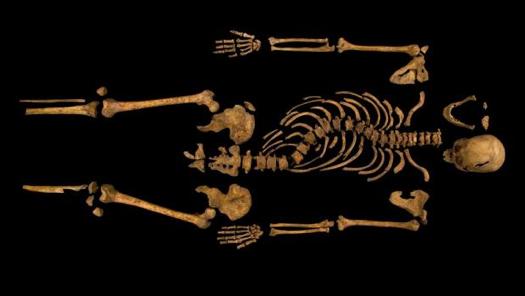
Ever since the announcement a few days ago that the bones found under a parking lot in Leicester really are those of the hunchbacked king Richard III of England, Shakespeare has been much on my mind. Yes, now that Richard is in the news much is being made of the recent efforts to rehabilitate him as a nice guy and champion of the poor. However it’s beyond dispute that Richard had his two nephews (one of whom was twelve, and the future king) imprisoned in the Tower of London and later executed. This after he had been appointed their Lord Protector, following the death of his brother, King Edward IV. Not really the actions of good guy. So if you ask me, Shakespeare had it right.

READ ON

Making Chocolate Filling

Bake-in chocolate fillings are strange animals because no matter what you do the chocolate is going to seize and go grainy, at least to some extent. Bar chocolate, chocolate sticks, ganache, chocolate chips, chocolate pastry cream…none of them will be the same after all that high oven heat. Which means a bake-in chocolate filling will never be creamy. Assuming you can accept that, and I have a feeling you can, proceed.

READ ON

Chocolate Filling

I can see the demand for chocolate kringle is high enough that I need to take some action here! Also I don’t have a bake-in chocolate filling on the site anywhere. The time is now! This is basically a chocolate rugelach filling, but use it however you see fit!

6-7 ounces (about a cup) cup finely chopped dark chocolate
4.5 ounces (2/3 cup) granulated sugar
1 teaspoon cinnamon
3 tablespoons melted butter, cooled

READ ON

Making Kringle

Like a lot of sort-of laminated pastries, it’s hard to put your finger on just what it is that makes kringle so delicious. It’s not a croissant. It’s not a coffee cake. You think: it’s sort of like both of them but it has it own special, oh…I don’t know what. Then the plumped raisins and hints of cardamom kick in and well…you’re hooked.

READ ON

Snow Delay

It snowed over an inch last night and that, combined with the 10-degree cold is causing mayhem in Louisville. Given I lived in Minnesota for six years, where children aren’t allowed to wait outside for the bus if the wind chill drops below -20, I’m tempted to make fun. But Kentucky isn’t prepared for snow and ice like Minnesota is, and when you consider how hilly the terrain often is, any amount of ice can make driving treacherous.

So school’s out, also little Joan has a fever. All of which means I won’t be blogging today. However I’ll leave you for the weekend with the world’s oldest kringle joke. If it seems familiar it’s because variations are a told for all sorts of ethnic pastry: cannoli, kolacky, strudel, rugelach, the list goes on. Come to think of it I’ve heard apple pie and chocolate chip cookie versions too. It goes like this.

READ ON