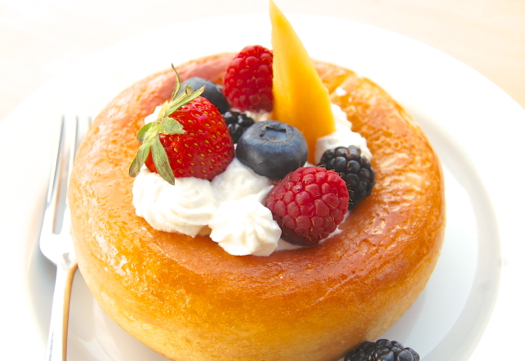
Making Savarins

On the surface of it a savarin is a rather restrained affair. A non-threatening fruit dessert that might be served after a decadent ladies’ lunch. A pastry that a fitness buff can take from a buffet table and still hold his head up high.

Let me tell you, that dude will be on the rowing machine all afternoon working one of these off. Because under the hood a savarin is an indulgence machine: a buttery brioche loop soaked in aromatic syrup and filled with Chantilly cream. The fruit? It’s sort of like the glow-in-the-dark lure of an anglerfish, enticing the dieter to his doom.

READ ON
The Mystery of the Crowning Cake

Reader Melissa writes:

I have an issue and I know if no one else can, you can tell me why I am having it. Everytime I bake a cake, the middle cones up and it splits. I checked through your tutorial but didn’t find an article on it. So I decided to write.

Thanks for writing in with this, Melissa, since it’s an extremely common problem. There are two main causes for bulge-in-the-middle cake layers. The first is over-mixing. Too much agitation creates a lot of activated gluten. Think of gluten as a stretchy network of rubber band-like molecules that’s trying to pull the cake together into a ball as it heats. It’s a very common cause of crowning — especially in muffins, the tops of which are often cone-shaped (a sure sign of a pasty, chewy product).

READ ON

Scaling Baking Recipes

I get quite a few question about the recipes here on the blog. Does this or that recipe scale? This is one of the great advantages of being a baker as opposed to a cook: our formulas can be scaled up or down pretty much infinitely. A baguette recipe that works for 3 loaves will work just as well for 300. Cakes, cookies, frostings, icings, they pretty much all work that way. Yes there’s the odd, oh, pancake recipe that doesn’t scale well, but 99% of the time you can scale the proportions you find in baking books forever with no problems.

READ ON

Snacking in Zapatista Country

If you’re wondering where I disappeared to on Friday, it was into my own private world of worry. Mrs. Pastry was in Mexico for the week, WAY down south in Chiapas, in the picturesque mountain town of San Cristóbal de las Casas. It’s a lovely and quiet spot, if a little too close to the Lacandon Jungle and the EZLN for my comfort.

READ ON

On The Physiology of Taste & Other Amusements, etc.

Reader Allen wants to know if Brillat-Savarin’s The Physiology of Taste was more a book about science and physiology or more about philosophy and other intangibles/ineffables. The answer is yes. You really have to read the book to get a feel for it, Allen, or at least a few parts of it. To me it’s really about fun.

When you set out to tackle Physiology it’s important to remember that it is very much a product of its time: the mid-Enlightenment. This was a period when most learned people took a keen interest in science and the physical world, but practiced science rather informally. Yes the scientific method was around, but techniques for conducting experiments were still evolving, so more than a few of the “science” books written around the time were simple collections of observations, anecdotes and speculations.

READ ON

Whipped Cream & Protein

Reader Mari asks:

Does the process for whipped cream involve casein too? I’ve always thought it was ironic that so many non-dairy cheeses and non-dairy whipped creams contain casein in them, which is what causes an allergic reaction to dairy products for a lot of people. I concluded that casein must have something to do with the structure of cheese and whipped cream. After all, there aren’t any other 38% fat/ 60% water mixtures that can whip up like cream does, right?

Interesting question, Mari! Casein is indeed fascinating stuff, and it abounds in milk (about 5% of milk is casein). You’re absolutely right that it’s critical for things like cheese and yogurt, since it clumps up together when it’s exposed to acid. Those clumps trap fat and water creating the large curds that make cheese, and the tiny curds that make yogurt and sour cream.

READ ON

Brillat-Savarin Honoraria

Given Brillat-Savarin’s influence in the world of gastronomy, I’m surprised there aren’t more foods and food accoutrements named for him. One is the savarin (this week’s pastry) the other is Brillat-Savarin, a soft, white, triple-cream cow’s milk cheese. It’s 75% fat. Which indicates that when it came to food, the man clearly knew what he […]

READ ON

Jean Brillat-Savarin

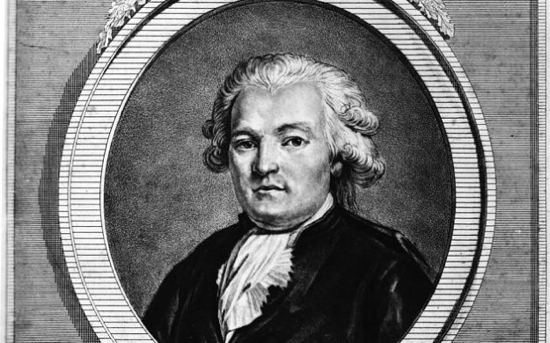
Everyone who knew Jean Brillat-Savarin knew he was an epicure. No one, however, had the slightest inkling that he was the burgeoning author of a ground-breaking book on gastronomy. Anyway not until just before he died, in 1826. For Brillat-Savarin worked on it in secret, spending some 25 years creating the semi-scientific, semi-philosophical, semi-humorous 8-volume opus that would become known as The Physiology of Taste, or Meditations on Transcendental Gastronomy. The book came out late in 1825, and then anonymously. Still, by February of ’26 Brillat-Savarin was dead, having caught pneumonia at a memorial mass for King Louis XVI at St. Denis Cathedral in Paris. As word of his achievement spread among his friends and acquaintances — very probably at his funeral — the result was mild shock.

READ ON

Where Do Savarins Come From?

As I mentioned below a savarin is really a baba, just in a ring shape. So depending on how far you want to trace the lineage, you could go all the way back to not-so-good-King Stanislas Leszczynski. However the true date of the savarin’s invention came over 100 years later in Paris. The year was 1844 and two brother pâtissiers by the name of Julien decided to try a variation of the rum baba, baking it in a ring-shaped mold and soaking it with (secret) citrus-infused syrup. It succeeded, and the pair shortly named their creation “savarin” after Jean Brillat-Savarin, whose collection of gastronomical essays, The Physiology of Taste was much in vogue at the time. More on him later!

READ ON

Savarin Recipe

Savarins are basically ring-shaped babas, though the hole in the middle provides more opportunity to fill and top them. Combine filling and/or topping with a creative soaking syrup and you can see where the simple savarin can quickly start to take on some rather complex and/or sophisticated flavors. Here’s the basic early summer fruit version, but feel free to improvise as you see fit. I probably will!

For the dough:

2 1/2 teaspoons (1 envelope) instant yeast
9 ounces (1 3/4 cups) all-purpose flour
1 teaspoon sugar
1 teaspoon salt
3 ounces (1/2 cup minus two tablespoons) whole milk
3 eggs
2 1/2 ounces (5 tablespoons) softened butter

READ ON