Whisk It

This week, for reasons that are surely clear, I found myself wondering when the whisk was invented. For a clue to that I started checking into the history of egg foams generally. I found that while people have been eating eggs forever, and binding ingredients with them for at least 2,500 years, egg foams haven’t […]

READ ON

On Whole Egg Foams

Reader Clay writes:

I’ve whipped whole eggs to a pretty impressive volume, which is why I’ve always been skeptical of the claim that fat ruins foams.

True enough, Clay. However while whole eggs will make foams, they’ll never rise as high or last as long as all-white foams. Under the right conditions egg whites can be whipped up to about 8 times their original volume. With whole eggs you’re doing well if you can do 3 times, and even then the foam will only hold up for a few minutes on its own. However a whole egg foam will last long enough to be of some use in a thing like a flourless cake, where you want to lighten the consistency just enough to prevent it from baking up into a chocolate brick. Though I suppose even a brick can be good if it’s made of chocolate, yes?.

READ ON

What does sugar add to an egg white foam?

Reader Allison writes:

Could you explain how sugar effects [the egg white foam] equation? I know that meringue I make with a higher sugar content holds longer for me (in addition to Italian meringue that holds even longer.) It seems to stabilize it, but I would love to know more about the science.

That’s a really interesting question. As soon as sugar hits the watery egg white, assuming you’re not adding too much or too much at one time, the crystals begin to dissolve. As they do so they combine with the water to make a syrup. The more sugar, the denser the syrup, and it surrounds the protein-reinforced bubbles, creating a sort of cushion in the spaces between the bubbles. Think of the sugar molecules like packing peanuts among a bunch of glass Christmas ornaments in a shipping crate. That’s pretty much what they are.

READ ON

Fat: The Foam Foiler

There is a popular myth which holds that even a speck of egg yolk, butter or oil can make an egg white foam all but impossible to form. This is, um…a myth. Sure, you ought to go out of your way to prevent fat or other oily and/or soapy substances from coming in contact with […]

READ ON

The Clenching Fist

The frustrating thing about fiddling with egg white proteins is that the same whipping action that uncoils them will cause them to bunch and clump if you don’t quit while you’re ahead. The point of no return occurs somewhere right after the stiff peak stage, when the proteins that were arranged in nice regular lattices, bonded elegantly, cradling big fat bubbles of air…start to lose their mojo.

What happens? In a nutshell, the excess agitation causes the protein molecules to bond excessively to their neighbors and gather together in masses (coagulate). As this happens water molecules are squeezed out from between them and the forces of surface tension start to take over again. The bubbles start to pop. The foam starts to turn grainy, then clumpy, then watery, at which point it’s pretty much useless.

READ ON
Let’s Talk Foam

What’s a foam but a bunch of bubbles? Masses of air surrounded by thin walls of liquid. The shape of a bubble is a factor of surface tension, i.e. the pull that the water molecules that make up the wall exert upon one another. That pull causes the wall to reduce itself into the most […]

READ ON

Crème Anglaise Recipe

Crème anglaise is a standard that every aspiring pastry maker needs to know how to prepare. Essentially it’s just a custard (of the “stirred” variety), that’s so thin that it can be used as a sauce. It’s most common application, however, is as an ice cream base. To make it all you need is:

seeds from half a vanilla bean
2 cups whole milk (for a richer result use half milk and half cream)
4 egg yolks
1/3 cup sugar

READ ON

This Week: Floating Islands

Îles flottantes is a dessert that everybody’s familiar with. In France. Here in the States, and I dare say in lots of other places on Earth, it’s virtually unknown. Why I can’t say, but it’s a treat you’ll find in France wherever simple food is served: in bistros and in homes. It’s comfort food, in other words. But what exactly is a “floating island?” Basically it’s a blob of meringue poached in milk, floating in a puddle of crème anglaise and topped with caramel and/or nuts. It’s sweet but not too sweet, rich but not too rich, light but satisfying. In many ways a perfect dessert. If you’ve never tried it, you’re in for a very pleasant surprise.

READ ON

Making Cheese Wafers

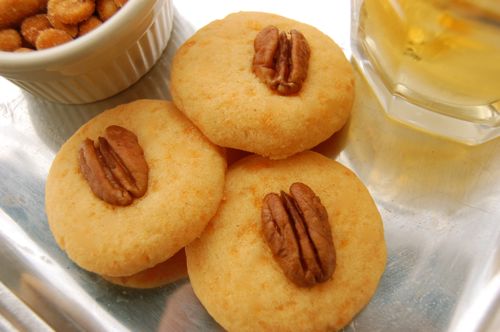
My grandmother was born and raised in Chicago, but these wafers seem to me to be Southern in origin. Not only are they topped with pecans, but their flavor profile bears an uncanny resemblance to a classic Southern spread: pimento cheese. Regardless of where they come from you’ll find them rich, tasty and refined. Begin by preheating your oven to 325. Combine the flour, salt and cayenne pepper in a bowl or the bowl of a mixer fitted with the beater and stir on low.

READ ON