Can you overcook syrup?

Reader Jenni asks whether a candy syrup is usable for anything else after it’s overcooked, i.e., once soft ball syrup is cooked to, say, firm ball syrup. The answer, Jenni, is that you can fix an overcooked candy syrup by simply adding more water to it. For there’s really no “cooking” going on in a candy syrup that contains only sugar and water. Proteins aren’t coagulating, starches aren’t gelling, fats aren’t breaking down, nothing like that is going on. Indeed when you boil a sugar syrup, as long as it’s below the caramelization temperature, only one thing happens: its water content goes down. Seen in that

READ ON
Conflict Resolution in Woody Woodpecker

Not being much of a fan of The Powerpuff Girls or My Little Pony (apologies to any bronies in the audience), I feed the girls on a steady diet of classic cartoons come Saturday morning. Looney Tunes primarily, though we also have a few mixed disks containing 20th century Saturday morning staples like Casper the Friendly Ghost, Felix the Cat etc.. If you’re going to watch cartoons, is my thinking, it might as well be the good stuff.

READ ON

Heard the one about Churchill, Mountbatten and the bathtub?

So asks reader Will, an engineer who’s evidently familiar with the story of pykrete. He’s referring to a story, almost certainly made up, about Churchill’s first, er…exposure to the material. It’s said that one day in early 1943 Lord Mountbatten showed up unexpectedly at Churchill’s country home carrying a mysterious box. Informed that the prime […]

READ ON

How long does it take for pykrete to melt?

…asks reader Jason. That’s an excellent question and I confess I don’t know the answer. I understand that different types of wood have different insulating properties once they’re pulped and frozen. What I do know is that the prototype pykrete ship that was made in Canada in the spring of 1943 stayed frozen all summer […]

READ ON

Vanilla Slice (Uptown Version) Recipe

I’ve agonized a bit over this I must confess. There’s always pressure when you’re taking on a cultural icon…especially one you’ve never tasted. The filling of a vanilla slice bears an uncanny resemblance to pastry cream, only it’s often thickened to a rubbery degree. Some recipes I’ve seen call for up to a cup of cornstarch (in only three cups of liquid). That, to me, is a starch monstrosity. So my plan is to thicken a relatively thin pastry cream with gelatin in an attempt to achieve the starchy-rubbery consistency the appears to define a “snot block”. So here’s what I propose:

about 16 ounces puff pastry, store bought or home made
1 recipe pastry cream
3 teaspoons powdered gelatin
1 recipe poured fondant
simple syrup

READ ON

Butter Pats and Battleships

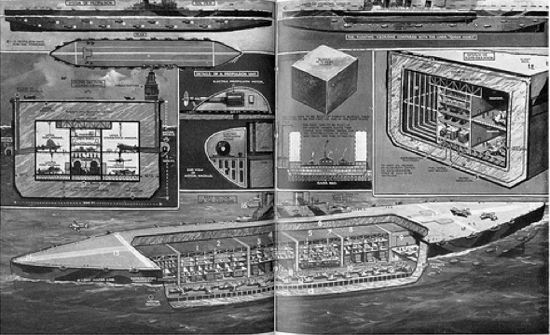
Reader Devin wants to know why you mix a little bit of flour into the butter pat when you’re making laminated dough. What purpose does it serve? For the answer to that, Devin, we’re going to journey back to World War II and the allied war effort.

The year was 1942. The British were fighting the good fight against the Axis powers, but still losing too many ships in the English Channel and too many American supply convoys in the Atlantic. What was needed was air cover. The problem was that the fighters and torpedo planes of the day couldn’t fly very far on the fuel they carried, which meant they could only go so far out to sea before they were forced to turn back and head for home. That left the merchant marines at the mercy of U-boat wolf packs for most of their journey across the Atlantic. The obvious solution: aircraft carriers. They’d be able to sit out in the ocean and refuel planes as they crossed the pond from east to west and back again. The fly in the ointment was that aircraft carriers were (are) made of steel, and steel was in very short supply just then.

READ ON

How important is “premium” butter in laminated dough?

That question from reader Lee, and I’m glad he asked. I’m not normally one to get all choosy with ingredients. As I’ve said many times before — often to my detriment in terms of reader feedback — “good” is almost as always as good as “great” for most home baking needs. However butter is where I start to get a bit fussy. I like cultured “Euro-style” butters, especially when it comes to laminated doughs. On the one hand they perform better as they tend to have a little less moisture and are also generally firmer, with a broader melt point. That means they stay plastic longer when you’re folding your dough. On the other hand I think they have also have a better taste. The acidic tang is not only different, it reduces the “fatty” mouthfeel

READ ON

Why is “dry” butter an advantage in laminated dough?

Nice question reader Dorrie! Perhaps you are a professional baker or pastry student, yes? Because “dry” butters aren’t products that the rest of us can easily get. As the name implies dry butters have a lower water content than most other butters, around 3-5% versus 12-17% for conventional store-bought butter. Why might they be an advantage in making laminated dough? Because while some water is essential if a laminated dough is going to rise (see the below post on the mechanics of puff pastry) too much water can actually undermine rising by moistening the dough sheets such that they get sticky and limp. In that case the steam in the dough can’t push them apart and/or keep them aloft. Is dry butter essential for

READ ON

Er…what is “laminated” dough?

I’ll admit it doesn’t sound all that appetizing just to say it, reader Jo. Lamination is a word most people associate with driver’s licenses, though the word actually means “alternating layers”. Puff pastry is made of 729 alternating layers of butter and dough. Some people like theirs with 2187. And while that might sound like a lot, the difference between 729 layers and 2187 is but one more “turn” — or letter folding — of the dough.

READ ON