Making Vanilla Slices (Downtown Version)
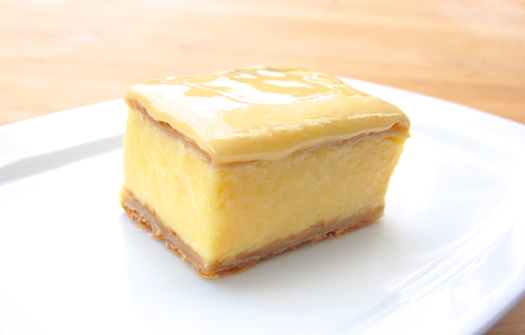
Boom. There it is, the closest I can get to the classic everyman Australian vanilla slice (a.k.a. New Zealand custard square) using locally available ingredients.
READ ON
Boom. There it is, the closest I can get to the classic everyman Australian vanilla slice (a.k.a. New Zealand custard square) using locally available ingredients.
READ ONSo alright, after a lot of fiddling I have a formula for the simple, day-to-day, down n’ dirty, semi-homemade, express version of the vanilla slice. It’s taken me three tries since there’s no American equivalent for Australian custard powder (who knew?). But this is should approximate the real deal as defined by several readers and a recent visiting Kiwi (note to non-experts, they call vanilla slices “custard squares” in New Zealand). Anyway, here’s what you need:
1 package store-bought puff pastry
2 boxes JELL-O vanilla pudding/pie filling (4.6-ounces each)
5 cups milk
1 ounce (1/4 cup) cornstarch
1 recipe simple icing made with passion fruit purée
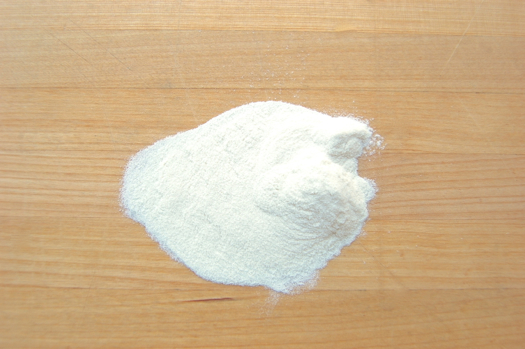
It’s hard to know where to start with an ingredient as incredibly versatile as xanthan gum. Yes, it’s a thickener, but really it’s much, much more than that. Add water and it becomes an elastic goo that works as a thickener, an emulsifier, a gluten replacer for gluten-free breads, a foaming agent, a fat replacer, a moisture enhancer, the list goes on. Notice I said “add water” and not “heat” for xanthan gum will thicken a liquid of any temperature, hot or cold. It doesn’t clump, so it can simply be whisked into a cold salad dressing or a hot sauce. A few seconds later — presto chango — you have an increase in viscosity.
READ ON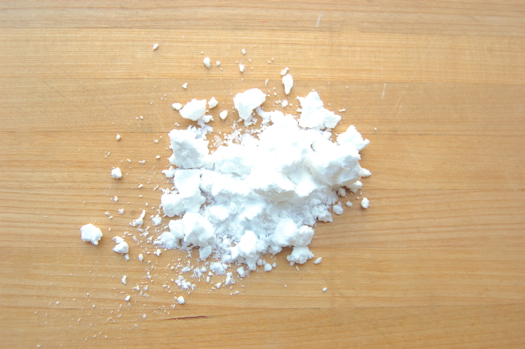
The Joe Pastry All-Star Tour of Thickeners continues with potato starch. Boy. After a while all these white powders really start to look the same don’t they? And they’re awfully hard to photograph without overexposing them. Poor, poor blogger me. Anyway, where was I? Ah yes, potato starch. Potato starch is another pure starch like cornstarch and tapioca. In other words: pure thickening power in powdered form. Potato starch performs much like other thickening starches, and is good for a wide variety of applications, especially soups. It thickens at below-boiling temperatures and in fact should never actually be boiled, as it un-thickens quite rapidly at that point. Potato starch is especially useful during Passover for those who adhere to Jewish dietary rules, as it’s a non-grain thickener.
READ ON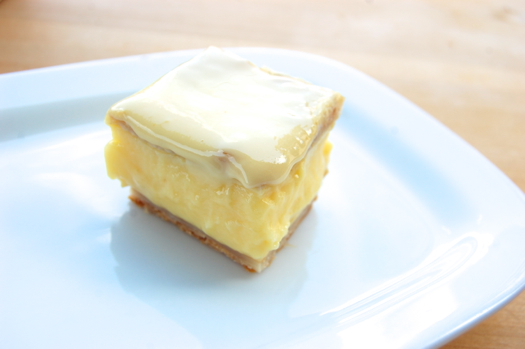
As feared, American JELL-O vanilla custard/pie filling mix doesn’t have the rigidity of Australian custard powder, even at 125% concentration. Seems I’m going to have to double-concentrate it if I want the tensile strength of the real deal. Bear with me, friends, we’ll get there!
READ ON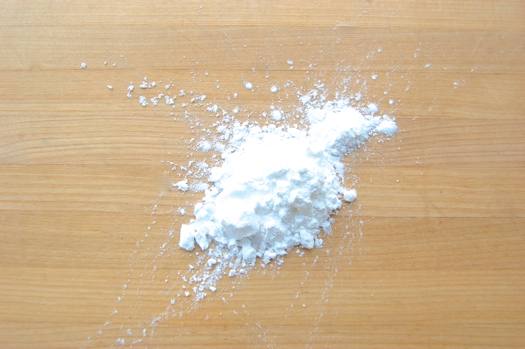
Like cornstarch tapioca is a “pure starch” which means that compared to wheat flour it has no protein, bran or germ in it and as such packs more of a thickening punch. Tapioca comes in “pearls”, in granules (pieces of pearls) and in flour form. All can be used as thickeners, though the smaller the pieces the more readily they dissolve and the faster they act. Tapioca flour, my preference, dissolves almost instantaneously and because it gels at a lower temperature than cornstarch you can see the results immediately if the mixture is above 140 or so degrees Fahrenheit. Like other starch gels, however it also “un-thickens” when overcooked.
READ ONI just had to pull the Joe Pastry train off to the side tracks for a moment to extoll the virtues of a truly amazing ingredient: xanthan gum. Oh sure, people demonize it, but usually without bothering to find out what it really is or does. The fact that it sounds “science-y” is enough to elicit derision from certain purist foodie types. They know not of what they speak.
Xanthan gum was invented in the heyday of corn sugar fermentation research, the 1960’s. At the time, folks in the USDA labs were looking for a thickener that was more versatile and efficient than corn starch and easier to produce than guar gum. One day, they allowed a culture of a bacterium by the name of Xanthomonas campestris to feed on a solution of corn-derived glucose. What resulted was a slimy, colorless substance that turned out to be one of the most broadly useful food ingredients currently known to man. For it turns out that in the process of digesting the glucose, the bacteria rearranged the individual sugars into longer-chain sugars (polysaccharides) with truly amazing properties.
READ ON…that a couple of recent baking projects have become sleeper hits among my family, friends and neighbors. The first is the vanilla slice, which is now the particular obsession of little Joan Pastry. The second is bee sting cake, which has become such a neighborhood favorite that I can barely keep up with the requests. I shall continue to work on perfecting the vanilla slice, but those of you who have yet to try bee sting cake, I heartily recommend it. Your friends and family will thank you.
READ ONPlease excuse the lack of photo. Air is a thickener we commonly take for granted, but bubbles slow the flow of water as well as any other type of thickener. Where would our egg white foams be without it? Of course the trouble with bubble thickening is that bubbles tend to pop. That’s largely a […]
READ ON
Melted fats or liquid oils make very effective thickeners in watery mediums. Oil and water won’t dissolve in each other, so when you combine them the result is a mutual disaffection that runs all the way down to the molecular level. Cooks can force the two to mix by a liberal application of the whip, which has the effect of breaking up large blobs of fat into many smaller ones. The thing is that no matter how small the blobs get they’re still many times larger than water molecules, and so do a very effective job at slowing down their flow.
READ ON