Pre- and Proto-Puddings II: The Rise of “White” Puddings

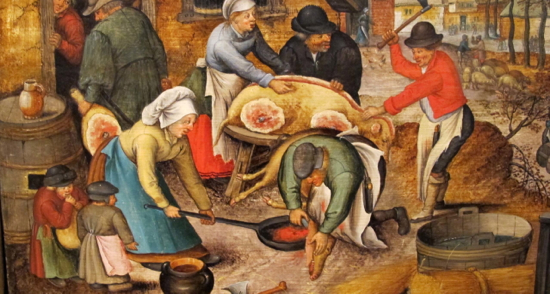
One thing pretty much everyone agreed upon back in the early days of puddings was that they were a very good idea. Organs, blood and grain all stuffed into a bladder and boiled? What’s not to love? Yet the big problem for pudding lovers of the period was that puddings were prisoners of seasonality. I mean let’s face it, the average person didn’t have fresh blood, guts and bladders lying around everywhere all the time. On the farm animals were only slaughtered in cool weather to prevent spoilage (refrigerators being in very short supply in the first few millennia before Christ). Thus at the dawn of the Age of Pudding, it would have only been a once-in-a-while treat.

READ ON
Pre- and Proto-Puddings

The word “pudding”, it’s thought, comes down to us from the Latin word botellus which basically means “sausage.” Boudin is how the word occurs now in French. Pudim is the Portuguese version, pudín the Spanish. Sounding a little familiar now? Thought so. But did spotted dick and sticky toffee pudding really start out as sausage? Yes. Sort of. Here it helps to take a brief — and very general — look at early days of sausage making.

READ ON

Pastry Cream Conundrum

Reader Helen writes with a very interesting problem:

I’ve had a pastry cream disaster that remains a mystery to me. I’ve been making it with no problems for a long time. Just made 4 batches 2 weeks ago. Today, I tried it 3 times and every time it curdled as soon as it came to a simmer. I’ve never had this problem before and usually simmer it for 1-2 minutes to make sure to kill the enzyme in the yolks that thins out the starch as the cream sits. The only thing I did differently today was use all new ingredients (milk, cream, and eggs). I tasted milk and cream and they didn’t taste spoiled. I noticed that my corn starch expired 2 years ago, but it worked fine 2 weeks ago, so I can’t imagine it went bad all of a sudden. Here is my recipe and procedure: http://www.beyondsalmon.com/2014/07/pastry-cream.html

READ ON

Sticky Toffee Pudding Recipe

I don’t often do “plated” desserts, so this will be fun. It’s kind of fun to play with sauces and squeeze bottles every so often, no? This recipe is adapted from Delia Smith’s Christmas, but why not serve it in July? I can’t think of a reason!

2 cups chopped pitted dates
3/4 boiling water
1 teaspoon vanilla extract
2 teaspoons instant espresso
3/4 teaspoon baking soda
3 ounces (6 tablespoons) butter
4.5 ounces (2/3 cup) sugar
2 eggs at room temperature
6.25 ounces (1 1/4 cups) flour, sifted
1 1/4 teaspoons baking powder
1/4 teaspoon salt
1 recipe the toffee sauce
1/2 recipe créme Anglaise or melted vanilla ice cream or lightly sweetened cream
walnuts for garnish

READ ON

Making Strawberries Romanoff

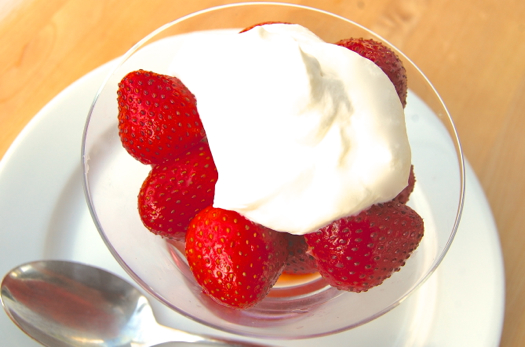
Should, upon placing an elegant little bowl like this in front of your dinner guest, he reply “I don’t like strawberries and cream” you shall grasp the nearest available pair of leather riding gloves and slap them with great force against his cheek bone. Villain! Do you not recognize strawberries Romanoff when you see them??? At that point you can challenge him to pistols at dawn if you like. It’s a judgement call.

I made mine in the Russian style with sour cream added to the sweetened whipped cream because, well, why not? I started of course with the best strawberries I could find. This is a half batch of two cups. I picked the smaller ones because I like the presentation of the uncut berries and the smaller they are the better the better the flavor balance you’ll have. I added the orange juice…

READ ON

The Mystery of Czar Alexander

Is it really true that Czar Alexander I staged his own death and assumed another identity? Quite a few people believed that, reader Alice, and not just conspiracy nuts. Most Russians of the time believed he was still alive after he was reported dead. Even members of the late Czar’s own family seemed to believe it. But why would they? Possibly because Alexander talked about vanishing and becoming a hermit almost incessantly. He certainly made no secret of his distaste for the trappings of wealth and power and his deep guilt over the death of his father, Czar Paul I, was well known.

Alexander had, shall we say, a troubled relationship with his family. His grandmother, Catherine the Great, hated his father (her own son) and made no secret of it. She considered Paul I to be an unstable tyrant-in-waiting. When Alexander was born Catherine immediately took charge of him (Alexander’s mother was indifferent to him) and educated him in the classical liberal virtues. Despite Paul’s attempts to literally beat some toughness into the boy, Alexander grew up sullen and sensitive. When Catherine died in 1896, Paul ascended the throne. His subjects quickly came to see that Catherine’s instincts were entirely correct and by 1801 a coup plot was hatched.

READ ON

Who invented distillation?

Reader Rikki, that’s a darn good question. All we know for sure is that somewhere around 900 years ago people in and Europe and China started having a lot more fun on Saturday night. Greek alchemists had mastered water distillation long before, in about 100 A.D., but alcohol distillation took longer. It’s likely the technology traveled the Silk Road either East to West or West to East but nobody knows for sure.

Brandy was probably the first hard liquor in the western world, evidently an attempt to create a reconstituted beverage that was easy to transport and sell. Reduce your wine at production point, take it by ox cart to the point of sale, add water and presto — wine. That was the thought anyway. Tasting the first brandy, I can only imagine what that early entrepreneur said to his business partner as he approached with the water jug. Take another step and you’re dead, buzzkill.

READ ON

Carême and the Czar

So if Antonin Carême lived in Paris, why did he design a dessert to appeal to Russians? There are two parts to that answer. First, Russian food and manners were all the rage in Paris around 1810. Napoleon and Czar Alexander I of Russia were allies then, and Czar Alexander had dispatched a very dapper and glamorous ambassador to look after Russia’s interests in Paris. His name was Alexander Kurakin, and it was he who not only introduced Russian dishes to Parisian society, but also the single-plate course-after-course dining style known as service à la russe. We employ it in our restaurants, even homes, to this day.

READ ON