Joe’s Books: Baking Out Loud

Back in my Chicago-area baking days I used to like to go to trade shows, specifically the wedding shows where bakers would show up to debut new designs and test-market new products. Of course every bakery used the opportunity to shop the competition. The male proprietors of the family-owned shops would stroll around shaking hands and cracking jokes. The 1-woman-shop wedding cake bakers would scurry hither and yon, sneaking peeks. And then there were the pastry shop owners, usually women, with their culinary school minions in tow: usually female, dressed matching toques, hair pulled back in neat little buns. They’d stop in front of each display where they’d press their index fingers to their lips and deconstruct each cake, every petit four.

READ ON
Home and Broke

Forgive the lack of posting yesterday, but I was beat. Two days of traveling between which were two 10-hour days of running all over a small Wisconsin city asking people questions over a cameraman’s shoulder. Shooting commercials is a rarity for me these days, and I always forget how exhausting the process is: lots of standing-around boredom punctuated by moments of extreme pressure when everybody has to be “on” in big way.

READ ON

In Praise of Neurotics

Reader Alli asks:

Um, Joe, exactly how old was little Marcel when his mommy was serving him those cookies and tea?

Funny question, Alli. It was actually his aunt, as reader Noel reminded me, but the answer is about 30. Truth be told, Proust was something of a…well what should I say here…a momma’s boy. He lived at home with his parents for as long as they lived, until he was in his early 30’s. His mother died in 1905 and after that he continued to live in his family’s apartment in Paris until his own death in 1922.

READ ON

Where do Madeleines come from?

Proust novels. Well, maybe not really, but it may well be true that Madeleines would be lost to the scrap dough heap of history if it weren’t for In Search of Lost Time, the Proust classic that most of us knew as A Remembrance of Things Past growing up. If you never read any of it in school, In Search of Lost Time is an autobiographical novel that begins with Proust’s aunt laying before him a cup of herbal tea (poor Marcel had terrible digestive problems, don’t you know) and a Madeleine. He dips the edge of the cake in the tea, tastes it, and an extended flashback ensues. And when I say extended, I’m talking 4,000+ pages. Not even Jimi Hendrix tripped that long, and he had an endless supply of LSD-soaked headbands. Clearly Madeleines have a powerful effect on some people.

READ ON

Madeleines Recipe

Madeleines have a reputation for being rather fussy things, and I suppose that reputation is deserved to some extent. However where small cakes are concerned, you’re always in good hands with Maida Heatter. Here’s her recipe slightly altered to reflect some of my ingrained habits.

about 1 cup bread crumbs, ground finely in a food processor
2 ounces (1/2 stick) unsalted butter
1 egg pus two egg yolks, room temperature
1.75 ounces (1/4 cup) sugar
1/2 teaspoon vanilla extract
2.5 ounces (1/2 cup) all-purpose flour
zest of one lemon

READ ON

Making Apple Strudel

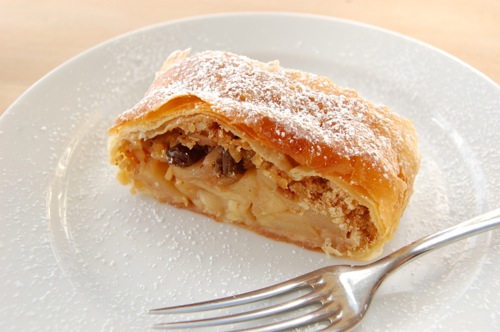
There’s a reason strudel has been consistently popular all over continental Europe for more than three hundred years: it’s pure, delicious comfort. It’s also fun to make, even when you count in the intimidation factor. The fear keeps you focused like a laser, and makes the exhilaration of baking up your completed roll tat much sweeter. Even more so than with a “fancy pastry”, you walk away from the strudel baking experience with a swagger. Oh yeah — baker in the house!

READ ON

The Melting Thing

Reader Jo (like that name, Jo!) asks:

So if I understand you correctly from your post on baking tart apples, it’s the inside-out ripening process that causes apples to get mushy as they bake. Is this the reason why some apples seem to “melt” when you sauté them?

It is! The outside of the slices are the softest, so that portion of the apple dissolves fairly quickly leaving the firmer middle. Thanks for the great question, Jo!

READ ON

When did strudel arrive in America?

I was getting to that, reader Nicole! There’s no way to know for sure, so I’ll play it safe and say sometime in the middle 1800’s. That’s about the time that the very large waves of immigrants from central Europe started arriving in the US. One of the earliest known instances of a strudel recipe printed in the States was an 1889 Jewish-American classic called Aunt Babette’s Cook Book. It contained an entire section on strudels, including many of those cited below plus one for calves’ liver and lung. Don’t knock it ’til you try it, folks!

READ ON

Strudel Moves North

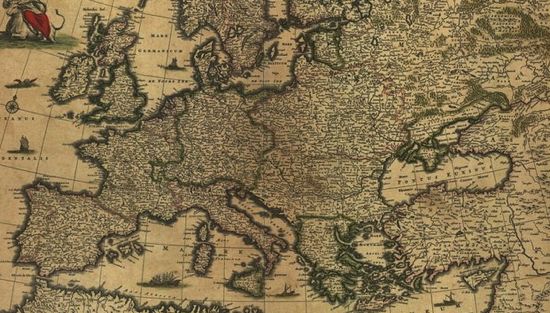
I mentioned below that Hungary remained a battlefield for decades after 1526, as Ottoman and Habsburg forces swept back and forth over the region fighting for control. The logical question is: when did it all end? When did strudel finally make the leap northward?

Those of you who’ve read the blog for a while may know that the turning of the tide for the Turks occurred in 1683, at the most baking-intensive conflict in the history of man, the Battle of Vienna. From that point onward the Ottoman Empire was either in retreat or stagnating (though it’s important to remember that it endured in some form for almost another 250 years, until just after World War I).

READ ON