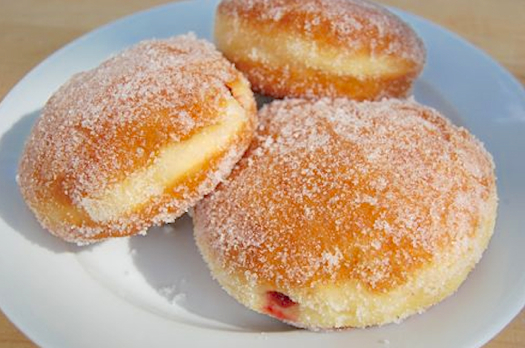
Happy P?czki Day!

They may call it Mardi Gras down in The Big Easy, but back home in Chicago it’s P?czki (POH-nch-kee) Day. It’s the day that Chicagoans of every ethnic background dive head-first into a dozen box of, you guessed it, p?czki, the Polish version of jelly doughnuts. Chicago has more Poles than any other city in the world, (including all the cities in Poland, with the sole exception of Warsaw). So it’s hardly surprising that p?czki are everywhere the day before Lent. And being that it’s Chicago, they’re an easy sell.

READ ON
On Seasoning Cast Iron Pans

Reader Rikki writes:

I know this probably isn’t your area, but I’m trying to season a cast iron pan. The pan maker says I should use low heat to season it, but just about every other seasoning article I’ve seen on the web says very high heat is the thing. Can you tell me: what’s the difference and which method should I use?

Rikki, just because I’m a baking blogger doesn’t mean I can’t flap my fingers for a while on this general cooking subject. It’s pretty interesting stuff! As you surely know by now from your readings, seasoning is the process by which porous die-cast metal pans are transformed into smooth, virtually non-stick cooking implements. In the old days people didn’t think much about seasoning since it just happened over time with use. Today home cooks take a more clinical attitude toward seasoning. As you mentioned

READ ON

Making Pork Pies

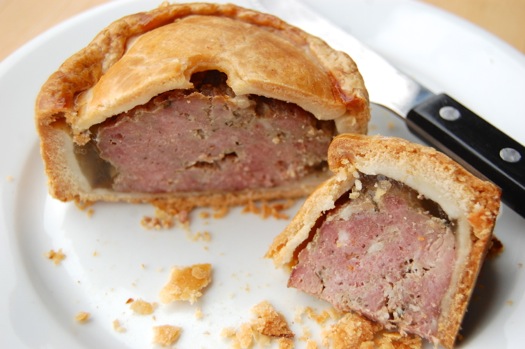
I have to admit, these Melton Mowbray-style pork pies aren’t just something you just throw together, but for the serious pork pie enthusiast they are well worth the time and effort. To make them the old-fashioned way you’ll need an old-fashioned piece of equipment called a pie dolly plus some rendered leaf lard, for without good quality lard the side walls of the pie won’t stand up in the oven. Oh yes friends, these pies are baked free-standing, didn’t you know? Forms are for sissies. At least they are in Melton Mowbray.

That said you absolutely can adapt this recipe to more conventional ingredients and equipment. A standard hot water pie crust or even an American-style pie crust can be used along with a muffin tin or other form. They’ll come together in an afternoon. Personally, once I read about this technique I couldn’t resist trying it, even if it took three days. The result was the pork pie of the gods.

READ ON

Big Fat Pockets, Little Fat Pockets

Reader Irena asks if I wouldn’t mind clarifying just why it is that a very evenly mixed, extremely homogenous dough or batter yields a stronger piece of pie, cake or pastry than a less-evenly mixed one. Irena, I’d be delighted.

I brought up fat distribution a couple of times over the last week, pointing out that a British pie dough, in which the fat is thoroughly blended into the flour, is both stronger and more flexible than an American pie crust in which the fat is “cut” in in large, uneven pieces. Both doughs have very similar characteristics until they’re baked, at which point the fat goes liquid and the crust starts to resemble a brick wall that’s losing bits of its masonry.

READ ON

Playing With Food, Big Time

High-end food store chain Eataly has announced that it plans to open a food-based theme park in Bologna called “Fico Eataly World”, a 20-acre $55 million park that’s being described as a “Disneyland for gourmets”. If all goes according to plan the park will open in November of next year. As a member of the food-entertainment complex I suppose I should be excited about that, though the whole idea leaves something of a, oh what’s the idiom I’m looking for here…a bad…I don’t know. Something.

READ ON

Beer for Breakfast

And that’s the truth. I’ve been drinking dark beers since 7:00 a.m. across the river in Indiana, for the opening of the Gravity Head beer festival. The whole morning I’ve been surrounded by hipsters in long beards, ball caps and “Liver Olympics 2014” t-shirts. One seriously pierced beer dude from Indianapolis was sporting knuckle tattoos à la Night of the Hunter, only instead of “love” and “hate” across his fingers

READ ON

How did British and American pies come to be so different?

That’s a great question, reader Kaitlin! After all, we Americans were the Brits to a large extent prior to the Revolutionary War. Does it not stand to reason we’d have a British-style pie tradition in this country? It does, and at one time we probably did (at least on the East Coast), however over time it’s clear that our shallow, slope-sided, flaky pies won out over the Brits’ tall, straight-sided firm-crust pies. The question is: why?

The big reason is because we Americans had very different baking traditions from get-go. In Britain pies have pretty much always been made by professionals: by skilled craftspersons working either in bakeries or on large estates that operated communal ovens. Remember nobody owned such a thing as a “home oven” until about 150 years ago. Before that time if you wanted a decent pie, you bought one from — or had one made by — somebody who knew what they were doing.

READ ON

Hot Water Pie Dough

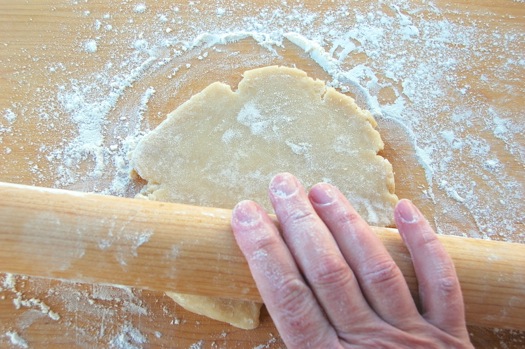
The Brits make several kinds of pie crusts, all of them wetter than American-style pie crusts (though they sometimes make those too). This one is sometimes called a “hot water” crust — though “hot fat” is more accurate — and is specifically for meat pies. It contains:

7 ounces leaf lard, rendered
2 ounces water
2 ounces milk
17 ounces all-purpose flour
1/2 teaspoons salt

READ ON

British vs. American Pie Crusts

Quite a few questions from some confused American readers on the pork pie crust recipe: is there no “cutting in” step? I thought pie crusts couldn’t stand water. And what’s with all the mixing? Won’t it end up rather tough with lots of developed gluten in it?

All very valid concerns from an American pie maker’s perspective. Our crusts aren’t built to stand up on their own. Rather they’re made to be fall-apart flaky, thus we take extreme measures to deprive our crusts of moisture and ensure that the fat isn’t evenly distributed.

READ ON