Remembering the Somme

Of course large, flat expanses of land are good for more than planting sugar beets. They’re great for fighting on. So it’s not surprising that the world’s deadliest-ever battle was waged in Picardy, on the banks of the River Somme. It was of course the Battle of the Somme, which occurred right in the middle of the First World War.

Those who aren’t familiar with WWI probably still know that it was famous for slow, bloody trench warfare. At the outset of the war in July 1914 the Germans wasted no time invading eastern France, where they promptly dug in. That long battle line barely moved for two years as troops from both sides shot at, gassed and bombed one another. The whole thing was very inefficient from a military perspective, costing lots of lives relative to the territory gained.

READ ON
Lingua Franca

Something else that’s interesting about Picardy is that they have their own language: Picard. Some consider it a distinct language, others just a dialect of French. But so I’m told, speakers of Picard and French can’t necessarily understand one another.

In our modern education environment where we take French, German and Spanish classes, it’s easy to forget that Europe — despite its best efforts to integrate itself into an economic, even cultural whole — remains a patchwork of cultures and languages, many that the average person has never heard of. The big, internationally accepted tongues are merely language of convenience which (supposedly) tie everyone together.

READ ON

Where does Gâteau Battu come from?

It’s from Picardy, a province in extreme northern France. Picardy is notable for several things including red brick houses, stunning Gothic cathedrals and excellent beer. I find it interesting first and foremost because it was the region where Napoleon first introduced the sugar beet.

Not many people think of Napoleon as a food (and food science) innovator, but he had to be — he had big armies to feed. Napoleon is mostly remembered as a brilliant military strategist and political leader, and he was certainly all that. What’s less well remembered is that he was the inventor of war on a societal level. Prior to Napoleon’s arrival on the European stage, war was mostly conducted by armies of professional soldiers whose loyalty was available to the highest bidder. Maybe they were from the country they were fighting for, maybe not. The cash was the main thing. Remember how the Hessians, German-speaking regiments that fought for the British crown, were one of the great terrors of the colonies during the American revolutionary war.

READ ON

Next Up: Gâteau Battu

Having spent the last ten days or so on the tried-and-true’s, it’s time for a curveball: gâteau battu. “Beaten cake” is the translation, I believe, though it’s not really a “cake” in the modern sense. Rather it’s a cake in the 18th Century sense: a bread enriched with lots of eggs and butter. Sounds quite […]

READ ON

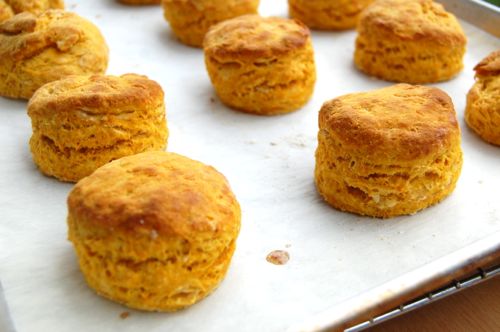
Making Pumpkin Scones

New Zealand/Australian scones are so like American biscuits it’s tempting to say there’s no difference between them at all. That’s not true of course. On balance they contain a little less butter and are moistened (at least the pumpkin versions) with egg instead of buttermilk, which gives them a more tender, cake-like crumb. Another big difference is that they’re frequently loaded up with flavorings like pumpkin, cheese or dates. Most Americans (especially Southern Americans) view flavored biscuits with deep suspicion, if not outright hostility. These, however, are fantastic.

READ ON

Pumpkin Scones Recipe

Things work a little differently in New Zealand and Australia where baking nomenclature is concerned. Relative to American baking, their scones are our biscuits. Their biscuits are are our cookies, and their cookies are…well honestly I don’t know what they are. I’m not sure they have any. But these pumpkin biscuits scones are something special. Talk about a great way to get kids to eat their vegetables fruit, these things have more pumpkin in them than flour.

Slightly cake-like relative to American biscuits (that’s because of the egg) the process of making them is identical. Try them soon, as you’ll be able to whip up a batch in about half an hour total.

READ ON

What are “tea breads” anyway?

Tea breads are a fancier name for quick breads. Banana bread, lemon bread, zucchini bread and pumpkin bread are the most common tea breads in the States, but there are countless others, from apple to chocolate to pineapple to strawberry. Tea breads are often confused with pound cakes, but in fact they’re quite a bit leaner (usually), having both less fat and fewer eggs in the mix.

How long have tea breads been around? Oh about a hundred years, roughly. Several of the classics date to the home baking explosion which occurred in the 1880’s as post-Civil War industry got on to the more important business of mass-producing baking pans and implements for American consumers.

READ ON

What does over-mixing do to tea breads?

Excellent, reader Mark! Thank you. We’ve been talking a lot about gluten lately, your question is a continuation of that important topic. As we know, moisture and agitation causes gluten to develop. Developed gluten in a cake-like device is a problem because it toughens the finished product. Most of us have probably tasted over-beaten tea breads, those sweet but rubbery slices that sometimes appear on holiday buffet tables.

You can judge an over-beaten tea cake (or cake, or muffin) by sight: that very tall crown — a muffin with a conical top, a cake layer that’s humped up in the middle, a tea bread loaf that looks like a treasure chest. All evidence that the crumb is holding too much gas and steam. Believe it or not, while we bakers rely on chemical leaveners to create gas pockets that will fill up with steam in the oven, we ultimately want most of that gas and steam to escape.

READ ON

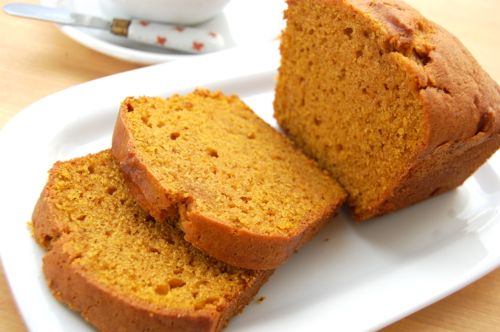
Making Pumpkin Bread

I should do more pumpkin recipes, they match so well with my overall color scheme. As with most tea breads, the only trick to this is avoiding over-beating. Otherwise it’s a snap. Begin by preheating your oven to 350 (or 375 if you’re using small 1-pound pans). Apply butter or cooking spray to your pans.

READ ON

Pumpkin Bread Recipe

This pumpkin tea bread is moist and flavorful — one of the few things I make that both my girls absolutely love. Like most tea breads, it combines the virtues of low effort and large payoff quite elegantly. I like to make all my tea breads in small “1 pound” loaf pans as I believe the end result is not only more convenient but less dry. However I’ve included directions for conventional loaf pans as well.

1 lb. (3 cups) all-purpose flour
1/2 teaspoon ground cloves
1 teaspoon ground cinnamon
1 teaspoon ground nutmeg
1 teaspoon ground ginger
1 teaspoon baking soda
1/2 teaspoon baking powder
1/2 teaspoon salt
1 lb. canned pumpkin
3 large eggs
1 lb. 5 ounces (3 cups) sugar
1 cup vegetable oil

READ ON