Rising, Fast and Slow

Reader Anna wrote in late last week to ask why big heat (i.e. around 500 degrees Fahrenheit) helps shortbread-type cakes like scones and American biscuits rise higher. Anna, you’ve made me a very happy blogger this Monday morning. Leavening is a fascinating, fascinating subject.

READ ON

Making Cream Scones

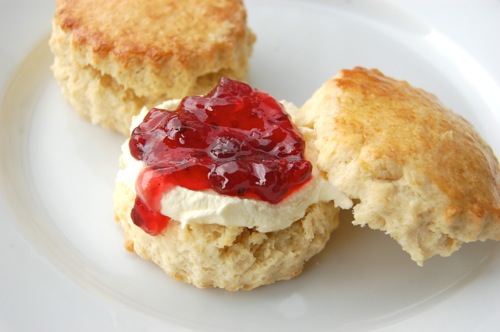
Cream scones are the classic compliment to the Devon cream tea. They’re comparable in flavor to an American scone, but smaller, lighter of crumb and above all easier to slather with clotted cream and jam. Though the procedure and ingredients may be similar to American biscuits and/or Australian scones, they’re really their own animal. Try them and you’ll see.

READ ON

Whence the Scone?

That’s an awfully difficult question to answer. There’s no question that scones are descendants of Scottish oat and/or barley cakes. The word is actually Scottish in origin. “Skons” is how they pronounce them up that way. “Skoans” is the pronunciation I mostly heard down in Devon and Cornwall.

The barley cakes of old weren’t polite little circular scones like they have all over Britain today. A couple of hundred years ago they were made in one large, flat round which was placed on a hot griddle and flipped, sort of like a huge pancake. The finished cake was then cut into big wedges which were then buttered and eaten hot.

READ ON

Battle of the Cream Teas

The residents of Devon and Cornwall don’t agree on much generally, but least of all where food is concerned. A couple of years ago I discussed the ongoing row between those two English counties on the crucial question of pasty crimping: side or top? With issues of that magnitude on the table it’s no wonder there’s so little intermarriage across county lines down that way.

READ ON

Foodism Gone Mad?

“The Great Googa Mooga” is going to hit Prospect Part in Brooklyn this weekend, a sort of Lollapalooza of food with music attached. You know “food-tainment” is pushing the boundaries of, well, taste when star chefs, pricey appetizers, wine and hog butchery can draw crowds on a rock n’ roll scale. Livy, the Roman historian, famously remarked that the glorification of chefs was a sign of a culture in decline. I hope that was one of his throwaway lines, otherwise I’m deeply concerned with the plight of Western civilization. Thanks to reader Catherine for the hat tip!

READ ON

What is English “clotted” cream?

Reader Mark asks:

Any chance you’d be able to expand on what clotted cream is, and why it doesn’t seem to be something that can be purchased in the US? Is it practical to make at home? Just doesn’t seem one can have a proper scone w/out some clotted cream to go with it.

I would be delighted, Mark! Most people think they call it “clotted” cream because that’s the way your arteries look when a Devon creamy tea is over. I’m not saying that isn’t true, but it’s not technically correct. “Clotted” or “double” cream is made via a process that’s unique to Devon, Cornwall and a few regions of southern Asia and the Middle East (where the end product is known as Malai or Kaymak). But how exactly does it work?

READ ON

The Highs and Lows of Tea

Quick: what’s the first thing that comes to mind when someone says the word “scone”? Other than sawdust, I mean. Right: English tea. Or more specifically, the ritual of English afternoon tea. Erroneously called “high tea” here in the States (probably because of the formality that’s associated with it), the meal is actually, technically, “low tea.”

READ ON

Cream Scones Recipe

These scones are the kind I remember from my college days in Devon when I, along with the other overcoat-wearing nihilists from the University of Exeter’s philosophy department, would descend on a local tea shop and munch cream-covered scones from delicate china plates set on doilies. The universe might have been impersonal and meaningless but the butterfat content was high. You’ll need:

READ ON

Bad Week for Music Lovers

Last week it was MCA of the Beastie Boys, this week a legend from another generation went down. The man was Donald “Duck” Dunn, who was second only to the great James Jamerson in the pantheon of R&B bass players. But whereas Jamerson was the house bassist for Motown Records, Dunn held down the low end down in Memphis at Stax.

READ ON