Next Up: Cannoli

Here’s a Sicilian classic that’s long overdue. Back home in Chicago people still travel miles to their favorite Italian bakeries to get their favorite version. Of course that’s also true in New York and other cities with large southern Italian/Sicilian populations. But I can tell you that as will the kolaczki I’m going to be feeling the home town pressure this week. If I screw these up I’m going to hear about it!

READ ON
Remembering Day

Good morning Joe readers! I won’t be blogging today as it is Memorial Day, the day we here in the States devote to remembering those who’ve fought and died for our country. This day used to be a very big deal in our culture, but it isn’t so much anymore, and that’s a sad thing. These days, in which the Self is king, it’s fashionable to think of those who’ve died in wars as victims, not as heroes. But there’s a cure for that. Just browse a few Medal of Honor citations. You’ll find thousands of stories of people who put their lives at grave risk for the sake of others. That human beings are still capable of that sort of courage and selflessness is something else worth remembering in this, our cynical age.

READ ON

How does cream “whip”?

I knew that question was coming, reader Wolfe, thanks for pulling the trigger. It’s a good time to discuss this since we’re on the subject of butterfat globules and such. As you remember from the post below, the protein membranes that surround fat globules tend to break when you apply shear forces to them. That allows the butterfat molecules they contain to escape, which can be a good thing up to a point.

READ ON

Why can’t heavy cream be frozen?

A few questions to that effect have come in the last couple of days. The answer is that it can be frozen, it just isn’t as functional afterward. It can’t be whipped up very high, for instance. It also tends to separate a bit and often needs to be shaken up to re-establish the butterfat emulsion. But what exactly happens to cream in the freezer?

READ ON

Making Clotted Cream

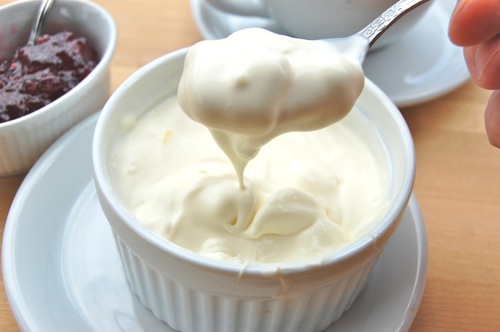
The texture of clotted cream is really unlike any other dairy product I’m aware of. It’s smooth, incredibly thick, full of big, curd-like blobs and just a little gooey. “Mud-like” is the term I usually use, and it’s apt.

For a one-time Devon resident like myself, the realization that I had the resources available to make my own clotted cream caused waves of both nostalgia and lust — butterfat lust — to wash over me. I had to rush out immediately and try it. If you have small, local dairy cream available to you (un-homogenized and especially un-stabilized) this recipe will be a snap. If not you probably won’t get quite the same result, but to my way of seeing things that’s no reason not to try. The potential rewards are simply too great.

READ ON

Does all this mean..

…you can’t make clotted cream with mass market cream? Reader Jools, I think it does. I have yet to try that, but it’s my belief that the stabilizing molecules in mass-market cream will prevent the dairy fat globules it contains from clumping up together in quite the same way. My belief is that you’ll get […]

READ ON

Hand-Skimmed Milk Question

Reader Ellen asks:

I’ve been trying to track down the answer to this one for a while…maybe you or some of your dairy chemist followers can [help]? I am looking for a (ballpark) estimate on the fat content of manually skimmed raw milk. That is, I let the cream separate in my half gallon of milk for a day or more, then I remove as much of the cream as is possible with a scoop of some kind. Any idea what the approximate fat content would be of the remaining milk? (The milk is from pastured cows, though I really don’t need that level of accuracy.)

READ ON

Homogenized, stabilized…

Reader Cici writes in to ask:

What is homogenization and why must all grocery store milk be homogenized and/or stabilized?

The trouble with cream for big commercial processors is that it separates easily. The fat globules that make up 36 (or more) percent of it tend to become attracted to one another and clump up into…well, you can see the results below. Homogenization — essentially hot, high-pressure spraying that tears large fat globules into teeny tiny pieces and distributes them evenly through the milk — helps to inhibit that natural separation.

READ ON

Joe’s Clotted Cream Adventure Begins

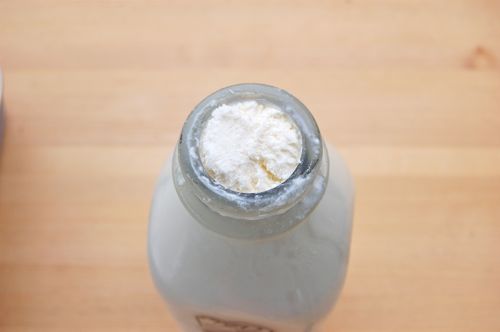
Most days I’m one of those cynics who thinks the local foods movement is overdone. Oversold, over-hyped, overwrought…over pretty much everything. But today is not one of those days. Why? Because this morning I opened up a glass bottle of locally-produced cream and found this:

READ ON

No Moo = Glue

Reader Kim, writes:

I have a couple lactose-intolerant folks in my house, and we sometimes bake with rice milk instead of cow’s milk. I’ve noticed a stark difference in the leavening and texture of pancakes and popovers when I use regular milk. With regular (cow’s) milk, the pancakes and popovers are fluffier and rise higher. With rice milk, they don’t rise as much, and have a gummier, gooey texture. Is it the magic of milk solids? The protein content? The fat? The type of sugars?

READ ON