Ehem.

Lots going wrong here, but the problem at the center of it all is a lack of elasticity in my dough. This stems from the fact that it’s so darn rich. All the fat is lubricating the gluten (protein) molecules in the dough, preventing them from linking up with one another and forming a stretchy network.

READ ON

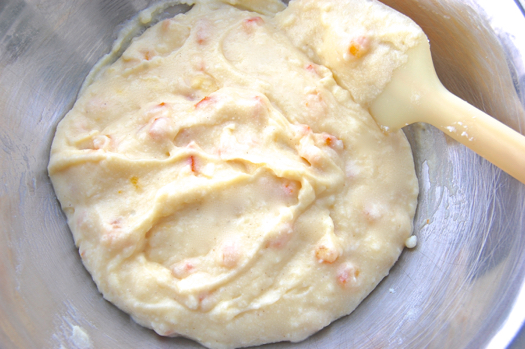
Sfogliatelle Filling

This filling is mostly used for sfogliatelle riccia, but works nicely as a bake-in filling in other applications. It’s a touch on the fussy side, but the results are worth it. You’ll need:

2 cups whole milk
pinch salt
4.5 ounces (3/4 cup) semolina or 3.5 ounces (1/2 cup) durum flour
7 ounces (1 cup) ricotta cheese
4 ounces (generous 1/2 cup) sugar
2 egg yolks
3 ounces (about 1/2 cup) candied citrus peels or candied cherries, finely chopped
2 teaspoons vanilla extract
1/4 teaspoon ground cinnamon

READ ON

Proto-Laminated Dough

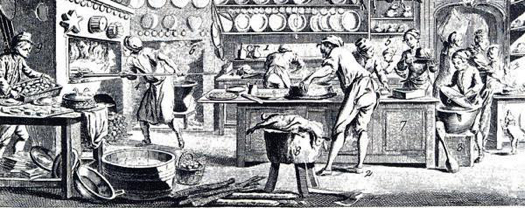
The laminating technique that produces the dough for sfogliate riccia may be the world’s oldest. As you may have noted from the posts below, the method involves stretching a rich, flexible dough to paper-thinness, rolling it up into a log that’s about two inches across, then cutting it into slices. This method predates folding-style lamination by a minimum of 50 years, having been documented by the Belgian master chef Lancelot de Casteau in his book Ouverture de cuisine in 1603 (folded laminated dough was first mentioned in Le Pâtissier françois written by François Pierre de la Varenne in 1653). However it’s probable that roll-style lamination is much older than that.

READ ON

Blowing Up Cornbread

Reader Glenda writes to say that she recently made a mistake with her cornbread: she put in too much chemical leavening (exactly how much she doesn’t say). Yet the bread with the extra baking soda turned out virtually identical to the cornbread she makes with the normal, lesser amount. Why is that? she asks. It all has to do with gluten, Glenda. Or rather, the lack thereof.

Cornbread recipes typically call for lot of leavening. The reason: because corn flour has no gluten in it. In wheat flour doughs and batters, gluten creates an elastic batter that traps and holds little bubbles of CO2 and steam. As those bubbles continue to heat, they inflate, and the bread rises. A batter made from corn meal doesn’t have that elasticity, so its ability to trap and hold gas and steam is greatly diminished. Indeed, most of the gas and steam created during baking simply escapes out the top and sides. Yet it rises…why?

READ ON
Where do sfogliatelle come from?

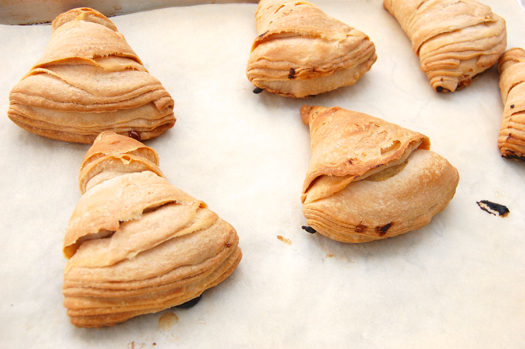
The short answer is the region of Campania in southwestern Italy. Naples is the capital of that region, and sflogliatelle have been enjoyed there for at least several centuries. The Pintauro pastry shop in Naples says they invented sfogliatelle in the year 1785, indeed they’ve gone so far as to inscribe the claim on their building’s outside wall. However there is some debate as to whether the founder of the shop, one Pasquale Pintauro, wasn’t a better marketer than he was a baker, and whether instead of inventing sflogliatelle as he said, simply created a knockoff of a preparation that had been made for decades by nuns at the Santa Rosa convent in the nearby town of Conca dei Marini.

READ ON

On the Two Kinds of Sfoglietelle

Several Italian readers have weighed in to point out that two kinds of sfogliatelle are made in Naples. There are riccia, or “curly” sfogliatelle (which is what I’m planning) and frolla, the “dough” style which is more like a cream puff. Had I known about the distinction I might well have chosen the much easier frolla style, declared victory and moved on to other things. But then the only sfogliatelle known in the States are the curly kind, so I probably wouldn’t have gotten away with it anyway. Sigh.

READ ON

Kentucky Hills + Chicago Snow = World’s Best Sledding

The snow may not be as thick as it is in Boston, but it’s amazing what a foot of snow will do to shut down the City of Louisville. Schools, businesses and government offices are closed. It would all be so depressing if the sledding wasn’t so fantastic. As a Chicago boy I’m no stranger to snow. Heck I spent almost six years of my life in Minneapolis where I saw snow almost 30 inches thick on Halloween. And while the climate favors snow, the topography is mostly indifferent to sledders. Oh sure you can find some decent hills here and there in the Midwest. The City of Chicago once maintained some wicked toboggan runs (all now taken down due to too many cracked tailbones — killjoys!).

READ ON

What sort of fat?

Here’s an interesting question. As mentioned below, lard is traditional for this type of rolled laminated dough. That’s probably because pig fat has traditionally been cheap and available in places where you find sfogliatelle and Murcian meat pies: Italy and Spain. The question is: will other types of fats work for this dough? My feeling is they will. Butter should work great even though it’s about 15% water (lard by contrast is only about 1% water). As we pastry makers know, butter works well with other types of laminated doughs, though the lower moisture Euro-style and “dry” butters are generally preferred. Why? Because more moisture means wetter dough layers, which tend to stick together instead of separate. In my research I’ve found recipes that call for a mix of lard and butter which I think is a terrific idea. That way you’d get good layer separation without too much “piggy” taste, assuming that’s a problem. It isn’t for me.

READ ON

What are sfogliatelle?

And how the heck do you pronounce them? Let’s take the second part first. When I’ve heard Italian nationals pronounce the word, it sounds a lot like it’s spelled: sfo-lee-ah-TELL-ay. Of course over on this side of the pond Italian-Americans have their own ideas about it. Sfwee-ah-DELL-ay is how I mostly hear it pronounced back home in Chicago. Who knows which one is correct? Neither. Both. Hell they probably say it completely differently in Philadelphia.

Anyway. In practical terms, sfogliatelle are a type of laminated pastry, made with disks of tightly rolled, well-lubricated dough that are pushed out like paper yo-yo’s into pockets, then filled. Of course the disks of dough are a lot wider than the diameter of a Chinese paper yo-yo, but the mechanics are the same.

READ ON

Next Up: Sfogliatelle

I’ve been traveling on business the last couple of days, not so much because I need to keep the mortgage paid but because I’m trying to avoid doing these. They scare me. But I’ve been promising them to various readers for a while, and what is life without adventure, eh? Let’s get after ’em!

READ ON