On Instant & Active Dry

Reader Chia writes in to ask:

Why do we have to choose between instant and active dry yeasts? Which one do you recommend? How do I substitute one with the other? How do you keep the freshness when one buys that huge bag from CostCo or Sam’s?

Very good questions, Chia. Thanks for asking! I use instant yeast (SAF Red or sometimes SAF Gold) almost exclusively for one reason: it’s less fuss. Unlike active dry, instant yeast can be added directly to any recipe that calls for yeast, no “proving” necessary.

READ ON

Japanese Cheesecake Recipe

This mixing technique is a little unconventional, but heck, I’m game:

2 ounces (4 tablespoons) butter
8 ounces cream cheese
3 ounces (1/3 cup plus 1 tablespoon) milk
1 tablespoon lemon juice
6 egg yolks, room temperature
2 ounces (generous 1/2 cup) cake flour
1 ounce (1/4 cup) cornstarch
1/4 teaspoon salt
6 egg whites, room temperature
1/4 teaspoon cream of tartar
5.25 ounces (3/4 cup) granulated sugar

READ ON

Next Up: Japanese Cheesecake

Here’s something that I have absolutely no experience with, but I was so intrigued by the request that I felt I had to at least try it. Japanese cheesecake is apparently a soufflé-like version of the heavy classic that turns some people (like me) off. And anyway I feel like I need to pump up […]

READ ON

On Buttermilk Substitutes

Reader Jud writes:

There are several favorite baking recipes of mine that require buttermilk. Inevitably, I have to make a trip to the store to buy fresh buttermilk if i want to use one of them. I’d like to be able to substitute powdered buttermilk that has been rehydrated. My problem is that there appears to be two types of powdered buttermilk at stores – the kind I apparently mistakenly just bought, which makes a thin “sweet buttermilk” drinkable variety (my wife tells me this is what buttermilk originally was) – and the kind that is a powdered version of the sour buttermilk we find in store dairy cases.

READ ON

Mexican Getaway

No, not me: Mrs. Pastry. She’s on a research project in Mexico City all week. What a time for my biggest client to demand a presentation! So I’m packing up the girls and we’re hitting the road for Chicago. I figure I’ll do the talking, my 7-year-old can run the powerpoint and my 4-year-old will […]

READ ON

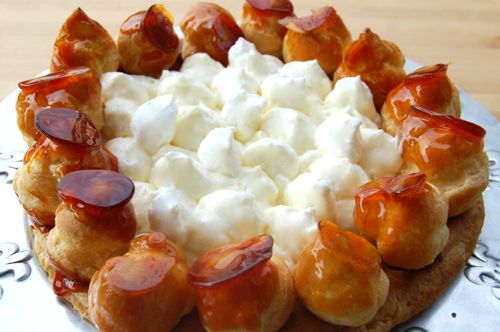
Making Gâteau St. Honoré

Every so often a pastry comes along that makes even the most jaded sweet-eater throw down his fork, stomp his foot and shout out loud:
my GOD that’s good. Gâteau St. Honoré is that pastry. Yes, you may think you know what it tastes like: cream puff dough, pastry cream, meringue and caramel. But I’m telling you friends, until you actually prepare and serve one of these you won’t understand the impact that all those components can have when they’re delivered together. The uninitiated are always, always stunned.

READ ON

Making Chiboust

Call it chi-BOOST, call it she-BOO, it’s a sweet, light and delicate filling either way. Pastry cream lightened with Italian meringue is what it is, and it works well in just about any context where you want a large volume of filling, but don’t want to overwhelm the eater with richness or heaviness. A Paris-Brest is a good example, or a Gâteau St. Honoré. Bear in mind that chiboust — like most meringues — doesn’t like humidity. And while it can be piped, pipe it only through large-bore nozzles, since constriction and pressure causes it to deflate and go runny. Here I have about a cup of the firmer of the two pastry creams that are up on the site.

READ ON

Church of the Sacred Spatula

St. Honoratus (and/or the urn containing his relics) was well-known by 1202. That was the year a baker by the name of Renold Theriens donated a plot of land in Paris so that a chapel might be built in the saint’s honor. Though I haven’t seen anything to back this conjecture up, it seems that this was the time that Honoratus became formally associated with baking.

READ ON