On Falling from Great Heights

Reader Mark asks:

Living in Denver, Colorado, which is known (among other things) as the Mile-High City, I know all about falling cakes. Can you comment on how altitude affects the baking process and what adjustments need to be made to recipes?

Great idea, Mark, and well-timed. What happened to me with my Japanese cheesecake is in fact very similar to what happens to most bakers at high altitudes: they get a whole lot of leavening action, which weakens their cake’s (or muffin’s or whatever’s) structure and the thing falls.

READ ON
Wait, isn’t fat the foam foiler?

…asks reader Marci. How is it that you can add a fatty mixture to a batch of egg white foam and not have it collapse? That’s an excellent question, for indeed egg white foam and fat don’t mix…at least until the foam has already formed.

Those of you who recall other posts on egg white foam may remember the mechanics involved. Each individual bubble inside the foam stays intact because it’s being reinforced by a mesh of egg proteins. The long protein molecules are attracted to the bubble surface because some parts of them are water-loving (hydrophilic) and some are water-hating (hydrophobic). The surface of a bubble is therefore an ideal spot for them. They can stick their water-loving parts in water, their water-hating parts in the air, and they’re 100% happy. Additionally, they can (and do) bond with one another side-to-side, the result being a film that helps keep the bubble from popping.

READ ON

Making Cheezoo-Kaykee

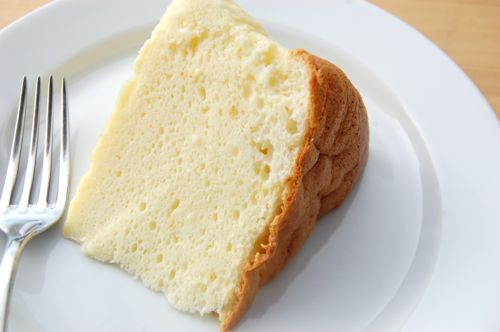
I’m not going to call this chiizukeiki or Japanese cheesecake, I’ve decided. I’m going to call it “cheesecake surprise.” Because let me tell you, I put a bite of this into my mouth convinced that I already knew what it tasted like…but I was completely surprised. For Japanese cheesecake has the feel of a dense soufflé or angelfood cake, but it has none of the dryness those sorts of egg foam-heavy foods can have. Instead it’s entirely moist, lightly sweet and smooth, and it vanishes off the tongue almost instantly, leaving nothing but a hint of New York behind. Remarkable.

READ ON

What causes a cake to fall?

The short answer, reader Timothy, is because it rises. And while that may sound like a smartass answer to your question, it really isn’t. Cakes usually fall because they rise too aggressively. If you think of a baking cake as a mass of expanding bubbles encased in a starch-and-egg batter, the ideal is a bubble size that’s large, but not so large that it taxes the structure of the cake. For it is the batter surrounding the bubbles that’s ultimately going to solidify and hold the cake up. If the bubbles get too big too fast, the bubble walls get extremely thin, so thin that even after they harden they can’t support the weight above them…and the cake falls. This is why more leavening — especially chemical or mechanical (air bubble) — isn’t always a good thing. A balance is what’s needed.

READ ON

Why is it “Philadelphia” and not “Chester” cream cheese?

Love that question, reader Tanya, for indeed cream cheese was invented in Chester, New York and not Philadelphia, Pennsylvania. It wasn’t inspired by Philadelphia, it was never manufactured in Philadelphia, never shipped from there, stored there…nothing. So why then was it named “Philadelphia Cream Cheese”? Simply because Philadelphia was a big food town in those […]

READ ON

Philadelphia: Accept No Substitutes

I may not be the world’s biggest cream cheese fan, but I know a top-quality product when I see one, and Philadelphia cream cheese is it (no, they’re not paying me to say that). Its composition is similar to several of the “natural” cream cheese products on the market except for a few very important additions: xanthan and/or guar and/or carob gum. These harmless additives help make cream cheese what it is, and by extension, cheesecake what it is. All three are natural compounds, though truth be told, while guar and carob gums are naturally-occurring (found inside the seed coats of beans), xanthan gum is fermented from corn starch (don’t tell Michael Pollan, OK?).

READ ON

Can I make my own cream cheese?

Good question, reader Babs! The answer is yes…and no. Home-made cream cheese can be very good, but when made with home kitchen equipment it comes out quite crumbly compared to the stuff you get in the foil packet.

Why? The reason is that cream cheese’s consistency is dependent on precise timing and control of temperature. Cream cheese is made by warming a milk/cream mixture that contains a bacterial culture and allowing it to ferment…but only briefly. The reason, because one of the by-products of fermentation, as you fermented dairy freaks out there already know, is acid — and acid causes coagulation and curds.

READ ON

Where does cream cheese come from?

So we know when cream cheese came to Japan, and from where: commercial cheese makers in America and regions Down Under, about the year 1980. But then where did those guys get it? Who invented cream cheese to begin with? The answer is: a dairyman from Chester, New York by the name of William Lawrence. He’s said to have accidentally invented cream cheese in 1872 while attempting to create a short-ripened American version of the soft French cheese, Neufchâtel. He failed, but the rest, as they say, is history.

READ ON

Chee-zoo-kaykee

My little girls love the sound of that word so much I don’t think they’ll ever pronounce “cheesecake” the same way again. But the time has come to ask: what is the technical difference between an American cheesecake and a Japanese one? I’m inclined to state the answer this way: American cheesecakes are custards, albeit very thick ones, and Japanese cheesecakes are soufflés. Again, very thick ones.

Look at the process for mixing a soufflé, then the process for mixing a Japanese cheesecake and you’ll find the two are very similar. Both involve combining a cheese and egg yolk-rich base mixture with an egg white foam, then baking the batter. The difference lies in the fact that a Japanese cheesecake batter has quite a bit more structural material in it, so it’s not inclined to fall like a soufflé.

READ ON

Wait, they eat cheesecake in Japan?

I didn’t know they even ate cheese there! But in fact they do. Despite what we here in the West hear about Asian disdain for beef and dairy, the fact is that both are now quite common in the Far Eastern regions of the globe. In fact Japan has become famous for besting the French at their own game, producing some of the finest brioche and laminated pastry in the world. Quite a reversal from the old days of barbarian invasions and butter stinkers, wouldn’t you say?

READ ON