Crop that Conquered the World

Corn is thought of as a quintessentially American crop. That’s true if by “quintessentially American” you mean that Americans have exploited corn’s industrial potential to a greater degree than anyone else. But of course corn didn’t originate in North America, and its popularity is by no means limited to North America, nor even to the New World.

Corn is grown on every continent on Earth save for Antarctica, most intensively in the American Midwest, western Europe and eastern China. On which note, I was watching a terrific BBC program called Wild China the other night. In one sequence on the subject of farm villages in Hunan province, I noticed that the ceilings of the homes there had bundles of dried corn hung from all their rafters. I did a double-take until I remembered that the farmers there — like most corn farmers around the world — think of corn as a traditional crop. It’s been around for so long, few are even aware that corn originally came from somewhere else.

READ ON
Mieliepap Recipe

This a pretty dressed up version of the South African classic. Some call this a cornbread but a baked pudding or porridge is really what it is. Save for the cheddar cheese, this could easily be a classic southern American preparation. Check it out:

1 cup cornmeal
3/4 cup milk
2 cups buttermilk
3 tablespoons melted butter
1/2 cup sugar
1/4 cup honey
1/2 teaspoon salt
2 eggs lightly beaten
2 teaspoons baking soda
1/2 cup chopped slab bacon

READ ON

Next Up: Mieliepap

I’ve been getting all sorts of interesting emails since I announced my month of savory baking. Among the most intriguing was from reader Abri in Durban who told me to try something South African for a change. Not knowing much about South African food I naturally asked for some suggestions, the more classic the better. This topped Abri’s list of classic South African foods. It’s not a pastry, nor a bread…it’s actually a side dish. However since I just came into possession of some pretty nice corn meal, it seemed like fate. And given the holiday yesterday and the fact that little Joan has bronchitis, this is going to be a pretty abbreviated week anyway. So let’s do it!

READ ON

Making Bastilla (Bisteeya)

I spent a lot of time playing in orchestra pits as a youth. Trombone at first, then later bass. I played high school musicals mostly, and let me tell you, those were some tough scores! But fun. I particularly enjoyed the overtures, when the house lights would go down, the strings would come up and the orchestra would acquaint the audience with the musical themes they would be hearing over the next couple of hours.

READ ON

Why is Arab food so heavy on spices?

…asks reader Will. That’s the sort of question I really, really dig, reader Will. The reason is simply because Arabs are legendary traders, blessed by happenstance to be situated right on the receiving end of history’s ultimate wholesale supply line: the Silk Road. The Silk Road — which wasn’t actually one road but a network of trade routes — stretched for some 4,000 miles from the Pacific coast of China all the way to the Mediterranean.

READ ON

Another Way to Peel the Onion

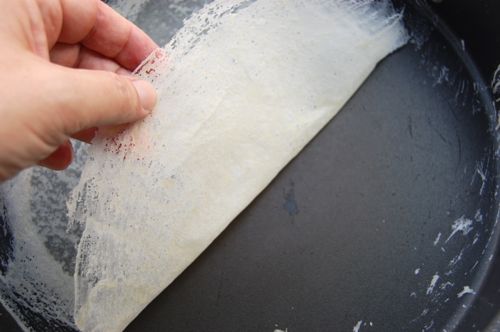
Reader J from Singapore submits this very interesting and helpful video showing how spring roll wrappers are made. Warqa is the very same concept, just done in Morocco. And indeed it seems at least possible that along with all the spices the Arabs imported from the Far East they may have imported some kitchen techniques as well. The only difference between this and warqa-making is that a slightly firmer dough is dabbed onto hot metal several times to create “leaves” which altogether make up a finished sheet. If you prefer not to use a paint brush — try it!

READ ON

Making Warqa a.k.a. Brik Pastry

Paper thin Moroccan warqa, used for bastilla and other pastries, is easy once you get the feel of it. The sheets are thinner than phyllo dough, but make a good substitute for those instances when you’re in the mood to impress party guests with an impromptu “You know I make my own pastry, of course!”

Plus it’s fun to do. Provided you have a large, flat pan to paint the batter on, the only thing you need is a broad brush. A new nylon or polyester paint brush from the hardware store will work just fine. Start by assembling your ingredients. Whisking the dry ingredients together…

READ ON

A Dab Will Do You

When it comes to making ultra-thin sheets of pastry, you can go one of two ways. You can roll, which is the Western way, or you can “dab”, which is the Eastern/North African way. For long ago it seems, pastry makers in the East (probably China) realized that rather than trying to compress a dough to a paper-thin thickness, you could instead dab a moistened ball of dough onto a hot surface to make a film. Cooked, that film could then be lifted off, lubricated and used to make pastry.

READ ON

Bastilla (Bisteeya) Recipe

Trying to be as flexible as possible, I’m including equivalents for squab and chicken as well as vegetables (a couple vegetarian readers weighed in on this preemptively).

1 Spanish onion, finely chopped
4 tablespoons butter or vegetable oil
1 teaspoon salt
3/4 teaspoon ground ginger
2 teaspoons ras el hanout (a.k.a. “Moroccan Spice”), optional
2 pigeons (squab) OR about 2 pounds chicken pieces of your choice OR about 1.25 pounds root vegetables of your choice
2 cups chicken or vegetable broth
1 cinnamon stick
Pinch of saffron threads
1/2 cup chopped fresh parsley

READ ON

Pastry with a Thousand Spellings

I mentioned yesterday that there are a lot of spellings for bisteeya. Of all of the ones that are pronounceable in English, it seems to me that “bisteeya” is the most misleading of the bunch. For based on what I’ve been discovering over the last few days, the most common pronunciation of this pastry is something akin to “pastila.” That brings it a lot closer in look and sound to the Spanish word “pastel” which means “cake” in that language. Interestingly, if you look around the Mediterranean you can find more than a few baked items — including many savory pies — that sound quite similar.

READ ON