Love for Sale

Just a quick note for those of you who may be considering paying huge bucks for ad space on an industry-leading pastry blog. My exclusive arrangement with Foodbuzz has expired, and I’m experimenting with some new potential sources of ad revenue. Next generation strategies for revenue stream enhancement and site monetization, in other words. Of course I’ll still be doing this with or without the extra thirty nine bucks a month. But…nothing ventured, nothing gained, knowadimean? Joe is open for business.

READ ON
Do gristmills ever explode?

And if they do, why? That from reader Afton, age 9. Boy is a question like that ever a great way to start a day, Afton! I thank you for it. The answer is…sometimes. However I’m not aware of many (or any) explosions having to do with corn mills. Wheat flour milling is another matter entirely. But then why should that be so? Both involve the grinding of grains. I believe the answer has to do with particle size. But first a little bit about what causes mill explosions.

READ ON

Gristmill Under the Hood

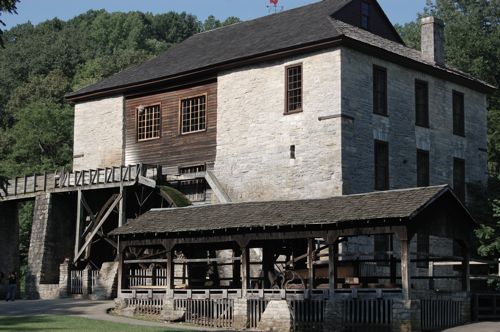
Regular reader, good friend and world traveler Warren helpfully submitted these pictures over the weekend of Aldi Mill in Virginia. Still working (over the summers, anyway) it’s a classic example of the gristmills that could once be found all over the Midwest and Eastern US.

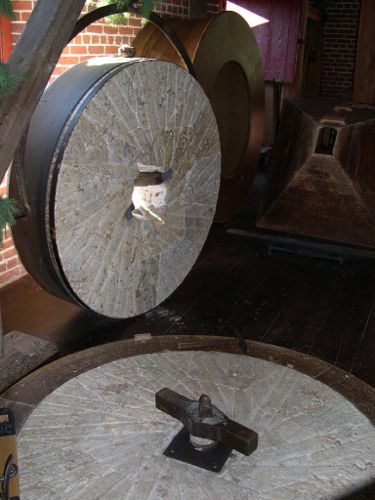
Here’s a terrific shot of the rocks…the runner above and the bed below with furrows cut into their faces. Based on the angles, you can how the stones cut the corn kernels with an almost scissor-like action.

READ ON

Milling Matters

I got a little riled up yesterday, I admit it. I get a touch of the southern preacher in me talking about corn meal, which is weird because I spent most of my life in Chicago. After reading yesterday’s post I received a few comments and emails from folks asking if I thought good corn meal was worth an investment in a small home mill. I’m not sure about that, though I know home milling was common in the US (and probably lots of other places) as recently as 100 years ago.

READ ON

Corn Meal is Corn Meal

Not! I may be blasé about the differences between cane sugar and beet sugar, between high-end grand cru chocolates and the chocolates you can buy at the supermarket, but when it comes to corn meal I get animated. Simply put, you need the best quality stuff you can find. And when I say “best quality” I mean stone ground, ideally from an old-school grist mill of the kind you find in national parks and those historic restoration villages.

Why am I so particular about corn meal? Because there’s no corn meal like fresh meal ground slowly between stones from whole kernels of dried corn. Though you may not realize it, the corn meal you find in supermarket packages is not only stale, it’s ground from only the endosperm of the kernel, the oily germ having been pinched off by steel rollers.

READ ON

Corn in Africa

What’s interesting about corn as a food crop in Africa is how long it took to become truly dominant. For indeed there was a time, in the few centuries after its introduction, when corn was but one of number of — ehem — vegetable crops that appeared in many home and/or village gardens.

Because it was adaptable to many sub-Saharan African climates it was frequently planted between rows of other food crops like beans or peas. Because it produced ears so early in the growing season it was an ideal stop-gap food for growers who were waiting for their millet or sorghum to start producing. And because it wasn’t attractive to birds (at least until it dried out) it was reliable so long as the weather was good.

READ ON

Beet or Cane?

Reader Bee writes:

I heard cane sugar is better for baking and candy making. If [the package] says sugar, it is likely beet sugar. If it says cane sugar, it is cane sugar. Most store bands are beet sugar. At my local Wally World, their store brand, 5 pound bag stated “Sugar”, but the Store Brand 10 pound bag stated “Cane Sugar”. So I guess we can’t go by store brand!! Just read what’s on the label. Which do you use??

Bee, I use pretty much whatever comes in the bag. It’s true that beet sugar is now more common in the US than cane sugar. But the truth is you never really know what you’re getting when you buy a bag that isn’t clearly marked “cane sugar.” It might very well be beet sugar, but then it could be cane sugar. Most likely it’s a mixture of both. Why would that be? Prices. Sugar packagers will generally acquire their sucrose wherever they can and the best price wins. Beet sugar isn’t always cheaper.

READ ON

What’s the difference between a grain and vegetable?

I should have seen that one coming! Thanks, reader Clare. Grains are the seeds of grasses. Vegetables are…well, there isn’t a strict definition of what vegetables are. A vegetable can be any edible part of a plant that’s not a) the seed or b) the ripened ovary. The ripened ovaries of seed-bearing plants are what are known in scientific terms as “fruits”, if you follow me. Thus you can see why tomatoes and squash are classified as fruits and not a vegetables: they have seeds.

READ ON