Next Up: Gâteau Basque

This is a truly great — and mostly simple — preparation. If you’ve never tasted it before, you’re missing one of the world’s ultimate afternoon tea (or coffee) accompaniments. Gâteau Basque is really quite an unassuming little pastry. Classically it has but one filling: black cherry preserves or pastry cream. However I’ve seen versions with up […]

READ ON

Making Pastéis de Nata

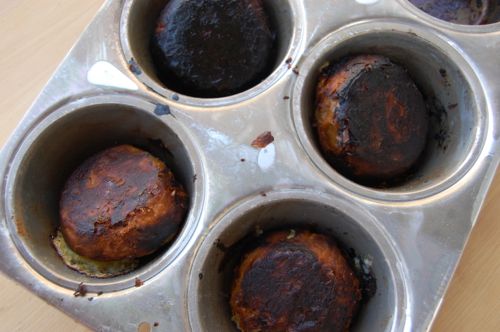
These things are really neat. They’re little, rich, aromatic and caramelly. As perfect an afternoon sweet as I’ve ever made. Not that I’d call these particular pastéis perfect. They’re a little too toasty. Yet they passed muster with a one of Mrs. Pastry’s Portuguese colleagues, who claimed they tasted just like home. She was probably being nice. Yet there’s no denying even these first-attempt pastéis had a certain…something. I’ll definitely be making them again. They’re one of the few pastries I’ve made that both my little girls loved.

READ ON

The High Heat Myth: Busted

I think we can safely count the claim made by the proprietors of the Antiga Confeitaria de Belém bakery — that they bake pastéis de Belém at 750 degrees Fahrenheit — as a myth (of the intentionally created variety). Probably a diversionary tactic they use to discourage people from trying to make their pastéis at home.

READ ON

How does flour protect a custard?

Thanks for the question reader Alan. As you may recall from other posts on custard, custards are gels that are created when egg proteins are heated. Gentle heat coaxes these long, bunched-up molecules into releasing their chemical bonds and opening up. As they unwind they get tangled up with and/or bond with their neighbors. That has the effect of restricting the flow of the water and fat molecules that are are among them, and the mixture firms.

READ ON

Pastéis de Nata Recipe

This recipe has some unusual features: plenty of flour in the custard mix (presumably to inhibit curdling in the high heat) and a cooked syrup. I have yet to try it, so maybe hold off until I give it a go. Should be fun!

About 2 pounds puff pastry dough (home made is what makes this recipe)
2 cups whole milk
the peel from one lemon
1 cinnamon stick
1/2 teaspoons vanilla extract
2 ounces (half cup minus 1 tablespoon and 1 teaspoon) flour
12 ounces (1 and 2/3 cups) sugar
2/3 cup water
7 egg yolks

READ ON

The Rise of “The People”

Reader Staci comments:

My impression has always been that Europe and especially countries like Spain and Portugal were very Catholic and religious, so I was surprised to read what you said about a ‘great religious upheaval.’ Aren’t those countries today still quite Catholic? Please explain.

Staci, I would be absolutely delighted. The question isn’t really whether or not countries like Spain and Portugal are Catholic today, but to what degree they’re Catholic. Once, and we’re going back hundreds of years now, the Catholic Church was the richest, most powerful single institution in Europe. It was involved in every aspect of European society including politics and commerce, and held property of all sorts all around the Continent, including opulent structures and gigantic land estates.

READ ON

#3 on Joe’s Most Interesting Natural Disasters List: The Lisbon Earthquake

One thing I forgot to mention about the Hieronymites Monastery is that it somehow managed to survive the Lisbon earthquake of 1755, an event that ranks among the most devastating natural disasters in recorded history. The interesting thing about the Lisbon earthquake — though I’m certainly no seismologist — is the type of motion the city was subjected to. The way I understand it, most earthquakes are strong in just one type. The Lisbon earthquake was notable in that it started with jostling up-and-down primary waves which were then followed up by even stronger shimmying, side-to-side secondary waves. Again, as I understand it, many buildings, even those built in the 1700’s, could withstand one of those two forces. But the combination of the up-and-down and side-to-side knocked down virtually every building in Lisbon.

READ ON

Who were the first to make pastéis de Belém?

Monks, it’s believed. Specifically those who lived at Hieronymites (Jerónimos) Monastery which is of course in the Belém neighborhood of Lisbon. So the story goes, the monks there invented pastéis de Belém sometime in the 1700’s, the point at which the monastery was at its richest and most influential. That could be accurate given the history of the building, which to this day remains one of the jewels of Portuguese architecture. The first structure on the site was put up by no lesser person than Henry the Navigator in 1459, which makes sense as Lisbon is located where the magnificent Tagus river meets the Atlantic. It’s one of the world’s great natural ports.

READ ON