Just a Little Extra Protein

This past weekend we had an outbreak at chez Pastry. A neighbor family was leaving town for a year-long sabbatical, so a couple of weeks ago they brought over all their partly-used pantry foods. It was a bonanza of oils, vinegars, pastas and sauces. Woohoo! Unfortunately among the bounty was a sack of semolina that turned out to be full of flour beetles. By the time we noticed them they’d gotten into, well…just about everything. We needed to clean out the cabinets anyway.

Pantry pests happen to everyone at one time or another. You probably know the experience. You’re doing dishes one evening and you notice a couple of little moths with stripey wings flitting about. Who let these darn moths in here? “Honey,” you call to your spouse in the next room, “we’ve got to make sure we’re keeping the screen doors closed. Moths are getting in.” But of course no one is letting the moths in. You’re bringing them in — in live egg form, in your flour.

READ ON
Next Up: Buckle

This is going to be another very short week since I have yet another business trip Thursday-Friday. However I also have a couple of pints of blueberries in the fridge that I need to use up — and quick. A good ol’ buckle seems like just the thing for the time-pressed blogger who hates to […]

READ ON

Wrap-Up

I could spend an awful lot of time blogging on the subject of Chinese food. Since the heyday of chop suey in America, successive waves of immigrants have introduced myriad variations on the theme: Mandarin food, Szechwan food, and so on and so on. Nearly all of it has been adopted and assimilated to a greater or lesser extent, carrying on the grand tradition of the great American melting pot (in its edible form).

Today virtually everyone in America eats Chinese food at least occasionally. As of last year there were over 40,000 Chinese restaurants in the States. Unsurprisingly, the vast majority of them serve what one might call a “classic” American-Chinese menu…egg rolls, wontons, General Tsao’s Chicken, you know the drill. You might have trouble turning up a chow mein or chop suey nowadays, but the go-to repertoire of dishes that Americans have put their stamp of approval on is everywhere. Indeed it’s estimated that a mere 20% of Chinese restaurants in America serve dishes that are considered in the least “authentic” (whatever that means).

READ ON

Making Spring Roll (Popiah) Skins

Now me, I grew up calling these sorts of devices “egg rolls.” It wasn’t until I got to be in high school that I began to know them as spring rolls. That was when one of my father’s oldest friends married a Chinese woman who happened to own one of the best Mandarin restaurants in Chinatown. We started eating there once a week, so I had to at least appear to know the lingo. These below are what I always thought were “spring rolls”:

READ ON

Chinese Spring Roll Skin Recipe

Spring rolls began showing up on American Chinese menus in the 50’s and 60’s. That’s easy to understand when you consider they’re not Cantonese but hail from the Eastern and Northern regions of China, where they’re typically eaten during spring festivals. Thus the name. Chinese spring rolls are made with wheat skins as opposed to rice paper (the latter being Vietnamese).

The ultra-thin wrappers are made via an unusual technique whereby a large mass of high-gluten dough is dabbed on a hot plate. The skin cooks up in about a minute, and is then peeled off. More on that in the tutorial. For now you’ll need:

READ ON

Making Mandarin Pancakes

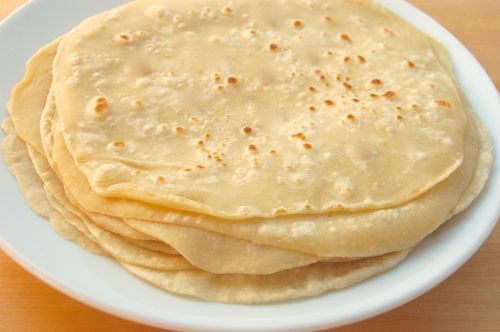
The only application I know for Mandarin pancakes is as a holder for moo shu pork. I know there much be others, but in my universe that’s more than enough. What’s fascinating about these pancakes is that they’re extremely thin and flexible while containing no egg or fat. Just white flour and hot water. It’s the boiling water that’s the key, it quickly creates a starch “gel” that keeps the pancakes supple. Begin by combining the water and flour in a medium bowl or a mixer.

READ ON

Where does moo shu pork come from?

When you consider that chop suey peaked as a phenomenon in the 20’s, Chinese cuisine — at least of the Cantonese variety — experienced a long period of stagnation before new and improved versions came along. There were several attempts to update the formula of course. Chinese restaurant/jazz joints were popular in the 20’s and 30’s. Following World War II Chinese restaurant/tiki bars were huge, and they endured well into the 60’s. Actually I know of at least one of those that’s still around: Chef Shangri-La on 26th Street in Riverside, Illinois. My college buddies and I tossed back a few Dr. Fongs at that place back in the late 80’s I can tell you. Oh the hangovers. But the grass roof in the bar was very cool as I recall. My memory might be a little skewed.

READ ON

Are you SURE chop suey is Chinese?

Because I’ve always heard the dish was a hoax perpetrated on gullible Americans, writes reader Margie. Margie, you are definitely not the only one who’s heard the same thing. In fact this particular rumor about chop suey has a pedigree nearly as distinguished as chop suey itself.

It dates back to 1904 in fact. That was the year that a Chinese cook by the name of Lem Sen hired a New York attorney to help him prosecute all the many thousands of Chinese restauranteurs in America who, he claimed, had stolen his recipe. So he said chop suey was a dish he’d invented in his restaurant in San Francisco, only few months before Li Hung Chang’s momentous visit to the US. It was an ersatz Chinese concoction made up to please American patrons.

READ ON

I’ll Have the Stew

Reader Dana asks:

This may be off-topic…I’m pretty sure it is…but can you tell us when chop suey went from being something authentically Chinese to the culinary travesty that it is now? Enquiring minds want to know!

Not at all, Dana…in fact quite on-topic since American Chinese food is what’s on the agenda this week. From what I know it wasn’t long. In the fifteen years following Li Hung Chang’s visit, Chinese restaurants spread like wildfire across America. Most of them had greatly abbreviated menus, serving popular dishes like chop suey, chow mein and egg foo young.

READ ON