Stone Ground What Now?

Chocolate. Yes you heard that right. Evidently it’s a new trend in the world of confectionery: gritty though not necessarily darker “Mexican style” chocolate bars. The story was in the Wall Street Journal on Wednesday but I just came across it this morning. It’s here, but behind the WSJ paywall. Here are the lead paragraphs if you’re wondering what this is all about:

Craft chocolatiers are using ancient techniques of the Aztecs and Mayans to create a dairy-free, low-fat product with a consistency a bit like crunchy dirt. Some chocolate lovers can’t seem to get enough of it.

READ ON
Can pecan pie curdle?

Oh yes it definitely can, reader Tillie. Though pecan pie doesn’t give the appearance of a custard it definitely is one, and as such it abides by all the usual custard rules, number one being: don’t overcook me. For when you overcook a custard the long, string-like egg proteins which unfurl so beautifully in gentle heat begin to clench back up again. When that happens they wring the water out of the gel they’d just created, leaving behind curds and a large puddle of syrup. I think we’ve all had pecan pies like that, no? Clumpy and syrupy…in other words…blech.

READ ON

When Sweets Are REALLY Bad for You

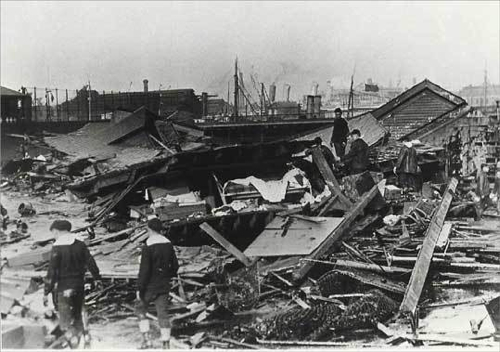
Since we’re already talking syrup and molasses I should note that today is the 96th anniversary of the Great Boston Molasses Disaster, which happened on January 15, 1919. On that fateful day a two-and-a-half million gallon tank of molasses located at the Purity Distilling Company in the North End of Boston burst, sending a 25-foot wave of sticky death hurtling down Commercial Street at some 35 miles per hour. How molasses could reach that speed (and viscosity) in the middle of a January day I don’t know. But then it was a hell of a lot of molasses. The wave demolished buildings, train tracks and conveyances, killed 21 people and injured 159.

READ ON

What’s the point of corn syrup?

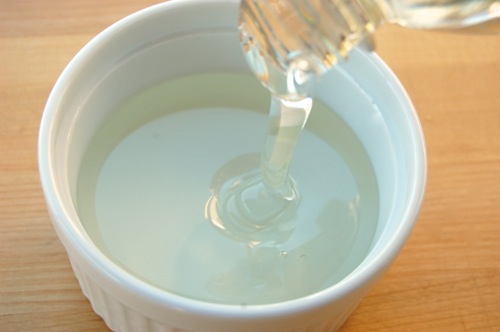
…when there are so many other types of syrup available to us these days? So asks reader Ted. And Ted, it’s a good question (even though I sense it’s loaded). When corn syrup was first produced commercially the point was to create a less expensive — and more neutral-tasting — alternative to molasses. Around the year 1900 most people used syrups, not more expensive crystal sugar, as general-purpose sweeteners. People up north used maple syrup. The Midwest favored sorghum. The rest of the population used molasses. In those days it was common to see a bowl of syrup on the kitchen table next to the salt and pepper, not a sugar bowl.

READ ON

Pecan Pie: Syrup or No Syrup?

That’s a very interesting question. I’ve received several opinions on the subject from readers since I posted my intention to make pecan pie, oh, way back in 2014. I confess I’m sympathetic to the no-syrup school to some extent, if only because the idea of a syrup-less pecan pie emits a strong odor of authenticity. I mean, people were making pecan pies before the invention of corn syrup, right?

Actually not really. It’s true that pecan pie was eaten in American prior to the heyday of corn syrup, mostly in and around Texas. However these recipes were qualitatively different than later, more popular pecan pies in that they were sweet egg-and-milk custards with pecans stirred in, usually topped with meringue. The first published recipe for such a pie appeared in Harper’s Bazaar in 1886.

READ ON

Making Melba Toast

The operative logic behind melba toast seems to be: if you’re going to eat nothing you might as well make it interesting. There’s no question that Escoffier did as much as he could with what he had to work with here. This is as interesting as dry toast gets. Start by turning on your oven’s broiler and procuring some bread. If it’s already a little stale, so much the better. This is some leftover brioche because honestly plain white bread was too much nothing even for me.

READ ON

What was so great about Escoffier?

Borne in 1846, Auguste Escoffier was one of the first chefs to have global name recognition. People traveled from everywhere to eat his food and to this day every serious student of cooking owns a copy of his cookbook, Le Guide Culinaire. But then a lot of chefs over the last century or so have cooked well, had broad name recognition and published cookbooks. So what made Escoffier a legend? Was his food that good? Could he have beaten Morimoto on Iron Chef?

READ ON

The Buttered Cat Paradox

It’s true that one of the defining features of melba toast is that it’s unbuttered. But while we’re talking toast history it’s interesting to note that quite a lot of mental energy has been expended (mostly by British scientists) on the question of why, when you drop a piece of toast, it always lands butter-side down. Most of us would just chalk the phenomenon up to Murphy’s Law, yet several serious theories have been advanced, most of them dealing with things like gravity, roll, pitch and yaw.

READ ON

Language, Common Law, Individual Rights and Toast

The weirdest thing about the history of toast is that while scorched bread has been around for millennia, it was only two hundred years ago that anyone hit on the idea of spreading butter over it. For most of human toast-making history people just ate the stuff plain, stuck on stick or a spit, held out over an open fire. Then in the Middle Ages honey became a popular addition, followed soon after by sugar pastes, dried fruits, spices and nuts. The 16th century saw the rise of meat toppings and hashes. The 17th, cinnamon, sugar and wine. Finally, by the dawn of the 18th century the perfect fusion of bread and dairy fat was achieved: hot buttered toast.

READ ON