Rise of the European Sweet Tooth

Muslim Arabs dominated the sugar industry for roughly 700 years. As their Caliphate expanded, so did the geographical range of their favorite grass. Muslims planted sugarcane on the shores of the Caspian Sea, in the Tigris-Euphrates Delta, in Palestine, the Nile Delta, on the islands of Cyprus, Crete and Sicily, and in southern Spain. Anywhere, in short, where they could supply it with the water it needed to thrive. For indeed sugarcane is an extremely thirsty plant. Arabs may thrive in the desert, but sugar, being tropical, needs water, water, water.

This map does a good job of showing the distribution of sugarcane during the period. Notice anything about the locations of these growing regions? None of them were in Christian-controlled Europe. That left sweet-lovers in the northern hemisphere mostly out in the cold, as it were. For European Christians and Muslim Arabs didn’t get along terribly well in those days. Which meant that when Europeans wanted sugar, they had to contend with bees.

READ ON
Straight Up Sugar

So what is sugar and where does it come from? That’s a good place to begin, I think. The answer is that — at least classically — sugar is the distilled, evaporated and crystallized juice of sugarcane, a giant grass that’s native to India. There it’s thought sugarcane was cultivated starting in about 3,000 B.C..

READ ON

This Week is Sugar Week

Reader Rick had an interesting idea last week: what if I put up a separate section on sugar to mirror the Flour section I have under “Baking Basics” to the left there. It might make a handy reference for bakers out there, plus I’d get to geek out on the subject sugar refining. Everybody wins! […]

READ ON

Geronimo!

On a non-pastry note, I hope you got a chance to check out Fearless Felix Baumgartner’s record-breaking 24-mile skydive yesterday. If you missed it you can watch it here. It’s amazing. Of course fifty years from now naked, drunken college kids will be doing this every weekend from the front porches of their orbiting, solar-powered fraternity houses…but for now it’s pretty darn impressive.

READ ON

Making Pop Tarts

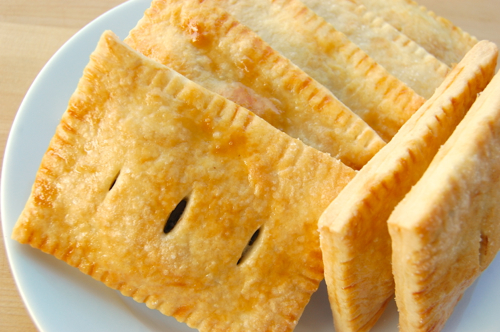
The genius of Pop Tarts is that Kellogg’s took a tried-and-true favorite — the jam tarts pie-baking mothers made for kids out of pie dough scraps — dressed them up with a new name, some new flavors and…presto: a big fat packed goods hit. The homemade version is better. All you need are some basic ingredients and the filling of your choice. Start by stirring the dry ingredients together in the bowl of a mixer fitted with a paddle. You can do this by hand if you like, also.

READ ON

Tough Stuff

Reader K-Line wants to know…

…if the crust, in order to withstand the toasting experience, needs to be durable at the expense of soft and buttery.

Great question, K! The answer is yes, to some extent. Pies baked up in plates can have incredibly tender crusts. However hand pies are meant to be, well…handled. Thus their crusts need to be a little tougher than a normal. Different bakers achieve this end in different ways. Some add more liquid to the dough to increase gluten development (thus making the crust harder and chewier) while others subtract fat to decrease the crumble factor.

READ ON

How Big is the Pop Tart Empire?

Reader Dean asks if I know how many — and how many kinds — of Pop Tarts are made by Kellogg’s each year. The total number is close to four billion if you can believe it. That’s more than 10 million every day. Given numbers like that it’s no wonder their corporate lawyers aren’t pounding down my door demanding I cease and desist using their brand name for a blogging project. Assuming every reader who visited me this morning went on to make a batch of homemade “tarts” I’d cut into their sales by a few thousand at best. Maybe a few hundred bucks in profits. Talk about a yawner. Their lawyers charge them that much just brushing their teeth in the morning.

READ ON

What’s in a Name?

Oh, maybe a billion bucks, give or take. But let’s back up a little. When last we left our hapless heroes at Post Cereals it was 1964. They were alerting the media about their big idea of packaging pre-made toaster-ready jam turnovers in metallized mylar packets. Announcements started appearing in national papers that week.

That Thursday over at the Kellogg Company, CEO J.P. Bigshot was following the story closely. “Say, that’s a pretty good idea,” he said through a mouthful of doughnut. “But what’s Post calling these things? Country Squares??? That’s about as exciting as a Beverly Hillbillies re-run. Miss Jones, get me the R&D department.”

READ ON

What is turbinado sugar?

So asks reader Rick. Rick, it’s a very similar thing to demerara or muscovado sugar, which is to say it’s a lightly processed brown sugar. However compared to others it’s got a high moisture content, which makes it nice for melting and caramelizing. Some people prefer it for crème brûlée for that very reason. No […]

READ ON

Oh and did I mention…

…that metallized mylar not only keeps gasses out, it keeps light out. About 99% of light. That’s nice for packaging things like camera film (not that anyone uses it anymore). However it also means you can view an eclipse of the sun through a Pop Tarts wrapper. It’s not technically recommended since manufacturing standards vary […]

READ ON