Why a tube pan?

Another very good question, reader Will. Heat penetration is the answer. Without that center hole, an angel food cake would be an extremely broad and thick mass. Heat from the oven would have a hard time reaching the center before the outside over-baked. Meringue-topped pies are a good illustration of this problem. Big as they are, the very centers are often under-baked or weepy, because it’s hard to get that middle region hot enough without overheating and breaking the rest of the meringue.

READ ON
The Fat Speck Myth

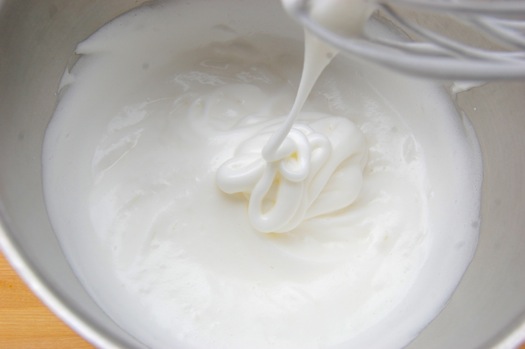
Several readers have written in to ask if it’s true that a tiny bit of fat in a mixer bowl will ruin a batch of whipped egg whites. The answer: absolutely not. A small blot of, say, egg yolk will do virtually nothing to impede a batch of whites from whipping up to a nice, voluminous foam.

Egg white foams work because the bubbles that make them up are reinforced by a mesh of string-like protein molecules, molecules which have been coaxed into untangling by the whipping action. At that point they begin to collect around air bubbles because certain regions along their length are attracted to air (are hydrophobic) and others are attracted to water (hydrophilic). Thus the surface of the bubble is a desirable spot for them, as all their different regions are happy, and they can bond to each other side-by-side while they’re there.

READ ON

What effect does cream of tartar have on an egg white foam?

This is one of the most popular questions here on joepastry.com, reader Nance! And no, you definitely can’t make an angel food cake with out it (or some other kitchen acid). But let’s start at the beginning. The reason egg whites whip so nicely into foams is because of the proteins they contain. These proteins naturally occur in clumpy balls. But apply a little shearing force and the proteins uncoil, at which point they begin to bond to one another, forming networks. These networks collect on the surfaces of air bubbles, preventing them from popping. The result is foam.

READ ON

Where does angel food cake come from?

That’s a bit of an unknown. It’s an American thing, that much we do know. What other culture holds five-inch-thick cake layers in such high esteem? As for exactly when and where angel food cake first appeared in America, that’s tougher to determine. People like to say Pennsylvania Dutch country, but that’s really just a guess, albeit a safe one since so much in the American home baking canon has come from that region.

READ ON

Chocolate “Sauce” Recipe

I’m putting sauce in quotes because a chocolate syrup is really what this is. However since I love David Lebovitz’s idea of bolstering regular chocolate syrup with a little eating chocolate to give it extra body, I’ll add some to my go-to syrup recipe and call it sauce! Thanks David! Cut the sugar down by as much as half for a less-sweet version.

2.25 ounces (2/3 cup) cocoa powder
7 ounces (1 cup) granulated sugar
8 ounces (1 cup) water
1/4 teaspoon salt
2 ounces bittersweet chocolate, chopped
1 teaspoon vanilla extract

READ ON

Angel Food Cake Recipe

When my grandfather realized, just a few weeks after his wedding, that his new bride didn’t know how to cook, he sent her to cooking school (my grandmother had been too busy studying law). That school was the Antoinette Pope School in Chicago, where my bookish grandmother learned the base skills that would one day turn her into a kitchen maestro. This cake is a slight variation on the recipe she learned then, and made probably hundreds of times thereafter:

4.5 ounces (1 cup) cake flour
1/2 teaspoon salt
1 3/4 cups (12 large) egg whites, at room temperature
1 1/2 teaspoons cream of tartar
10.5 ounces (1 1/2 cups) sugar
1 teaspoon vanilla extract
1 teaspoon extract of your choice: lemon, almond, orange, etc.. or citrus zest (2 tsp.)

READ ON

Next Up: Angel Food Cake

I know the site is getting big and popular when readers start heckling me over staple recipes I have yet to do. Just this week reader Linda complained that I’ve never done angel food cake, and reader Susan needled me over not having any chocolate sauce on the blog. So OK already, let’s do them […]

READ ON

Making Youtiao

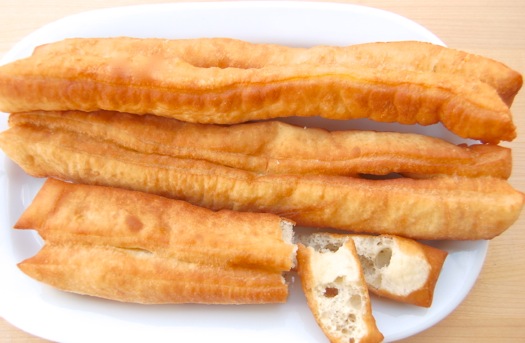
Revenge is a dish that is best served deep-fried. I’m pretty sure that’s how the Klingon proverb goes, and right it is. This is the most delicious ongoing corporal punishment I’ve ever tasted. Sampling these for the first time, Mrs. Pastry wanted to know how I got them to taste so, well…Chinese…when they’re really just simple fried strips of dough. I can’t say I know the answer, but somehow they do.

READ ON

What’s a “smoke point” and is it really important?

LOVE, that question, reader Jason. It seems like every food writer out there loves talking about “smoke points”, a.k.a. the temperature at which an oil starts to give off wisps of blue-black smoke. It’s the tell-tale sign that the fat molecules in the oil are breaking apart at an accelerated rate, which compromises both the oil’s flavor and its performance, to say nothing of its safety (since smoke is often a precursor to the oil’s surface catching fire).

READ ON