Lard

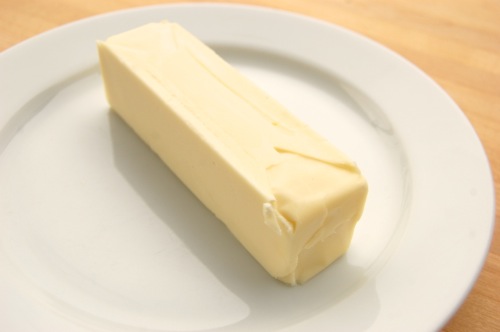
Lard is fat from a pig. However good lard is made from not just any ol’ pig fat. It comes from the region around the kidneys. This “leaf lard” as it’s called has the mildest flavor and a nice firm texture, and it’s really the only lard that’s good enough for baking applications. Generally you need to find it at butcher shops or farmers markets and must render it yourself. Fortunately that’s pretty easy to do. Good lard does introduce some piggy flavor, but it’s quite nice I think, even in sweet applications.

READ ON

Cultured Butter

Cultured butters are a lot like sweet cream butters, save for the fact that they’re made with cream that’s been allowed to ferment slightly. Lactic acid go to work on the sugars in the cream, digesting them and creating a variety of by-products including acetic acid, acetoin, ethyl formate, ethyl acetate, 2-butanone and especially diacetyl. The effect of those by-products is to heighten the flavor of the butter, in much the same way a starter heightens the flavor of bread.

READ ON

Sweet Cream Butter

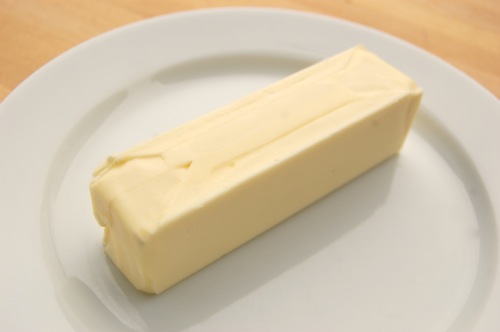
Most American butters (as well as most Canadian and British butters) are “sweet cream” butters, which means that they’re made from cream that hasn’t been allowed to sour at all. This was a big selling point in the days when dairy wagons frequently showed up late to collect cream from farms, by which point the product had fermented a bit. Butter made from soured cream was acidic and cheesy and mostly unpopular with American consumers. For that reason some dairies would “correct” the cream with an alkaline (like lye) which neutralized the acid but brought even more off flavors to the party. “Sweet cream” butter was bland, but far fresher tasting.

READ ON

On Butter

Butter is a firm fat that’s made by churning (agitating) cool cream. Cream, its unadulterated state, is an emulsion of fat within water: little butterfat globules within thin lipoprotein membranes, suspended within a watery medium. The act of churning breaks most of those membranes allowing the butterfat — a mix of different types of triglyceride molecules — to flow out.

At that point some very interesting things happen. Groups of like molecules start to collect and stack up on one another, forming crystals. The crystals collect into large masses and when the masses are pressed most of the rest of the watery medium (known as buttermilk) is expelled. The result is a reverse of the original emulsion: tiny drops of water within a medium of fat crystals, free fats and a few remaining butterfat globules.

READ ON

First, What is Fat?

In very general terms, fat is a storage system. It allows animals to lock away energy for later use, much as plants lock energy away in the form of starch. Of course plants make some fat too, though it’s usually in liquid form — oil. Animals make more fat because it’s a denser storage medium, and that’s better if you happen to have to move around (chase prey or, conversely, run away from predators). You can store 4 calories (kcals for you Europeans) in a gram of starch, bur more than twice as many (9 calories) in a gram of fat.

Chemically speaking, fats and oils are triglycerides, sub-members of the extremely broad lipid family of molecules. Triglycerides, as the name implies, are made up of a trio of fatty acids, all connected to a “backbone” of glycerol. They are all more or less “E”-shaped, though since the type and configurations of the fatty acid molecules they contain are highly variable, different triglycerides can behave in very different ways. One factor that greatly influences the behavior of a triglyceride is its degree of saturation (for a discussion of that, go here).

READ ON
Next Up: Fats

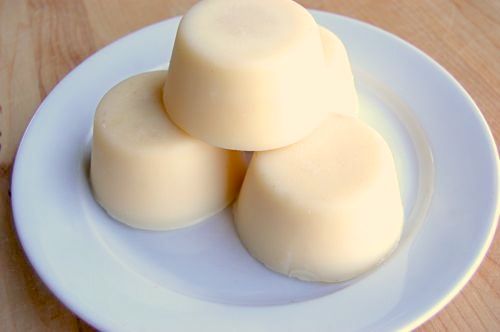
I’ve been receiving many, many requests to supplement the series I did on sugars and syrups for the Ingredient Basics section (look under Baking Basics to the left there if you’re curious) with another section on fats. Who am I to say no? I’m a pleasing type. I like people to be happy. So shall we get on with it?

READ ON

Making High Ratio Yellow Cake

Sheet cake lovers, this is your cake. It’s as close as you can get to a commercial sheet cake consistency without the high ratio flour and emulsified shortening that the pros use. It’s great for stacking and decent for carving (though if you really want to get serious about cake theatrics you’ll want to do a google search for “durable cake recipe”). But of course the main reason people like a sheet cake is for the decorating potential. Quite a canvas they present, oh yes they do.

READ ON

Making High Ratio Chocolate Cake

For those looking to imitate the sort of chocolate cake you get from a boxed mix, or you want a chocolate sheet cake like like you’d get from a larger commercial bakery, this is your ticket. This cake has the tight crumb and relative durability you want, plus it bakes up well in broad cake pans. This formula is enough for one 11″ x 14″ x 2″ sheet cake pan or three 8″ x 2″ round layer pans. It can be easily scaled up or down depending on your needs.

READ ON

Yellow vs. Chocolate Cake Formulas

Why is it so much more complicated to do a chocolate version of a standard yellow layer cake? That’s what readers Cynthia, Bertie, Doug and Seth all want to know. Why, if you’re converting a yellow cake to a chocolate cake, can’t you just swap out some cocoa powder for some of the flour and be done with it?

A chocolate cake layer certainly starts that way, Cynthia, Bertie, Doug and Seth, but cocoa powder turns out to be rather tricky stuff, chemically speaking. First, because it’s a fermented product, it’s acidic. So one must correct for that by adding an alkaline, otherwise the acidity would undermine the structure of the cake and make it softer (we especially don’t want that with the high ratio cake we have gong here, because one of the virtues of high ratio cake is it’s firmness).

READ ON

Speaking of small appliances…

I remember back when I got my first restaurant cooking job. I was sixteen and needed a second job to pay for a gold watch for my then-girlfriend’s birthday present. What was I thinking???

Anyway I remember walking into the back and looking for all the small appliances and cool gizmos that I associated with cooking. The early eighties were the heyday of Presto Hot Doggers and Ronco inside-the-egg scramblers, and I expected to see a lot of that stuff laying around in a professional kitchen.

READ ON