On Broken Batters

Reader Silviu asks: if your batter “breaks”, does it actually make any difference to the final product? That’s an excellent question, as it often happens that layer cake, muffin and tea bread batters take on a “broken” look during mixing, by which I mean a grainy appearance. That’s caused by very small droplets of fat floating around in the mixture. Though some bakers I’ve worked with insist that it’s a defect in the batter, I’ve never found a grainy texture to inhibit either rising or a good texture. To me it’s just one of those things that happens from time to time, especially in very buttery layer cake batters. I say: don’t worry about it.

READ ON
When Choux Puffs Won’t Stay Puffed

Any time there’s a choux-based pastry on the blog, there are always a lot of calls for help with collapsing puffs. There are three fixes to the problem that I can think of. First, you can pipe higher. Which is to say, try to make your dough shapes a bit more vertical to begin with. You can achieve this in part by making sure you pipe your choux from a height of about half an inch above your surface. This way you “lay down” batter instead of spreading it.

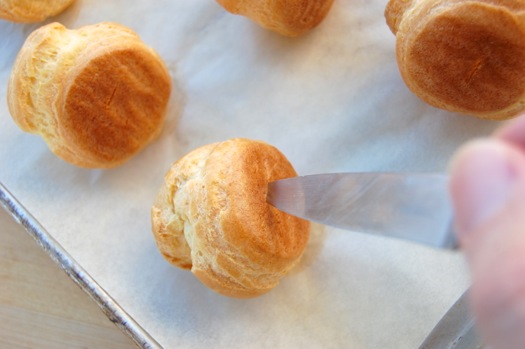
Second, bake longer. Get a good brown on your puffs. This will make the walls of the pastry more rigid and less inclined to collapse. For larger shapes it’s a good idea to “vent” them by poking a hole in the bottom with a knife. This allows steam to escape and again helps the walls to dry out and remain rigid. Once you’ve done that you can return the puffs to the oven and turn the heat down

READ ON

When Choux Puffs Won’t Puff

Reader Goody (love that name!) says she can never get choux to rise well. The puffs brown but are moist on the inside and seldom have the very large spaces she wants. Goody, I can think of a couple of things you might try. First, when you’re making your choux, be sure to cook the batter long enough before you add the eggs. It could be that you’re not getting the starch breakdown you need to form a nice, elastic batter.

Another possibility is that the batter is too wet. If you’re using extra-large eggs the batter can become so slack that it puddles on the sheet and has a hard time lifting off. So make sure, in the mixing step, that your batter is always firm enough to stand up on its own. Stop and check after the third egg is completely incorporated. Stand a blob of batter on your finger. It should have no trouble holding its shape. If you’re

READ ON

The Science of Pâte à Choux

Choux is a truly ingenious invention, though it almost certainly wasn’t “invented” in the classic sense of the word. It evolved, probably through decades, maybe even centuries, of trial and error. The secret of choux is that it’s “double cooked”, a process that imbues it with some very special properties.

If you’ve made éclair or cream puff shells before, you probably recall the process. Water and butter are combined in a sauce pan and heated to the boil, at which point enough flour is added to turn the mixture into a fairly stiff paste. That paste is then cooked over low heat until it forms a ball, which is then finished by beating in several eggs, one after the other. It’s then piped and baked (the second “cooking”). Interesting. Curious. But what does it all mean?

READ ON

A Tale of Two Revolutions

Reader Kevin writes:

Hello Mr. Pastry! In your first post about Antonin Carême you wrote that the American and French revolutions were different. I’m curious: what was the difference? Would you mind explaining that a little?

Entire books have been written on that subject, Kevin! But I’ll do my best. The most succinct summary of the difference that I’m aware of goes like this: that while both revolutions were against monarchy in favor of the rule of law and individual rights, the American Revolution was fundamentally about freedom and the French Revolution was fundamentally about justice.

READ ON

Did Carême Invent the Croquembouche?

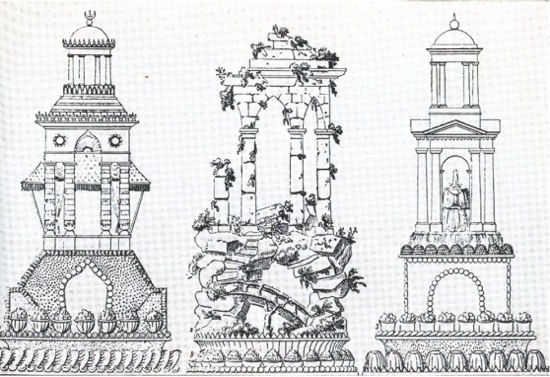
Indeed he did, reader Jesse, both the item and the name. The trouble is that no one is completely sure what Carême’s croquembouches looked and/or tasted like. Evidently he built them out of a variety of things: chestnuts, candied oranges and sweet (probably also savory) pastries, all glued together with sugar syrup cooked to the hard crack stage. As to what exactly they looked like, it’s a mystery. Many culinary historians believe he built his in the shape of a Turkish fez. Apparently there’s no evidence that he ever stacked them into cones as we do now, but it’s hard for me to believe that a creative fellow like him would have been satisfied with just one shape.

READ ON

Master of the “Mounted Piece”

The fine arts are five in number: painting, sculpture, poetry, music, and architecture — whose main branch is pastry.

God I love the arrogance of chefs. The Lighthouse at Alexandria? The Colossus of Rhodes? Child’s play compared to that centerpiece I made for the buffet the other night. I mean did you SEE that thing?? Antonin Carême was more entitled than most to that attitude. He began building pièces montées — huge table centerpieces — at the age of seventeen, and studied architecture informally on his own starting at the age of thirteen. Pretty good for an illiterate peasant who grew up in Paris amid the French Revolution. Carême’s father literally abandoned him on the street one day at the age of eleven, telling him he was too smart to live at home in poverty with his twenty four sisters and brothers. Proving his father’s point, Carême got a job that night at a tavern and shortly began teaching himself to read and write. Within a year or two he was making regular trips to the French National Library where he paged through books on travel and especially architecture. He taught himself to sketch and at the age of fifteen began working for Sylvain Bailly, the top caterer in Paris.

READ ON

“Lords, Ladies and Honored guests…

…will you now please direct your attention to the center of the gallery where we shall present tonight’s entremets for your amusement. We shall begin with an assortment of porridges flavored with pepper and cloves and colored with saffron. These are followed by three platters of duck innards boiled in ginger broth, adorned with pickled quinces in the shape of the Sardinian royal crest.

Following closely behind is a display of roasted spring hares stuffed with fried marinated sweetbreads and arranged as though they were still frolicking merrily on the sunny plains of Beauce. And what would our display be without fowl? Fix your gaze upon the center aisle where a bevy of swans now approaches

READ ON

Mold Or No Mold?

That’s the question of the week! My feeling at this stage is no mold. Or at any rate nothing made of metal, poster board or any of those sorts of substrates. The way I see it the challenges of a croquembouche are twofold: 1.) building it in such a way that it appears tall and graceful, not like a heap of paving stones, which can happen if you don’t have some sort of conical guide, and; 2. building it in such a way that it doesn’t lean, slump or tip over completely.

In an attempt to overcome challenge #1, many aspiring croquembouche makers construct witches hat-looking cones make of cardboard. They then build the pastry inside it, upside-down. When the caramel has cooled they up-end the croquembouche and remove the cardboard. The problem is that the cardboard doesn’t always come away cleanly and you’re left with unsightly bits of paper stuck

READ ON