Making Pan de Ramerino
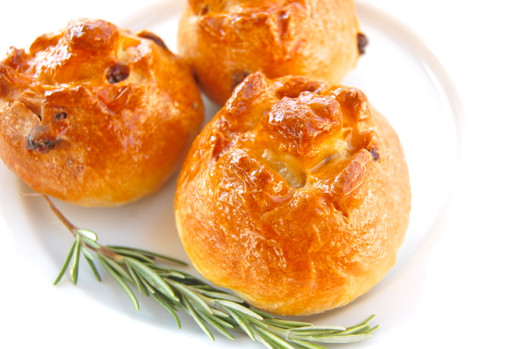
These little Tuscan breads are ingenious. Neither completely savory nor sweet they’re scattered with raisins, perfumed with rosemary and olive oil and lightly painted with an apricot glaze. They’re a variation on the hot cross bun, and as such appear around Easter in Florence. Traditionally this bread was made in loaves on Holy Thursday for the observance of the Last Supper. The loaves would be baked, taken to church for a blessing then eaten after mass. Nowadays I’m told this bread is mostly baked up in buns, and no longer just for Holy Thursday. You’ll want to eat yours all year round as well. Begin by assembling your ingredients.

READ ON
Pan de Ramerino

“Rosmarino” is how you say “rosemary” in Italian, but in the Tuscan dialect it’s “ramerino”. The formula has a few extra steps compared to a typical herbed bread as the aim is to infuse the oil with rosemary flavor instead of adding chopped herb to the dough. The results is a very light and elegant flavor. If you like a stronger rosemary flavor, add a tablespoon of finely chopped fresh rosemary leaves at the same time you add the raisins to the dough. The bread goes like this:

2 ounces (1/4 cup) olive oil
3 sprigs fresh rosemary
3.5 ounces (2/3 cup) raisins
3 1/2 teaspoons instant yeast
1 ounces (scant 2 tablespoons) sugar
17.5 oz (3 1/4 cups) bread flour
1 teaspoon salt
¾ cup water
2 eggs
egg wash
apricot glaze

READ ON

How to Make Hot Cross Buns

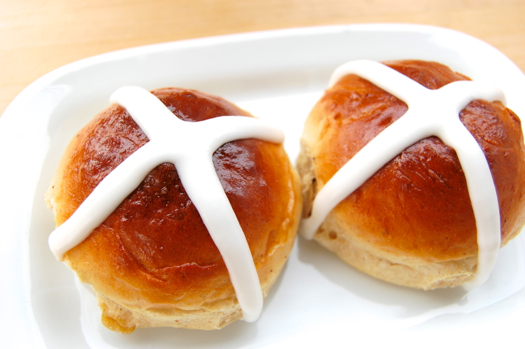
These come together so quickly and easily you’ll want to bake up a batch every Friday (or Saturday, or Sunday, or Monday…). They’re light, slightly sweet with a hint of spice and candied fruit. Delicious but not so much of a Lenten indulgence that you’ll have to go to confession afterward. Use whatever dried fruit is handy. Raisins are very common, currents are very English, citron is very hip, dried apricot is very, um…Louisville. Mix and match them to your heart’s content. Start by

READ ON

Hot, Cross II

Pagans and pagan symbolism are just the thin end of the wedge when it comes to hot cross bun buffoonery. There are all kinds of other made-up stories that have found currency over the years. Let’s see…there’s the one about the medieval monks who put crosses on their bread to ward off evil spirits. There’s the one about English housewives, so dissatisfied (i.e. “hot” and “cross”) with the output of their local bakery, they were forced to make their own rolls at home.

READ ON

Lent: Austerity vs. Indulgence

Funny thing about Lent, on the one hand it means abstinence (along with prayer and giving to charity). On the other it means it’s pig-out time, at least for some Catholics. The way I grew up in the Chicago area, Lent was always a fairly austere period, when gratuitous eating of any kind was frowned upon. But just try telling that to the more exuberant Catholics down here in Louisville. Lenten Fridays here may be meatless, but they’re host to high-spirited fish fries that would make many northern Catholics blush. Are we really supposed to be having this much fun this time of year?

READ ON

What about Vienna?

Got a few emails overnight in regard to yesterday’s post Remember Tacubaya!, among them this note from an attentive (and apparently long-time) reader Eric:

Hey Joe! Got a kick out of your Pastry war post, but I was surprised to hear you call it the world’s most famous baking-related conflict. I thought that distinction belonged to the siege of Vienna!

READ ON

Remember Tacubaya!

The month is almost over and I have yet to acknowledge The Pastry War, which ended in March of 1838. I try to mark this — the world’s most famous pastry-related conflict — every year as it’s instructive of the kind of violence that can occur when unruly pastry shop customers fail to give the artisans and staff that serve them the respect they deserve.

Fought between Mexico and (of course) France, The Pastry War was provoked when Mexican soldiers (officers mostly) ransacked the pastry shop of one Monsieur Remontel in the Tacubaya district of Mexico City in 1837. Remontel sued for damages and when he was denied satisfaction took his complaint directly to King Louis-Philippe of France. The French King demanded the sum of 600,000 pesos as compensation

READ ON

Hot, Cross

…is pretty much what I get every year when I see a food columnist parroting more of the same old hot cross bun claptrap. There are probably as many erroneous, exaggerated, or just plain made-up stories about the hot cross bun as there are about the pretzel. The most oft-cited myth goes like this: the hot cross bun is descended from pre-Christian peoples, for whom carving a cross on a round bread was a deeply mystical act connected to food and/or blood sacrifice. The symbolism, having to do with the progression of the sun

READ ON

Making Egg Wash

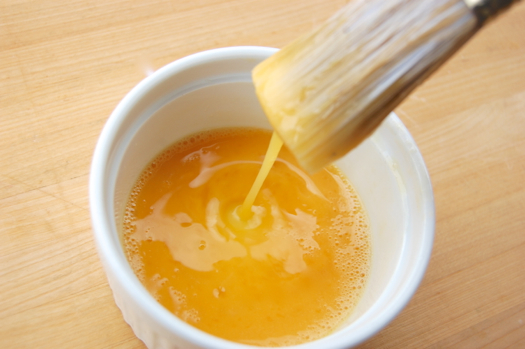
Since the simplest things can often cause great confusion it seems well worth doing a proper tutorial on the subject of egg wash. I should say straight out that while I am aware of all the possible additions to an egg wash, I’m not a big believer in the benefits of that alchemy. Unless you’re very much into the minute details of presentation — and I’m clearly not — a simple wash made of well-beaten whole egg plus a dash of salt will do you for most any job. Multi-ingredient washes made from egg, cream, water with a dash of sugar…homey don’t play dat. Here’s what I do: crack an egg.

READ ON

What about egg wash?

Reader Zane wants to know if adding salt to egg wash is anything like adding salt to whipped egg whites. Good question, Zane. It is in fact a somewhat different phenomenon. Again I think the best way to demonstrate is with a few photos. Hang tight!

READ ON