Making Lemon Meringue Pie
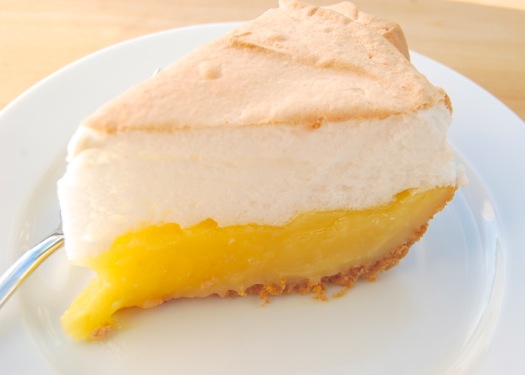
This is what you call a classic American lemon meringue pie: a light, frothy-sweet baked egg foam above, a tart and creamy curd filling below, all heaped up on a delicate crumb (or traditional) pie crust. Not much not to like here in my opinion. Indeed lemon meringue consistently ranks about fifth on the list of the America’s favorite pies. It would probably rank higher if more people made this pie at home, but its reputation for fussiness scares a lot of home bakers away.

That reputation is deserved to some extent. Under-baked meringue toppings often cause weeping, and are quite common as the very center of the pie is hard to fully heat without breaking the lemon custard (which causes another kind of weeping). Large pools of syrup are commonly found in pie plates, either upon cutting or the next day after any leftovers have had a chance to sit. The process below is designed to avoid that problem, and it works very well. However it is something of a dance, so I strongly encourage you to have all of your ingredients and component parts prepared and laid out on the counter before you begin. There’ll be much less confusion that way.

READ ON
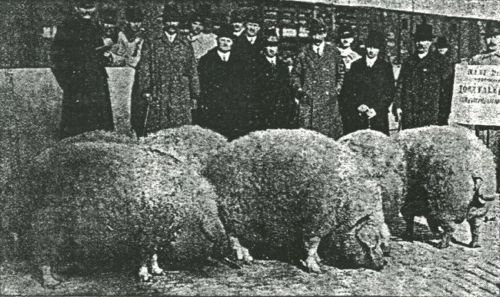
“It’s the dogs, JB.”

Whenever I engage in a discussion like this on the blog I always get a few notes — some more civil than others — saying: Open your eyes, Joe! It really is big, greedy, soulless mega-corporations that do things like take our lard away. That dark art known as marketing is to blame!

Speaking as a longtime food, ingredient and restaurant marketer all I can say is I wish it were true. I’d have a much bigger house. Sadly a food product’s success really does depend on humdrum market factors like quality, price, value, difference, shelf life and convenience. A product that doesn’t offer the right mix of those things can never succeed, no matter how much money you pump into marketing or what Madison Avenue genius is writing your headlines. Which reminds me of an age-old marketing joke that I occasionally tell. It goes something like this: JB, a big company CEO decides to launch a new miracle dog food. He calls in his marketing director.

READ ON

Lard vs. Butter

There’s good news and bad news here, though overall it seems the scales tip in lard’s direction. Calorie-wise, lard has more of them, about 15% more, which makes a lot of sense when you consider that butter is about 15% water. Compositionally, though, there are certain factors that make lard more desirable, at least based on the (ehem) current thinking of many researchers and nutritionists.

Fat, you see, is not a uniform substance. It’s made up of lipid molecules of many different configurations. As I’ve mentioned many times before, lipids are basically “E”-shaped molecules, consisting of a “backbone” of glycerol and three fatty acids. The fatty acids attached to the backbone are all different from one another, and more than that, vary from molecule to molecule. Where molecules in a fat have similar structures, they will often form solid crystals. Others won’t. It’s this mixture of solids and liquids that gives fats like butter and lard their semi-solid consistency.

READ ON

Blatant Lardism

What do so many people have against lard? Commenters have pointed out that a big reason lard fell into disrepute in the middle of the last century was because of its association with poverty. I think that’s at least partly true. If you look around at all the places where lard was popular in the early 20th century (the American south, rural Mexico, Hungary, Italy, Spain, the list goes on…), one thing that was common to them all was poverty. As I’ve written before, pigs are terrific poor peoples’ food. They’re easy to take care of, they grow quickly, breed prolifically and eat just about anything.

READ ON

Can I bake with the lard that’s in plastic tubs at the grocery store?

Price check: one tub of lard.

Reader Ronnie, there are good reasons for bakers to avoid lard in plastic tubs. For one, because it tends to be the lower grade stuff with the piggier taste. Second, a lot of store-bought lard — unless it’s a Mexican brand — is rendered at a very low temperature so it lacks the roasted flavor notes that are so important to its overall profile. Third, store bought lard is partially hydrogenated to extend its shelf life — and partial hydrogenation produces trans fats. I myself don’t think trans fats are worth worrying about. Many other people, however, do. That’s one reason for the turn back to solid animal fats over processed shortenings. Buying store lard, therefore, rather defeats the purpose.

READ ON

Why did we ever switch from lard to shortening?

Because greedy mega-corporations forced us into it! Or anyway that’s the pat answer you get in most of the pieces you read on the subject. It’s a simplistic idea that ignores the big food and technology trends that were underway at the time, as well as basic economic principles like supply and its effect on price and demand.

Flash back about 125 years in America and you’d find a nation of cooks who, just like today, wanted/needed fats for various purposes: baking, cooking, frying, spreading on toast, that sort of thing. In those days, different fats were favored in different regions of the country according to price and local availability. In the wealthier north and northeast, where dairying was common, people used a lot of butter. In southern states, which were far poorer, people used a lot of lard.

READ ON

So what’s your theory?

Reader David notes my skepticism of Nina Teicholz’s theory that vegetable oils and carbs caused a spike in heart disease in the 50’s and 60’s. He asks: do I have any theories of my own about what caused it? In fact I do, David, though be warned: I have theories about pretty much everything. My personal belief is that the increase in heart disease in the middle of the last century has comparatively little to do with the specific stuff we eat (vegetable oils, carbs, animal fats, corn, transfats, take your pick). Rather it is mostly attributable to two factors: that America got rich and that America got sedentary.

It’s well known that the big shift away from “agrarian America” that began in the 1890’s and picked up steam in the 20’s and 30’s was pretty much completed by a decade after World War II. The economy was booming and a strong middle class was forming. People were moving off the farm and into the cities where the jobs were generally higher paying and the living was generally easier. They had more money and more free time than they ever had before, and they spent a good deal of it eating and relaxing. And stressing about their office jobs, also smoking, I shouldn’t forget either of those.

READ ON