Seven Minute Frosting Recipe

They call it “seven minute” frosting because that’s how long you’re supposed to beat it with a hand mixer over boiling water. It’s amazing how right on that figure is. Seven minutes does it every time. Assemble:

10 ounces (1 1/2 cups) sugar
1/4 teaspoon cream of tartar
1/8 teaspoon salt
2.65 ounces (1/3 cup) water
2 ounces (2) egg whites
1 teaspoon vanilla extract

READ ON

Meet Mr. Mauve

His name is William Henry Perkin. I bring him up because reader Antuanete wants to know what precisely coal tar dyes are and how they’re made. I confess that the specific chemistry of synthetic dyes is mostly beyond me. What I do know is that the world’s first synthetic dye was a kitchen accident. It happened in 1856 when Perkin, then an apprentice to the legendary German chemist A.W. Hoffman, attempted to create synthetic quinine (an expensive tree bark extract that was a critical malaria medicine) over his Easter vacation. He combined aniline, a by-product of the coke-making process, with potash and sulfuric acid. The goo he made was not even a little bit like quinine, but when Perkin combined it with alcohol, a sort of purple was the result.

READ ON

The Dark Days of Color

So how did food colors come to be the most rigorously safety-tested ingredients in the world? Abuse, of course. Up to now I’ve written mostly about where safe colorings and dyes have come from. Unsafe colorings and dyes were once far more numerous, and far more widely used.

Fraud perpetrated by food makers — especially millers — goes back millennia. However it took the Industrial Revolution to really elevate the practice to an art. That was the time (the late 1700’s) when industrial workers began congregating in cities in earnest, attracted there by high-paying jobs. Removed from their farms, they were forced to hire out various aspects of their food preparation to others. These “others” ranged from bread bakers who might “step on” their flour with cheap additives like chalk dust or bone meal, to dairymen who’d frequently “correct” spoiled milk by adding lye to it.

READ ON

You Can Rely on Brown

With the controversy that sometimes surrounds food colorings, it’s easy to get lulled into the assumption that coloring food is a recent phenomenon. In fact it’s been practiced for millennia, especially among the Romans and Greeks who were renown for their manufacture of caramel color. Caramel color? Isn’t that what they put in soft drinks? Why yes it is, but as any ancient Roman will tell you, it can be used to color sauces, breads and beer too.

The process of making caramel color is fairly straightforward. All you need to make some is a little sugar and a little heat. Of course the ancients didn’t have much crystalline sugar lying around, but there was plenty of honey, which works every bit as well (actually even better). You simply heat it until the simple sugar molecules start to break apart, about 340 degrees, at which point it begins to cease being sugar and starts to become, well…nobody is quite sure what. But it looks good and it tastes good. What more do you need to know?

READ ON

Yellow Fever

Yellow No. 5 has also seen it’s share of controversy, not so much because it’s ever done anything much to anyone (most countries outside of Norway consider it safe, and “sensitivity” complaints against it are about on par with other coal tar dyes) but because it became the most widely used food coloring after Red No. 2 was de-listed due to public pressure. Once that happened, Yellow No. 5 was simply the next color on the target list. However no serious complaints — only urban legends — have ever sprung up around it.

READ ON

Color Me Blue

This color stuff is fun. So why not press on a little? I’m on the road so I can’t bake, and I have a fair amount of waiting around to do. Sounds like a recipe for jabber, no?

Blue No. 1, also known as Brilliant Blue FCF is one of the most popular colors in the world, but most people hear very little about it. Why? Because it doesn’t appear by itself very often. It’s mostly used in combination with others, especially Yellow No. 5, to make various shades of green. The reason for that, because blue is something of a turn-off when it comes to the human appetite. In fact studies have show that we’re instinctively averse to it.

READ ON

What is “Dutched” cocoa powder?

So asks reader Fleur, and it’s a great question. I’m not sure I’ve ever really blogged about “Dutching” before. The answer, Fleur, is that it’s cocoa made from cacao (fresh harvested chocolate) nibs that have been treated with an alkaline. More often than not that alkaline is good ol’ potassium carbonate, a once-common kitchen chemical known as “pearl ash” or “pearlash”…as sort of precursor to baking soda.

The process was invented, not surprisingly, by a Dutchman named Conrad van Houten in 1828 (he’s also the fellow who invented cocoa powder). At the time, van Houten was looking for a treatment that would help his new powder incorporate more readily into milk. Being fatty stuff, cocoa powder doesn’t mix with watery milk terribly well.

READ ON

Beetle Juice

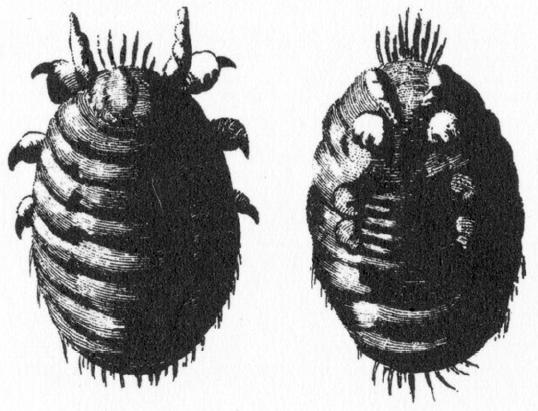
On the subject of red food coloring, for years grade school kids have been telling each other that the reddish hue in their lunch meat is made from ground beetles. As it happens, the story is true. Well, maybe not “ground beetles” exactly. “Ground beetle extract” is more like it. And it’s not just the odd lunch meat. More than a few products in present-day supermarkets owe their red, orange or pink tints to the Mexican cochineal beetle.

Cochineal is one of the oldest red pigments, used for centuries by native peoples in Central America, especially for clothing dye. The beetles were collected, boiled briefly, dried, ground and soaked to extract the color (the process is strikingly similar today). In fact cochineal dye was one of the earliest exports from the New World to the Old, as it was up to ten times more potent than dyes made from the Old World’s magic color bug, the kermes beetle (kermes having been used since ancient times to produce so-called “king’s red”). Cochineal was an important commodity up until the 1850’s when red Alizarin was isolated, causing Mexican bug futures to fall precipitously.

READ ON

Seeing Red

As I mentioned below, a lot of people get very worked up over artificial colors, especially red. There’s reason for this. The red food color many of us in America once knew, Red No. 2 (also known as Amaranth or E123), was banned in the US in 1976 after independent studies found it to be carcinogenic in large doses. It’s still used in many parts of the world, since researchers in other nations have come to the conclusion that it’s safe. This isn’t terribly surprising, since food colors are the most rigorously safety-tested food ingredients in the world, and every nation has its own set of standards.

In fact it’s interesting to note that our current replacement for Red No. 2, Red No. 40 (also know as Allura Red AC or E129) is currently banned in Denmark, Belgium, France, Germany, Switzerland, Sweden, Austria and Norway. But then most of those countries use Patent Blue V, which is banned here in the US, and in Australia and Norway. Most of them also use Yellow 7G which is banned here in the US and in Norway. We all use Yellow No. 5, except of course for Norway, where I’m beginning to think all food is served the same sickly shade of gray.

READ ON
On Color

Though bright artificial color is the key ingredient in red velvet cake, I almost hesitate to bring food colors up as a subject because I know there are more than a few folks out there who experience acute anxiety around them. This anxiety frequently arises from (mostly) outdated concerns about safety, though some people dislike […]

READ ON