Making Black and Whites
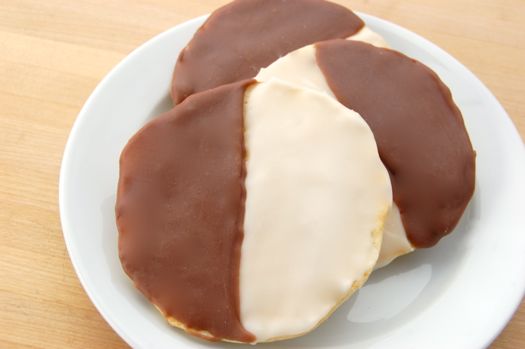
Repeat after me: black and whites are cakes, black and whites are cakes, black and whites are cakes. Got that? Whew! Now maybe the New Yorkers will get off my back and let me eat my cookies in peace!

These aren’t difficult once you have the fondant in hand, and I do recommend making actual poured fondant since the effect is much creamier than with simple sugar-and-water icing. Something about the way the smooth fondant melds together with the hint of lemon in the cake…it really makes these. Indeed the classic versions are much more interesting than the newfangled jobs made with real chocolate coatings or rich frostings. These, in my opinion, are the Cadillacs.

READ ON
Caramel: Crystal or No?

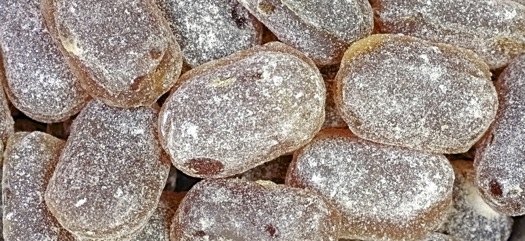
It is not, reader Bryan. Caramel has so many molecular whatsits in it that the sucrose molecules would need flashlights to find each other. First there’s all the fat from the butter or the cream. Next you have all the broken up pieces of sugars that the caramel-making process creates (the heat of caramelization literally destroys some of the sugar molecules, breaking them into pieces which recombine into all sorts of Franken-cules, most of which still have no names). Last you have some invert sugar, since the broken sugar pieces are acidic, and the slightly acid environment breaks some of the remaining sucrose into glucose and fructose.

READ ON

Syrup Good, Crystal Bad

Reader Marta asks, since I mentioned “crystalline candy” below, if there’s such a thing as “non-crystalline” candy. Indeed there is, Marta. In fact most candy is non-crystalline. “Amorphous” is another term for this sort of candy, since it lacks a crystal structure (amorphous is Greek for “without shape”). Ultra-dense syrups are what they are. Sometimes they go by the name of “non-grained” candies. The family includes virtually every hard candy you’ve ever seen: butterscotch drops, sour balls and the like, also peanut brittles and gumdrops.

READ ON

Fondant haters of the world unite!

Lots of mail overnight. I seemed to have popped the cap on a deep well of fondant hatred out there. I can sympathize with it to some extent, since fondant of the rolled type can be annoying when it’s laid on too thick. I’ll also say that commercially made fondant can taste a little…synthetic, and that’s no fun on a wedding cake. Unfortunately much of the fondant that’s used on cakes these days is pre-made, shipped to bakeries in 50-pound plastic-covered blocks that are fun to practice judo kicks on late at night in the middle of the bread shift. Not that I’ve ever done that.

READ ON

Frosting or Fondant?

I’m going with fondant because it’s traditional. Yes, I know there are a lot of bakeries our there that are updating the black and white these days, using coatings of melted chocolate, ganaches and/or thick applications of frosting. To me that’s taking a good idea too far. I’ve long maintained that good cake needs very little adornment…a thin application of a real buttercream or a delicate veneer of icing.

READ ON

Where do black and whites come from?

New York City. Exactly how and why they evolved is a mystery, though scores of bakeries around the four boroughs take credit for the innovation. There’s nothing documented that gives the honors to anyone in particular, however it is clear that they’ve been around in one form or another for at least the past hundred years.

The most popular myth about their origin holds that they were invented when a baker needed a way to use up leftover cake batter. That (possibly) solves the substrate portion of the question, but what about the fondant design on top? Nobody in New York really knows, however they do all agree it’s not a cookie, dammit. And who am I to disagree?

READ ON

Black and Whites Recipe

Black and whites are flat cakes, not cookies, though they tend to be a little firmer and less rich than actual pieces of layer cake, which would tend to fall apart during the icing step and when they’re handled generally. These should be right in the zone I’m after, but as with all early-week recipes, let me try this before you do. You’ll need:

5 ounces (1 1/4 cups) cake flour
6.25 ounces (1 1/4 cups) all-purpose flour
1/2 teaspoon baking powder
1/4 teaspoons salt
zest of half a lemon
5 ounces (10 tablespoons) butter, softened
7 ounces (1 cup) sugar
2 eggs, room temperature
2/3 cup milk, room temperature
1/2 teaspoon vanilla
Poured fondant and chocolate poured fondant for icing

READ ON

Next Up: Black and Whites

Here’s a cookie that’s not really a cookie but a flat cake, iced with vanilla fondant on one side and chocolate on the other. There are mediocre black and whites all over the place. I’ll do my best to make a good one!

READ ON