Genius of the Bird Man

Reader David wants to know when people first started thickening pastry cream with corn starch. That’s a question I can answer: 1837.

Or so. 1837 was the year that Dr. Alfred Bird invented his famous “eggless custard.” Dr. Bird is a fascinating character from history, who might have labored in obscurity as a pharmacist in Birmingham, England had it not been for his wife’s delicate digestion. It was because of that that Bird invented corn starch (or corn flour as the British say). Well, he didn’t technically invent the flour, but he was the first person to use it as a thickener for liquids.

READ ON
Where does brioche REALLY come from?

That’s a tough question, reader Janey. You’re quite correct that the word “brioche” has existed in the French language since about the year 1400. It’s a variant of the Old Norman broyer which means “to knead” or “to break up.” However just because the word has existed for that long it doesn’t mean that anything like modern brioche was around back then.

READ ON

What about Marie Antoinette?

Some say she’s the one who brought much of the viennoiserie to Paris. It’s a convenient explanation since she was Austrian and something of a culture maven (as long as it was Austrian culture). I confess that while I’m familiar with the arguments in Jim Chevallier’s book on August Zang, I’m not familiar with much documentation on Marie Antoinette’s contributions to French baking, though it’s probable there were at least some. I invite anyone who’s familiar with the subject to weigh in.

On a related note, reader Paul wants to know if there’s any truth to the notion that when Marie Antoinette said “let them eat cake” what she really said was “let them eat brioche.” In fact I’ve written on that. You can find the post right here.

READ ON

What about baguettes?

Reader Claire writes:

Hi Joe! I’ve always heard that baguettes were originally called “Vienna bread.” Does that make them part of the viennoiserie?

Nice question, Claire. It would make a certain amount of sense. After all baguettes are the definitive light and fluffy bread, and more than that they absolutely require a steam oven. However they are not technically part of the viennoiserie. It’s true that once upon a time most oblong, fluffy white loaves were known as “Vienna bread.” However in some places — like Denmark — “Vienna bread” refers to laminated dough. It just goes to show the amazing reach and influence of the Viennese baking tradition.

READ ON

When did “the viennoiserie” arrive in Paris?

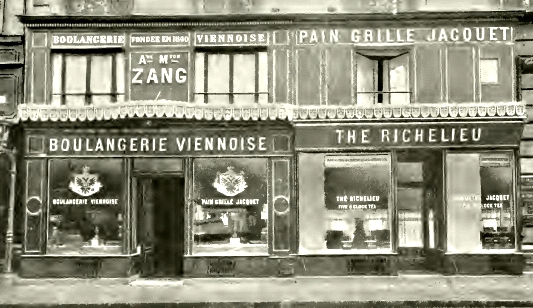
In fact much of it can be dated precisely: 1839 (or possibly ’38). That was the year that a rather odd and ambitious fellow by the name of August Zang opened the Boulangerie Viennoise in Paris. A former artillery officer in the Austrian army, Zang sought to spread the glories of Austrian baking among the philistines to the West. Though his business at 92 rue Richelieu started off rather slowly, it wasn’t long before his breads — and especially his crispy laminated crescent rolls which were known in Austria as “kipfels” — caught on in Paris and spread like ze proverbial wildfire.

READ ON

What about the viennoiserie?

Who bakes that? The boulanger or the pâtissier? An excellent question, reader Tom! The viennoiserie, loosely translated as the “stuff from Vienna”, is the portion of the French baking canon that hails from the former Austrian empire. Most people are quite surprised to discover all that’s in it, the stereotypically French items that it turns out aren’t really French at all: croissants, brioche, pain au chocolat, the list goes on.

The products of the viennoiserie all share certain characteristics. First they’re all made, at least classically, from fine white wheat flour. Second, packaged yeast cultures are critical ingredients (“brewer’s” yeast back in the day, granulated yeast products today). These concentrated yeast populations — which you could never achieve via natural “starter” cultures — create a quick rise and by extension the fluffy, light and/or crispy textures that are synonymous with “Vienna” breads. Lastly they are rich. The Viennese have never been content to leave bread alone. They add milk. They add eggs. They add butter. And the results speak for themselves: wow.

READ ON

Go Cards!

It’s a happy but bleary day here in Louisville as a result of the Cardinals clinching the NCAA basketball championship last night. But it ain’t over yet! Amazingly, U of L’s women’s team is also in the NCAA finals and that game is tonight. Talk about a rare treat – two nights and two national […]

READ ON

Team Effort of the Warring Tribes

Where does brioche Polonaise come from? Not Poland, at least I haven’t found any reference to Poland in my research so far. Brioche Polonaise is a Parisian sweetmeat, perhaps a take on a Polish-style cake, probably invented in the mid-to-late 1800’s, about the time that the fluted brioche mold became popular. Today it’s something of a staple of the Parisian pâtissier’s repertoire, though it’s little known in the States.

What makes brioche Polonaise so remarkable is not its name or its origin, but the fact that it’s a product of both the boulangerie (bakery) and the pâtisserie (pastry shop).

READ ON

“Chocolate Smack” Motherlode Hits the Streets

German police reported today that a truck containing five metric tons of Nutella has been stolen from a parking lot in the town of Bad Hersfeld in the central part of the country. The load is reportedly worth some $21,000 U.S., but that of course is its bulk value. Once the addictive cargo is portioned out for sale in hits of a few grams each, its street value will be inestimably higher. No doubt pale, trembling junkies in slums all over Europe are already lining up for their chance at a cheap, quick ride on the cocoa-hazelnut horse.

We here at joepastry.com believe in pragmatic solutions to these sorts of broad-based societal ills. Which is why this morning we’re pleading with any chocolate paste users out there who might be listening to please, put your own safety first. If you must indulge your addiction, do it out of the presscake dens and off the street corners. With a little equipment and some know-how you can learn to make your own at home. Yes, mainlining homemade Nutella may be sad and ugly, but at least it’s safe, and hopefully a first step toward getting the help you need.

READ ON

Next Up: Brioche Polonaise

Every time I start to get simple I feel the urge to go get all fancy again. Since I’ve gotten about as simple as a baker can get over the last week (at least where ingredients were concerned, flatbread techniques turned out to be surprisingly involved) I figure it’s time to rebound with something rather […]

READ ON