I’m sorry…what?

Youtiao. Beijing breadsticks. Chinese churros. Strips of deep fried dough that resemble what we call “crullers” or “long johns” here in the States. Only in China they’re not sugared (though sometimes salted) and are a lot bigger, up to about two feet long. I’d like to try and make some that are that long, but don’t think I have a frying vessel that big anymore…I’ll have to look around.

READ ON

Next Up: Youtiao

Reader Bronwyn requested these a couple of weeks ago, but I had French pastry on the brain at the time. So at the risk of creating jet lag amongst all you good readers — Paris to China with a brief layover in ancient Mesoamerica — let’s make some oil sticks.

READ ON

When Baking Recipes Don’t Scale

So then, if baking recipes scale about 99% of the time, in what instances don’t they scale? Oh sure, put me on the spot readers Robin, Carl, Heather, Sandi and Monica. But that’s a really good question. Most incidences of non-scaling have to do with chemical leaveners — especially baking soda, for the simple reason that once you get soda wet in the presence of an acid, the leavening reaction tends to happen quickly. So quickly that it can peter out before you get you’re panned…whatevers…into the oven.

READ ON

Making Savarins

On the surface of it a savarin is a rather restrained affair. A non-threatening fruit dessert that might be served after a decadent ladies’ lunch. A pastry that a fitness buff can take from a buffet table and still hold his head up high.

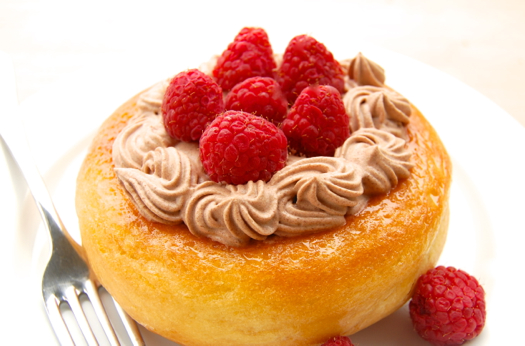
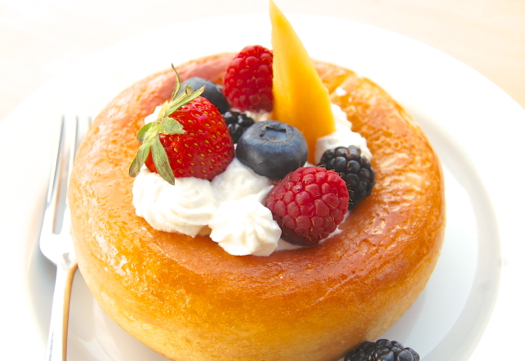
Let me tell you, that dude will be on the rowing machine all afternoon working one of these off. Because under the hood a savarin is an indulgence machine: a buttery brioche loop soaked in aromatic syrup and filled with Chantilly cream. The fruit? It’s sort of like the glow-in-the-dark lure of an anglerfish, enticing the dieter to his doom.

READ ON

The Mystery of the Crowning Cake

Reader Melissa writes:

I have an issue and I know if no one else can, you can tell me why I am having it. Everytime I bake a cake, the middle cones up and it splits. I checked through your tutorial but didn’t find an article on it. So I decided to write.

Thanks for writing in with this, Melissa, since it’s an extremely common problem. There are two main causes for bulge-in-the-middle cake layers. The first is over-mixing. Too much agitation creates a lot of activated gluten. Think of gluten as a stretchy network of rubber band-like molecules that’s trying to pull the cake together into a ball as it heats. It’s a very common cause of crowning — especially in muffins, the tops of which are often cone-shaped (a sure sign of a pasty, chewy product).

READ ON

Scaling Baking Recipes

I get quite a few question about the recipes here on the blog. Does this or that recipe scale? This is one of the great advantages of being a baker as opposed to a cook: our formulas can be scaled up or down pretty much infinitely. A baguette recipe that works for 3 loaves will work just as well for 300. Cakes, cookies, frostings, icings, they pretty much all work that way. Yes there’s the odd, oh, pancake recipe that doesn’t scale well, but 99% of the time you can scale the proportions you find in baking books forever with no problems.

READ ON

Snacking in Zapatista Country

If you’re wondering where I disappeared to on Friday, it was into my own private world of worry. Mrs. Pastry was in Mexico for the week, WAY down south in Chiapas, in the picturesque mountain town of San Cristóbal de las Casas. It’s a lovely and quiet spot, if a little too close to the Lacandon Jungle and the EZLN for my comfort.

READ ON

On The Physiology of Taste & Other Amusements, etc.

Reader Allen wants to know if Brillat-Savarin’s The Physiology of Taste was more a book about science and physiology or more about philosophy and other intangibles/ineffables. The answer is yes. You really have to read the book to get a feel for it, Allen, or at least a few parts of it. To me it’s really about fun.

When you set out to tackle Physiology it’s important to remember that it is very much a product of its time: the mid-Enlightenment. This was a period when most learned people took a keen interest in science and the physical world, but practiced science rather informally. Yes the scientific method was around, but techniques for conducting experiments were still evolving, so more than a few of the “science” books written around the time were simple collections of observations, anecdotes and speculations.

READ ON