Angel Food Cake Recipe

When my grandfather realized, just a few weeks after his wedding, that his new bride didn’t know how to cook, he sent her to cooking school (my grandmother had been too busy studying law). That school was the Antoinette Pope School in Chicago, where my bookish grandmother learned the base skills that would one day turn her into a kitchen maestro. This cake is a slight variation on the recipe she learned then, and made probably hundreds of times thereafter:

4.5 ounces (1 cup) cake flour
1/2 teaspoon salt
1 3/4 cups (12 large) egg whites, at room temperature
1 1/2 teaspoons cream of tartar
10.5 ounces (1 1/2 cups) sugar
1 teaspoon vanilla extract
1 teaspoon extract of your choice: lemon, almond, orange, etc.. or citrus zest (2 tsp.)
READ ON

Next Up: Angel Food Cake

I know the site is getting big and popular when readers start heckling me over staple recipes I have yet to do. Just this week reader Linda complained that I’ve never done angel food cake, and reader Susan needled me over not having any chocolate sauce on the blog. So OK already, let’s do them […]

READ ON

Making Youtiao

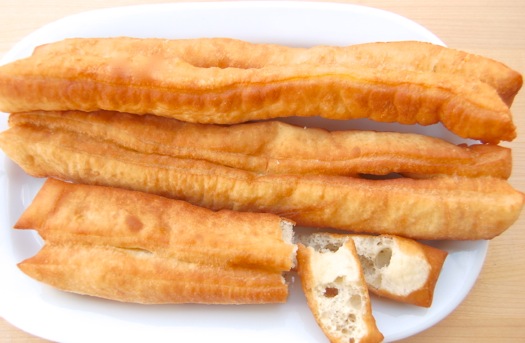
Revenge is a dish that is best served deep-fried. I’m pretty sure that’s how the Klingon proverb goes, and right it is. This is the most delicious ongoing corporal punishment I’ve ever tasted. Sampling these for the first time, Mrs. Pastry wanted to know how I got them to taste so, well…Chinese…when they’re really just simple fried strips of dough. I can’t say I know the answer, but somehow they do.

READ ON

What’s a “smoke point” and is it really important?

LOVE, that question, reader Jason. It seems like every food writer out there loves talking about “smoke points”, a.k.a. the temperature at which an oil starts to give off wisps of blue-black smoke. It’s the tell-tale sign that the fat molecules in the oil are breaking apart at an accelerated rate, which compromises both the oil’s flavor and its performance, to say nothing of its safety (since smoke is often a precursor to the oil’s surface catching fire).

READ ON

Look how big cheese has gotten.

Some of you out there may have noticed that Michael Pollan — a.k.a. The Big (organic, local, free range, artisan) Cheese — is back with a new book, Cooked, which I plan to review very soon, probably next week. The de rigeur buzz-builder feature story in the New York Times came out today in the food section, however since MP doesn’t seem to be making any major political statements this time out, the piece was light and lifestyle-ish, following him on a trip to the grocery store then home for lunch. It contains nothing new for those already familiar with Mr. Pollan’s work. I found this interesting, however:

READ ON

What about cream of tartar?

Reader Adrian wants to know why people in China use alum instead of potassium bitartrate, a.k.a. cream of tartar, to create leavening reactions. The answer I expect has to do with availability. Potassium bitartrate, a salt of tartaric acid, is a by-product of the winemaking process. It collects on the insides of casks as wine ferments. It’s also commonly found on the underside of wine corks where the crystals are frequently mistaken for bits of broken glass (for that reason it’s the bane of winemakers, since a large portion of those bottles get returned).

READ ON

Youtiao Recipe

This another instance where yeast is supplemented with chemical leavening for a little extra…oomph. Interestingly it’s in Chinese formulas that I see this the most. Typically youtiao recipes call for baking soda, but I’m going to use baking powder because a.) I don’t have an acid reactant in this dough — oddly, many recipes don’t — and b.) I don’t want to lose my chemical pop before I get them all fried, and wet baking soda reacts faster than wet baking powder.

8.5 ounces ( 1 2/3 cups) bread flour
8.5 ounces (1 2/3 cups) all-purpose flour
1 teaspoon instant yeast
1 teaspoon baking powder
1 teaspoon salt
2 tablespoons sugar
12 ounces (1 1/2 cups) cup warm water
peanut, canola or vegetable oil for deep-frying

READ ON

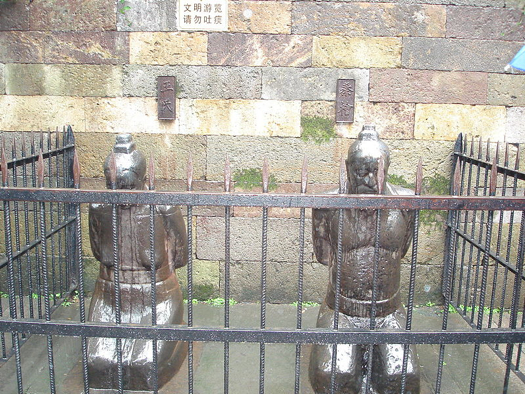
Qin Hui, Lady Wang and the Murder of Yue Fei

Chinese history, being long and populated by thousands of characters, gets very confusing very quickly. Still some stories from Chinese history do manage to stand out brightly in modern Chinese culture. One of them has to do with an evil minister, his evil wife and the murder of one of China’s greatest heroes. Sounds not unlike the story of MacBeth, no? The great stories are like that…they have resonance across cultures. But before I go all Joseph Campbell on you, let’s get to the story. Since it’s China, we need to back up a little since there’s always, always a backstory in Chinese history…even to the backstory.

READ ON

On “Chopstick Cakes”

I mentioned that is what youtiao are called in Australia. That name isn’t exactly traditional, though it does speak to an important feature of youtiao. Specifically that they are made in long, skinny pairs. They’re fried up and served that way, and before commencing the meal you usually pull them apart, just like a pair of chopsticks. So the metaphor works.

The obvious question here is: why are youtiao made this way? There is no definitive answer to that question. However there is a non-definitive answer, one rooted in a story from Chinese history and folklore, whereby an unscrupulous minister and his wife plotted the murder of one of China’s most famous patriots. We’ll get into that story next.

READ ON

Want a career as a pizza maker?

Move to Italy. Evidently there’s a big demand for pizza makers, but very few Italians willing to take the jobs. So most Italian pizza is made by Egyptians these days. Weird. But then I guess it’s no weirder than the U.S. where Mexicans, Guatemalans and Costa Ricans make pretty much all our “ethnic” cuisine, from French, Italian and Greek to Chinese and Thai. If we can sub out the work, why can’t they?

READ ON