What’s the Difference Between Wax Paper and Parchment?
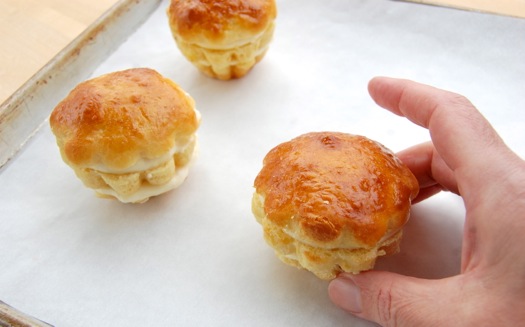
Oh there’s quite a lot of difference, reader Melanie. Wax paper is basically tissue paper with a wax coating applied to the outside. It’s nowhere near as tough and useful as parchment. Parchment is a thick (or at any rate thick-er) paper that’s been passed through an acid bath to increase its rigidity and give it a hard, smooth, glossy surface that resists just about everything. Most of the time parchment is also coated with silicone to give it extra stick-resistance.

READ ON

About Yesterday….

I used up my blogging time with my youngest, little six-year-old Joan Pastry, who opened up her eyebrow playing at summer camp yesterday. The urgent care clinic got her (literally) glued back together…amazing what we can do nowadays, no? Anyway, trying to get back on track today. Thanks for your patience!

READ ON

Where Does Pavlova Come From?

Can we just say “from the English-speaking peoples living south of the equator” and leave it at that? Because lordy, this has been a point of contention between the Aussies and the Kiwis for about 40 years now. I hesitate to dip my toe into these shark infested waters, but what the hey. My tea is strong and my resolve is up. I’m game.

What no one disputes is that pavlova is a sweet named for a ballerina, one Anna Pavlova, a principal dancer in the Imperial Russian Ballet in the last years of the 19th century. In 1905 she left the Imperial Ballet and formed her own company, with whom she toured the world until her death of pneumonia in 1931. During the twenties she toured Australia and New Zealand at least twice. Her skilled and sensational performances engendered honorifics of all kinds, many of them edible.

READ ON

Pavlova Recipe

Pavlova is little-known here in the States, but it’s the apple pie of Australia and New Zealand. Here’s my version which hews pretty close to the standard (there’s not much room to move where meringue is concerned). Toppings can be all over the board, though fruit is traditional. You’ll need:

8 egg whites, room temperature
pinch salt
2 teaspoons white wine vinegar
1 teaspoon vanilla extract
14 ounces (2 cups) sugar
1 ounce (3 tablespoons) cornstarch
one double recipe Chantilly cream

READ ON

Quick Side Trip to Boston

Reader Paul writes:

OK so here I am with three pastry school interns making Boston Cream Pies. One of them asks, “If this is a two-layer sponge cake filled with pastry cream and topped with a chocolate glaze, why is it called a pie?” My answer: “Durned if I know, but I’ll ask Joe”. So I’m asking.

Hey Paul! That’s a funny question. All I can say is that it’s one of those conundrums that probably has no real answer. There’s no question that in reality Boston cream pie is a cake, a pudding cake to be precise: two layers of sponge enclosing a whipped cream center. Legend has it that Boston cream pie was “invented” by a French pastry chef named Sanzian, an employee of Boston’s famous Parker House Hotel, in 1855. As the story goes he was looking for a way to dress up a business-as-usual English-style cream cake, a confection that had been around in America for about 100 years by that time. His solution was a chocolate glaze, something that would have been trendy then, since melt-able bar chocolate was relatively new. He dubbed it “Boston cream pie.”

READ ON

Forgot to mention…

…the encased meats, which were also a key feature of the vacation. Get up there among all those North Europe-descended yoopers and Wisconsinites and no matter where you go the sausages are outstanding. I forgot how good kielbasa and eggs was for breakfast, or how almost poetic Braunschweiger can be when it’s lovingly smoked. Wow. Even the hot dogs were buttery and delivered in links. That, my friends is good eating.

READ ON

Cro-Nutty

Holy moly. I take a week off to fish and pastry mania erupts. One day I’m on a walleye junket, the next I discover that a lust for deep fried croissant dough has encircled the globe. Cronuts are what they are. And if you haven’t heard of them, well, you must be living on a bass boat on Lake Escanaba.

Honestly I probably wouldn’t have heard much about them had I not received a score of emails this past week from readers wanting to attempt them. It seems that their inventor, one Dominique Ansel in Lower Manhattan, has stated that while they are made from croissant dough, the dough isn’t made with butter, since butter’s low melt point causes the layers to slide apart during frying.

READ ON

Early Summer Hiatus

It’s time for a little time off, ladies and gents. The pastry clan is taking vacation early this year, and none too soon. Between you and me, I’ve been working too hard at my day job. My tiny brain is as singed and crispy ’round the edges as that macaroon two posts down. So we’re […]

READ ON