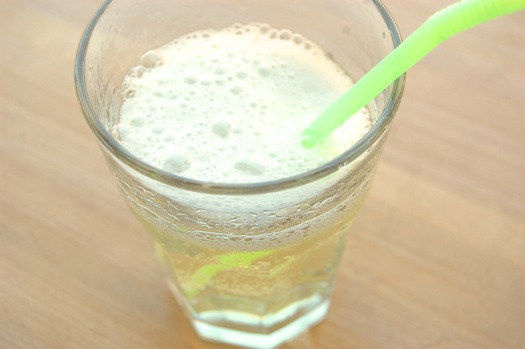
Regarding Un-Thickening

Several readers have written in with questions about starch thickeners: wheat flour or cornstarch (corn flour) in particular. Several have told stories about failed puddings which thickened at first but later thinned out after several minutes of simmering. They key thing to remember when it comes to starch-thickened mixtures is that they’re a as thick as they’re going to get as soon as they come to the boil. Starch-thickened puddings, creams or sauces can handle maybe 2-3 minutes of boiling, but that’s all. Beyond that they start to become thinner rather than thicker.

READ ON
Making Chocolate Pudding

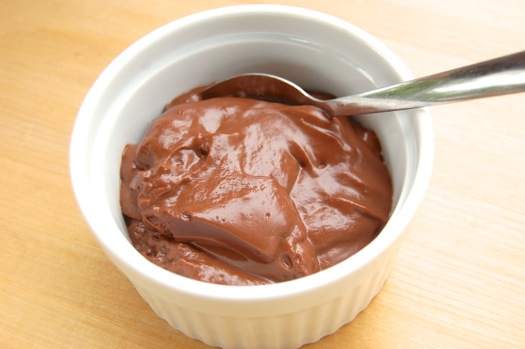
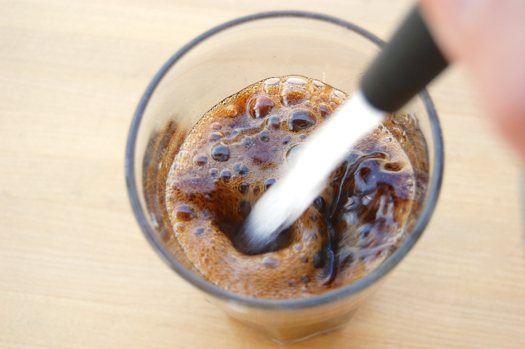
If I were to give this a name, I’d call it serious, I-ain’t-playin’-no-games chocolate pudding. Unlike conventional American-style chocolate puddings it has bar chocolate mixed into it, which gives it extra body and deeper chocolate flavor. It’s not chocolate-mousse-thick, it’s much lighter than chocolate mousse, but you know when you take your first spoonful: there’s real chocolate in there. Start by assembling your ingredients. Combine the dry ingredients in a small saucepan.

READ ON

Chocolate Pudding Recipe

This pudding has extra chocolate as requested (repeatedly) by reader Glenn. It’s no more difficult to make than the vanilla version, and yields a silky and delicious product that you’ll end up hiding from your kids. You’ll need:

1.75 ounces (1/4 cup) sugar
1.25 ounces (2 tablespoons, 2 teaspoons) cornstarch
1/2 ounce (2 tablespoons, 1 teaspoon) cocoa powder
1/4 teaspoon salt
16 ounces (2 cups) whole milk
2 egg yolks
3 ounces semi-sweet chocolate, chopped fine
1 tablespoon unsalted butter
1 teaspoon vanilla extract

READ ON

Quick Pre-4th Project

You haven’t been able to hear it because you’re miles away from Joe Pastry World Headquarters, but for several months now there’s been a constant, dull roar here. For a while I thought it was the Louisville airport, which is only about five miles away. Eventually I realized that the sound was a continuous, urgent […]

READ ON

Making Your Own Mineral Water

Reader Lee writes:

Hi Joe. I’m not sure if you’re done with this terrific bubbly side-trip, but if you aren’t, can you think of any way to make something that tastes like San Pellegrino at home? I spend a fortune on the stuff, and then there is the whole issue of shipping heavy boxes of water all the way from Italy, which is a bit problematic, carbon-footprint-wise. I know a bunch of hip urban restaurants have started to make their own — artisanal water!! — but I have no idea how.

READ ON

What is Malt?

I didn’t make any malts this past week, but even so reader Loni wants to know what “malt” is and why we eat it. It’s a great question since not only is malt rather unusual as ingredients go, it occurs in several forms in the baker’s kitchen.

I should start by observing that malt isn’t so much a thing as it is a process. “Malting” is a word that means the same thing as “sprouting”, or perhaps more precisely, “germinating”. It happens when a seed, notably a grain like barley, is exposed to water and a temperature of around 65 degrees Fahrenheit. The seed, which is composed of an embryo (the germ) and a food supply (the endosperm) breaks open so the embryo can grow. The embryo sends out a shoot and enzymes in the endosperm switch on and begin slicing the long-chain starch molecules stored there into simple sugars. Why?

READ ON

The Flavored Coke

I wanted to finish with my favorite soda fountain drink, which is also one of the simplest: the flavored Coke. My dad first introduced me to these at a historic diner in West Lafayette, Indiana, a place known as the Triple XXX, and no, not for pornography. He ordered me a simple vanilla Coke and to this day I don’t think I’ve tasted a better soft drink. Made from genuine Coca Cola syrup with a shot of thick vanilla syrup added, it was served cold with no ice (as soft drinks usually were back in the heyday of soda fountains) and I savored every last drop.

READ ON

What are YOU laughing at?

When buying replacement cartridges for your seltzer bottle or siphon, be aware that there are two different types of identically-sized gas cartridges that you can buy at gourmet or party supply shops. One is specifically made for seltzer bottles and contains CO2. The other is made for cream whippers and contains N2O, a.k.a. dinitrogen oxide, a.k.a. nitrous oxide a.k.a. laughing gas. Chuckle, nitro, buzz bomb, whippet, giggle gas, whoopee whiff…you get the idea. Teenagers have been inventing ways to open and inhale the contents of these little bottles for decades, though lately the owners of gourmet shops have gotten wise to the fact that the kids buying them aren’t pigging out on banana splits in the backs of those custom vans. Nope, even ice cream doesn’t bring THAT kind of smile to your face. But I digress…

READ ON

The Lime Rickey

The lime rickey is a sleeper soda fountain delicacy that I love. Not terribly sweet, not too citrusy, but with a sophisticated twang that comes from the addition of cocktail bitters. It’s a snap to make if you happen to have a little simple syrup lying around. Add to a glass about an ounce of lime juice…

READ ON

I’m not a jerk, I’m a fountaineer!

Despite the obvious prestige inherent in the job title, the fact of the matter is that not everyone who ran a soda foutain liked being called a “jerk”. The name came into vogue way back in the late 1800?s, a reference to the motion required to operate old-style pump-action water and syrup dispensers. But by the 1930?s the shine was definitely off the name for most of the young men who practiced the art. So much so that in 1938 a group of University of Michigan jerks, fed up with the ridicule they were routinely subjected to, attempted to form a new national society called the “Fountaineers of America”. How successul were they? You already know the answer. My guess is that the new name earned them more abuse than ever from their frat boy patrons. I mean how temping would it have been to pants, wedgy or noogie a guy who called himself a “fountaineer”? I mean good lord…

READ ON