Yeast: An Instant History

Yeast as an ingredient has been historically very closely tied to beer making. The first leavened breads were made from porridges that were left sitting out too long and eventually fermented (the first bread starters), but bakers soon came to understand that quicker, stronger, more aggressive rises could be achieved when the scum left over from beer making (what we now understand to be a thriving yeast culture) was added to dough.

Beer has been around for at least ten thousand years…about as long as bread, unsurprisingly. We know the ancient Egyptians brewed beer, though even earlier records of beer making come from the mountainous region of western Iran. So from the very earliest days of agriculture in the West, beer, and by extension bread, was hot stuff all around the Mediterranean, across the Middle East and up into the Eurasian steppes. From there it spread into the backward and barbarous lands of Europe and the British Isles. Out-of-control football hooliganism followed soon after.

READ ON
Sweaty Undershirts + Hay = Mice

Watching a bread dough grow is a wonder. Or at least it is to me, a dedicated baker and consummate geek. I never fail to be startled when I peer into a cloth-covered bowl and find a completely inflated sponge, bubbly and rarin’ to go. Just two hours prior it was a lifeless paste of water and flour. What could be cooler?

Moments like this make one understand how the ancients (and a few not-so-ancients) came to believe that leavening was a miracle. Certainly no one had any concept of the tiny creatures we call microbes until the age of Pasteur. Europeans in the Middle Ages simply called fementation “goddisgoode”. Whenever I think of that I imagine two Medieval dirt farmers staring drunkenly into mugs of beer a the local mead hall. One says to the other: I wonder how this happens? The other shrugs and says: Hey, God is good!

READ ON

Fresh Compressed Yeast

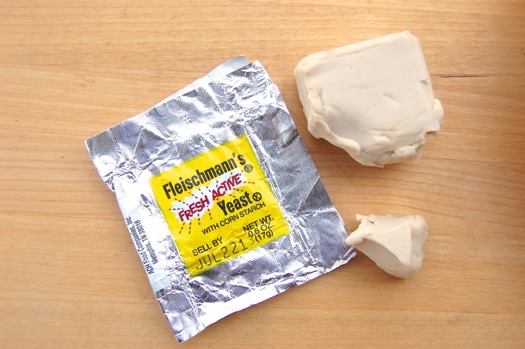
Also called “cake” yeast, this form of yeast is a living culture, taken straight from the fermentation vat — actually spun out via a centrifuge. Water is removed, then the live yeast is mixed with a little cottonseed oil, a few emulsifiers, then pressed to shape. It’s available in most larger supermarkets and is usually found on an upper shelf near the cream cheese (in the States).

The nice thing about fresh yeast is that it’s active when you buy it. It doesn’t need to “wake up” in order to be used, and a lot of people find that reassuring. Add it to a dough and you get a very fast and lively rise with it.

READ ON

Yeast Likes and Dislikes

Being a living thing, yeast has needs if it’s going to survive in the kitchen or anywhere else. Obviously it needs food (simple sugars) and water. Beyond that it has temperature requirements. It grows and produces CO2 most prodigiously at about 92 degrees Fahrenheit. It slows to the point of dormancy at 40 degrees and goes completely dormant below the freezing point of water. If it’s frozen for long, some of its population dies, about 10% per month. Similarly, yeast activity starts to slow down when the temperature gets over about 100 degrees Fahrenheit and stops completely at 135 degrees, at which point it dies.

READ ON

Who Needs Yeast?

Reader Jen writes:

For reasons that have nothing to do with baking, I recently stumbled on the 19th/early 20th-century technology called “aerated bread,” which used carbon dioxide instead of yeast for industrial baking – as I understand it, was intended to preserve the comparatively low quantity of protein in British-grown wheat, while still achieving something fluffy and bread-like. Have you ever heard of this? Do you know anything about what it was like?

I certainly have heard of it, Jen! In fact a short history of the “ABC” (Aerated Bread Company) of Britain would have made a good post last week when I was talking about carbonation, since that’s what ABC bread was really all about. The company was founded in 1862 by a fellow named John Dauglish, who envisioned a bright, shining future where bread yeast was a thing of the past.

READ ON

Let’s Talk Yeast

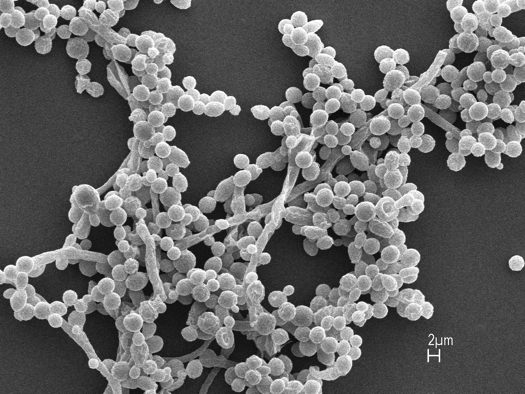
Since it always helps to start at the beginning, let’s first define what yeast is in the world of baking. It’s a fungi. The strain — out of some 1500 known species of the microbe — that’s best suited to baking breads and pastries. You’ve heard the Latin name before I’m sure: Saccharomyces cerevisiae, essentially “the brewer’s sugar fungus”.

Baker’s yeasts are very, very simple organisms, single-celled little bugs that have but three jobs: to eat, to excrete and to reproduce. As they carry on in this way they’re highly effective at turning simple flour pastes into doughs full of little holes that bake up all light and fluffy-like.

READ ON

Crotins au Chocolat

No, not crottins with two t’s, those are, er…something else. A recipe that’s very similar to this one appears in Nancy Silverton’s excellent Pastries from the La Brea Bakery. I changed it slightly to accommodate instant yeast. Her crotins are a chocolate body blow…for certifiable chocolate fiends only. They’re not terribly sweet, and that heightens the impression that you’re eating almost pure chocolate, just in muffin form. You’ll need:

READ ON

What the heck is a “crotin”?

Good question. It’s not really anything, it’s a word Nancy Silverton probably made up to describe this particular bit of bakery. However it resembles the French “crottin” as in crottin de Chavignol, probably the world’s most famous goat cheese. As for where that word came from, there’s some dispute over it. Some say that it comes from an Old French word crot, which means a short, round oil-burning lamp made from clay. That’s the uptown explanation. The downtown version posits that the word means “manure”, “dung” or “dropping”, specifically from a heard animal. Crotte is

READ ON

A Starch is a Starch

Actually it isn’t, but I liked the sound of that for the headline. Reader Mark asks:

In my local Asian food market I can find a few different starches (Corn, Potato, Tapioca) pretty easy, and it would seem to some extent starch is starch, but that also seems a bit naïve on my part to think of them all as inter-changeable. Are there texture, flavor, or other reasons why I’d want to use a corn vs. any other starch in pudding?

Hey Mark! A very interesting question. There are quite a lot of starches that can be used as thickeners and all of them are a little different from one another. Cornstarch (corn flour) is a common one for pudding because it’s so readily available and can handle some boiling before the “gel” starts to dissolve. Cornstarch-thickened mixtures also hold their thickness after being frozen, though acid can inhibit it’s ability to thicken.

READ ON

Next Up: Crotins au Chocolat

Generally speaking I try to avoid recipes that aren’t classics since, well, there’s no end of classics to do. However these seem appropriate given the requests I had last week. First there was reader Ted who asked me to write a bit more in depth on the subject of yeast. Then there was reader Aliyah […]

READ ON