Cannelé Recipe #1

So here’s what I did in this attempt if you’re curious. The original recipe I received is below (scroll down). In the interest of eliminating bubbles I removed the white and substituted 2 yolks, then baked low for the first 45 minutes in an attempt to get the structure to set before it was all blown out by expanding steam.

16 ounces (2 cups) whole milk
1 ounce (2 tablespoons) butter
5 egg yolks
8.75 ounces (1 1/4 cups) sugar
4.5 ounces (1 cup) cake flour
1 teaspoons vanilla extract
1 tablespoon rum
READ ON

The Thinking So Far

So OK, I’ve been mulling these over for a couple of days and I have my action plan together. It goes like this: first, I’m going to lower the heat. Reader Jim H’s provocative comment from late last week got me thinking. Why bother with a very hot oven at all…at least to start? Why not start low and let the eggs set — and allow the steam to steadily escape — instead of the rocket-hot traditional way that causes any bubbles in the batter to expand explosively?

READ ON

What’s the big deal with bubbles?

And why are they such a problem with cannelés? So asks reader Ronnie, and it’s a question well worth answering. After all, almost all cakes — both large and small — are filled with bubbles. They don’t explode, why do cannelés? Well Ronnie, the problem is the shape of the molds. They’re tall and narrow rather than broad and flat, the shape of most cake and cookie molds. And that’s a problem when it comes to expanding gas and steam. Normally the expanding gasses in, say, a financier can escape out the top and to a lesser extend the sides, which together make up a considerable surface area.

READ ON

Processing…processing…

My plan was to have at least a few examples of cannelés up today, but I changed my mind on the process so many times over the weekend I never got around to any actual baking. And today rain poured down all day, meaning there was precious little of the natural light I rely on […]

READ ON

I have seen the future of angel food cake…

…and it’s a loaf. Or so says reader Chana. She writes:

A while ago you did a series of posts on angel food cake. I’ve made it several times, it’s a particularly good recipe. (I usually make a half-recipe, since I have an angel food pan that is half the size of the regular pan.) Anyway, one of your readers had mentioned making angel food cake in a loaf pan. I really liked this idea. The tube pan is so cumbersome, impossible to slice nicely, etc. I never would have thought of using a loaf pan for angel food cake. (Duh.) So the other day I made your recipe. It fits absolutely perfectly into a 14×4″ Pullman loaf pan (a full recipe). Bakes up a treat (35-40 min), comes out beautifully (I lined the bottom), slices perfectly. (I remember the poster mentioned slicing with an electric knife to prevent compression. Good idea, but I don’t have an electric knife.) I will probably never use a tube pan again. The angel food loaf cake is the way of the future.

I shall make a note of your experience in the tutorial, Chana. Thanks so much for reporting back on your discovery!

READ ON

Shaking a Fist at the Gods

Reader Mari wrote in wanting to know how cannelés compare to other pastries I’ve made in terms of difficulty. What I like about that question is that it got me thinking about the various kinds of difficulty involved in making pastry, and how each one can drive you crazy in a different way. Mixing, baking, shaping, building, preparing and managing components, decorating, keeping, slicing and serving…a pastry can give you a workout in any area. Or worse, multiple areas. But why get all academic about it? Which of the recipes on the blog rank in my all-time tearing-my-hair-out, stomp-on-the-floor, cursing-the-gods-who-made-me top five? Here they are:

READ ON

So why are my cannelés always a disaster?

And what do I intend to do about it? Lots of curious emails here. The problem I have, as I said, is they explode. I open the oven about three quarters of the way through the bake to find that the top crusts of the cannelés, which are really the bottoms, have popped off, exposing the interiors. Heat and evaporation results in the cakes being mostly hollow with a dense blob of filling at the bottom. Sometimes the outer shells still look good, but they mask a mostly empty interior that contains a single knob of egg putty. My heart sinks just thinking about them.

READ ON

How to go broke on gear in one easy step.

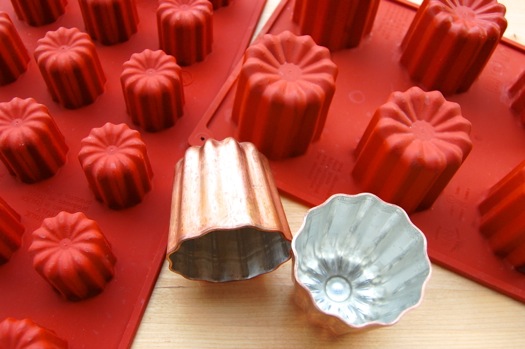
Buy lots of cannelé molds. As you can see here I’ve acquired a few different kinds over the years, and have made lousy cakes in all of them. The most expensive of these by far are the little copper cups in the middle there. Those are about two inches tall, hold a single cannelé, and cost about twenty bucks (U.S.) apiece. I know what you’re thinking: maybe I can just buy a couple of the good ones and bake several rounds of batter in sequence. Not really, since each batch bakes for two hours. You’ll be up all night making four mouthfuls of cannelé at a go. Nope, unless you have lots of disposable income you’re going to want to go with silicone, at least to start. It doesn’t deliver an exterior nearly as crisp as the metal molds do, but at least you won’t be broke AND aggravated over a failed batch at the very same time.

READ ON

Where do Cannelés come from?

Why from Bordeaux, a port city on Southwestern France located on a bend on the Garonne river, about fifty miles inland from the Atlantic Ocean. Legend has it that cannelés were created there. Or perhaps I should say that legends have it, since there are at least two major origin myths about the cannelé. The first regards spill-off from flour boats. As the story goes, cannelés were invented as a food for poor children, made from the flour that leaked out of sacks when the cargo was being off-loaded. I’m not sure if those would have done the kiddies any favors, honestly. I think they’d have been better off with the porridge at the local orphanage. Please sir, I want another dock refuse cake. Hmm.

READ ON

Cannelé Recipe (as Received)

This is remarkably similar to a crêpe batter. It needs to be made one day ahead and refrigerated overnight to allow the air bubbles to rise out of it. You need special fluted molds to make cannelés, economical silicone versions can be had from online baking equipment suppliers.

16 ounces (2 cups) whole milk
1 ounce (2 tablespoons) butter
3 egg yolks
1 egg white
8.75 ounces (1 1/4 cups) sugar
5 ounces (1 cup) all-purpose flour
1 teaspoons vanilla extract
1 tablespoon rum

READ ON