Beans Are Soaking
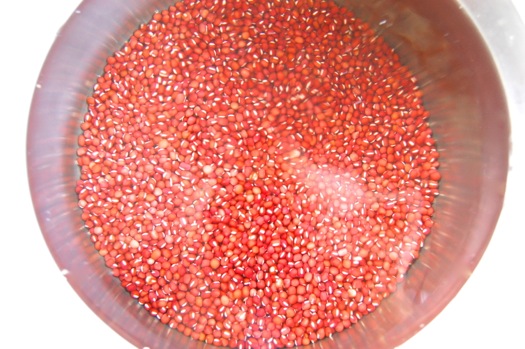
It’s Whole Foods to the rescue. Adzuki beans, they were right there in the bulk section. Let’s see where this leads us, shall we?
READ ON
It’s Whole Foods to the rescue. Adzuki beans, they were right there in the bulk section. Let’s see where this leads us, shall we?
READ ONWell I took my first stab at mooncakes today and determined that my textures were mostly wrong: dough too soft, filling WAY too runny. It was a sloppy mess. I corrected the dough for the skins, but the filling is a bit of a toughie. The canned bean paste that I can find here has […]
READ ON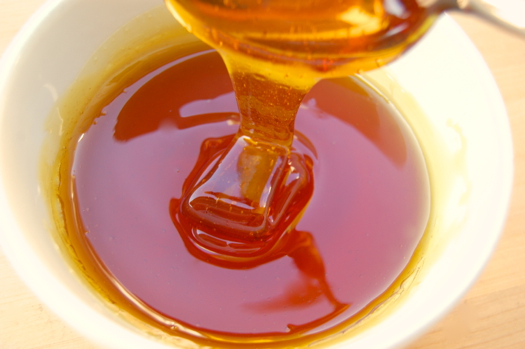
Chinese golden syrup is something of an odd duck in the syrup world. It’s an invert caramel syrup that flows at room temperature, even when undiluted with milk or water. That’s a very odd thing, since in order to get sugar syrup to caramelize you have to heat it well past the point at which it will flow once it cools. So how is this accomplished? Simply put, what you see here is a syrup made on top of a syrup, a dark caramel syrup for color and flavor, and a soft-ball stage syrup for flow. I’ll show you how it’s done.
READ ON
I haven’t written a book review in a while since writing book reviews takes time and effort and I’m lazy. However occasionally a book comes along that’s too good not to talk about and this is one of them: The Hoosier Mama Book of Pie by Paula Haney. Paula Haney, as the book title implies, owns the Hoosier Mama Baking Company which is not in Indiana as you might presume, but in Chicago. It’s a tiny little place. So tiny in fact that it would almost be more at home in New York where no one has any space, especially people who run kitchens.
READ ON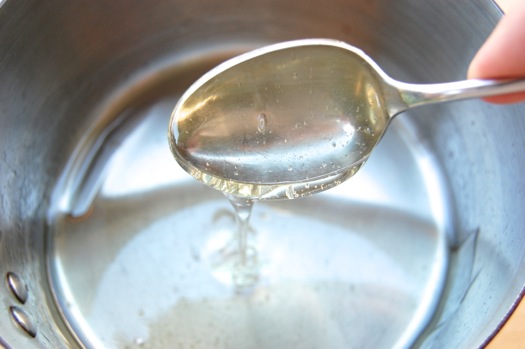
So OK, I’ve been working on a recipe for golden syrup for my mooncakes since I’m told it can be made at home. So far I’ve been meeting with limited success.
But first, what is golden syrup? In Chinese cooking it is an a.) invert sugar syrup that is b.) cooked to the soft ball stage, about 235 degrees Fahrenheit, and is c.) golden.
READ ON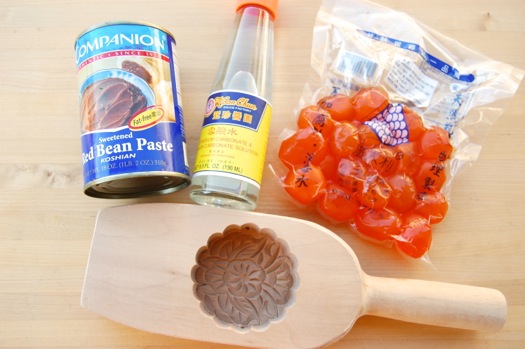
Several readers wrote in over the weekend to ask for a picture of some of the specialty equipment and/or ingredients. I understand that completely since Asian markets can be bewildering places to those of us who aren’t accustomed to shopping in them regularly. Here’s the stuff you’ll need. Clockwise from the upper left we have sweet bean paste in a can which you can find in the canned vegetable aisle (UPDATE: Homemade is far superior and not difficult, I recommend that instead!). Next we have lye water (alkaline water) which is typically kept in the sauce section near the soy sauce. Salted egg yolks are of course what’s next, they’re also in the refrigerated section near, you guessed it, the eggs.
READ ONReader T wants to know why the mooncake crust recipe below calls for baking soda AND Chinese lye water. It’s an excellent question and I believe the answer is twofold. First, an extremely alkaline dough will brown up more readily. I mentioned Maillard reactions in a post a few days ago. One aspect of these mysterious browning reactions that I failed to mention is that they happen faster in an alkaline environment. It’s one of the reasons breads like pretzels and bagels are dipped in a lye solution before they’re baked. Chinese mooncakes don’t spend much time in the oven, so to get even a mildly browned appearance the pH needs to be fairly high. I don’t know what the pH of Chinese lye water is, but it’s must be higher than that of baking soda (9). Otherwise, why use it?
READ ONReader Douglas is looking for an electric pizelle iron and some anise extract. The iron needs to be European (i.e. with a 220 European plug) and it would help if the extract vendor was as well. All you readers on the Continent…any ideas?
READ ON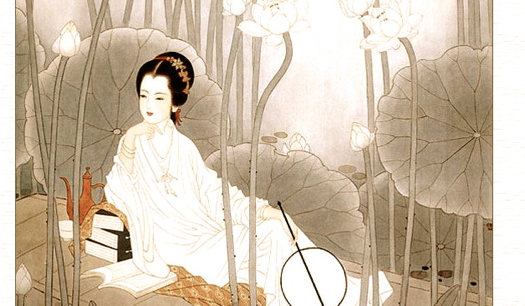
…is a story that’s central to the Mid-Autumn Festival. It has many versions, but generally goes like this. Chang E was a beautiful young woman who dwelt in heaven as a servant of the Jade Emperor, a Zeus-like character of Chinese mythology. She was married to another immortal, an archer by the name of Hou yi.
One day the Jade Emperor’s ten sons decide to have a little fun. They transform themselves into ten suns and begin to march across the sky together, burning the land to cinders. The Emperor is not amused and begs Hou Yi for help. His response is to shoot nine of the suns down and kill them, which wasn’t the solution the Emperor had in mind. So he punishes Hou Yi and Chang E by sending them to Earth to live out their lives as mortals.
READ ON