Are You Dining at Home Illegally?
You’re a chef, some friends invite friends over to your house for dinner, and before you know it you’re in violation of several public ordinances. I swear, officer, I thought the linguine was on the level!
READ ONYou’re a chef, some friends invite friends over to your house for dinner, and before you know it you’re in violation of several public ordinances. I swear, officer, I thought the linguine was on the level!
READ ONThis particular pastry has a more definitive history than most. It’s all but synonymous with the pastry shop Angelina which is located across from the Louvre in Paris. The establishment was opened by a fellow by the name of Antoine Rumplemeyer, which by strange coincidence is the very name I use whenever I’m traveling incognito. Guess I need a new alias, my cover is blown. Dang.
Rumplemeyer’s family had emigrated to southern France from Austria-Hungary in the late nineteenth century. Finding no Viennese-style coffee houses there, they decided to open their own. They began in Nice, spread to Monte Carlo and ultimately to Paris where Antoine opened Angelina in 1903. That was the year he invented the Mont Blanc, or according to some, only updated and took credit for it.
READ ONThis is my version of mont blanc. It incorporates all the elements of the original: chestnut spread, meringue and whipped cream which, while perhaps not a symphony of texture and flavor, are at least a heck of a good concerto. The difference is that this interpretation delivers all the components in a format that’s easier to prepare, build, store and serve. Notice that the ingredient list calls for pre-made chestnut spread, which is easier to get than chestnut paste, and may well be available at your closest boutique food store. I found some here in Louisville at a local specialty shop after ordering it twice online. Serves me right! You’ll need:
READ ONIt’s hard to make it there, says a very interesting article in today’s Wall Street Journal (the article is behind a pay wall, I think). Evidently everything from processed cheeses to tomatillos to corn fit for human consumption can be very hard to come by. That’s a big frustration, certainly for foreign food chain operators, but also for food truck entrepreneurs seeking to pull off higher-end versions of American and British lunchtime staples. Where do you get pastrami in Paris? Who knows?
READ ONIt’s time for a French/Italian classic it seems to me. If you’ve ever seen a dessert that looks like a small heap of whole wheat spaghetti with a dusting of powdered sugar on top, that’s it. The pastry is supposed to resemble the southern, Italy-facing side of the tallest mountain in the Alps, indeed in the entire European Union. Chestnut cream over Chantilly cream on a meringue and/or sponge cake base. So if you’ve got your cleats on, we’re ready for the ascent. First we’ll establish a base camp at 10,000 feet…
READ ONQuite a bit of chatter these days about the all-vegetable, Bill Gates-funded artificial egg. This story and others prompted reader Rainey to ask if I had an opinion on it. I’d be very curious to test artificial eggs in a home kitchen, Rainey, since I have a strong feeling that their main utility will be in the packaged foods industry where manufacturers are forever looking to replace the functional characteristics of animal-based ingredients with vegetable alternatives that won’t spoil and won’t fluctuate as wildly in price.
READ ON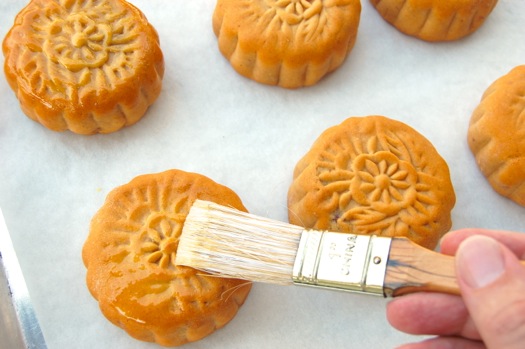
I could really get addicted to these. They’re like little sweet potato pies with a slightly salty, eggy reward in the center. I’ve come to the conclusion that mooncakes are best when they aren’t too sweet. Canned adzuki bean paste tends to be extremely sweet, so I urge you to try making your own. You’ll be far more satisfied with the taste of your cakes. Also, since the key to a successful mooncake is getting your component textures right, you’ll have far more control.
READ ON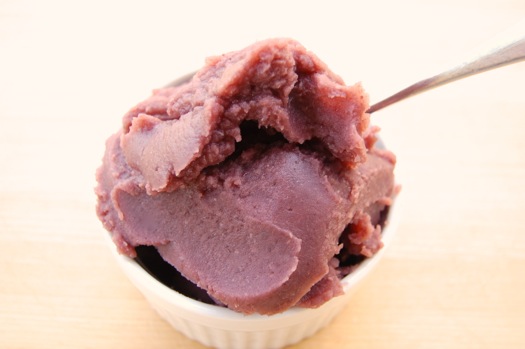
This staple Asian pastry filling is best made from scratch, since store bought is not only hard to find, it’s of highly variable consistency, texture, color and sweetness. Make it yourself and you can control all those factors, and it’s not difficult. Think of it as a sweet Asian version of refried beans, though now that I think about it, adzuki paste’s starchy sweetness reminds me more of thick mashed sweet potatoes. Excellent! Begin by soaking about a three cups of dried adzuki beans (available at Asian markets and/or your nearest Whole Foods in the bulk section) in water for about six hours.
READ ONMy new friend Amy has started a blog that I can already tell will be on my daily check list: Cooking, Rationally. She’s been baking up a storm so far, which has been great for me as I’ve already learned a lot from her relentlessly methodical approach. Keep up the good work, Amy!
And speaking of great blogs to check out, have a look at the delightfully named Egg Beat by pastry chef Shuna Lydon. It’s an insider take on the pastry world and a whole lot of fun!
READ ONWhenever I make something Chinese that has wheat in it, several readers are always surprised. After all, Americans eat corn, Europeans eat wheat and Asians eat rice. That’s pretty much the long and the short of it, no? But of course that’s’ a vast oversimplification of the, er…realities on the ground. It’s true that corn is native to the Americas, wheat to Europe (or at least the near East) and rice to China, but none of them are or ever have been the be-all and end-all grains in the regions where they were first cultivated.
New World natives consumed not only corn, but the seeds of range of other grasses including quinoa, amaranth, little barley, wild rice and sumpweed. Likewise Europeans has access to a variety of wheat strains (spelt, emmer, eikorn) as well as barley, oats, rye and buckwheat. Asian peoples, in addition to rice, cultivated millet, buckwheat, sorghum and others. And all that was before these peoples began mingling and trading with one another.
READ ON