Here’s what I learned today…
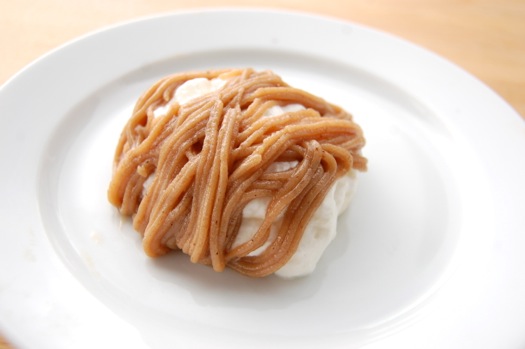
Chestnut paste is heavy, whipped cream is light. Put one on top of the other in any quantity and the result will be…this. Hm…this is going to mean a re-think of the recipe since I don’t much care for the idea of a giant, shambling mound of chestnut paste on a base. I like it, just not that much. Also, after all that hassle I ended up receiving chestnut spread in the mail, not chestnut paste, and there’s a difference. Man, my projects are getting the best of me in the dog days of summer, aren’t they?

READ ON

Why do star chefs love flake salt so much?

So asks reader Brandi. Part of the reason, Brandi, is merely caché. Yet there are some good reasons why many cooking show chefs prefer to work with flake salt. For one, it’s easy to pick up. And I mean that literally. Granules of table salt run from between your fingers like tiny ball bearings when you try to pick up a pinch. Flake salt by comparison clumps and allows for easy grasping. It also dissolves quickly, which is nice when you’re trying to correct the seasoning of a food just prior to serving.

READ ON

Sally in the Galley

…is the most original food blog concept I’ve ever encountered lately. Though she’s not in range of wifi too terribly often, she does manage to post regularly as she travels from port to port, making the best of whatever she can find in the sea-going larder. Check her out, as I am now a follower!

READ ON

These days…

…almost all the edible chestnuts you see for sale in the States are imported. We bring in some 4,000 metric tons of chestnuts per year from Europe, mostly around the holidays. Chestnut paste, a very common spread on the Continent, is virtually unknown here for reasons that a surely obvious. Perhaps one day, if the chestnut forests ever come back, we’ll make some of our own…’cause it sure is good.

READ ON

American vs. Chinese Chestnuts

Reader Melanie wants to know the differences between Chinese chestnut trees and American ones, since Chinese chestnuts are some of the only trees available to plant. I’m certainly not an expert on trees, Melanie, but I’ll tell you what I know. Though the chestnut tree species that produce the largest nuts come from Eurasia, there were species of chestnuts in America before European settlers arrived here. Native Americans ate the fruit of these trees for millennia.

Sadly, American chestnut trees were almost entirely wiped out when a chestnut “blight” was accidentally introduced in 1904, most likely on some Japanese chestnut saplings imported to the East Coast. By 1940 chestnut blight had killed an estimated 4 billion chestnut trees in the States. The Appalachian Mountain forests, which were about 25% chestnut, were especially hard hit. The blight also killed off most of the imported European species which were nearly as susceptible to blight.

READ ON

Size Makes a Difference

Reader Emily makes a great point: trace impurities may not have much impact on the way a salt tastes, but the size and shape of the salt crystals definitely do. Very true. And again, that’s not because the salt is any different chemically, but because crystals of varying sizes and shapes have different surface areas, and so dissolve at different rates.

Salt grains come in two basic shapes: granules and flakes. Granules are the shape we’re all used to, the little perfect cubes we all know as “table salt”. If you remember from other discussions on the subject of crystals (fat crystals, starch crystals, ice crystals), crystallization is what happens when molecules of the same type start stacking up upon one another. Given that molecules of sodium chloride are cubical, it’s easy to see why they might naturally want to stack up into cube shapes. In fact, given the right conditions, salt can grow into huge cubical crystals known as halite, which can be anything up to 4 or 5 inches across.

READ ON

On Gourmet Salts

On something of a side note, reader Jaye wants to know if gourmet salts are worthwhile, in baking or otherwise. Jaye, I’m something of a contrarian here, as I believe that all the fuss over salt these past few years, well…it’s just a lot of hooey. All “eating” salts are chemically identical: NaCl, or sodium chloride, a molecule made up of about two-thirds chlorine and one-third sodium. Whether you get it from the sea or from the Earth makes no difference, in the end it’s all the same thing, which makes it impossible for one gourmet salt to really, really taste different from another. Dissolved in water, I’ll defy the most sensitive palate to tell the difference between gourmet salt A and gourmet salt B.

READ ON

Dang Interwebs

I haven’t had web access at the command center all day. Which isn’t that bad a thing since I haven’t had much to blog about. Due to (ehem) operator error, the chestnut paste I ordered last week went to my sister in St. Louis by mistake. I thought it was taking a while!

READ ON

Old Man of the Forest

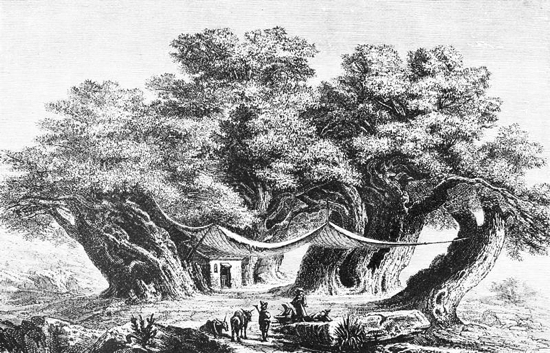
Foodstuffs are just the beginning of a chestnut tree’s utility. They grow fast, and when full-sized are practically lumber yards with roots. They regenerate lost limbs with astonishing speed, and so became ready, self-replenishing resources wherever they grew. Of course you could cut one down and use it for planking too, but regenerating chestnut shoots grow straight and strong, and as such are useful for pole roofs, grape trellises, all sorts of things.

READ ON

The Bread Tree

Mont blanc is something of a showcase for chestnut paste, and that’s no accident. For millennia chestnuts have been synonymous with the Alps, especially the alps of Northern Italy, where chestnuts were a staple starch in the centuries following the fall of the Roman Empire.

Chestnut trees originated in southwestern Turkey, where they were cultivated as far back as 2000 B.C.. They were “discovered” by Westerners in the first few centuries B.C., so it’s said by Alexander the Great during his eastern campaigns. The chestnut fruit appealed strongly to a military man like Alexander, packed as it is with vitamins and starch. Ounce-for-ounce chestnuts have twice as many calories as potatoes. They last forever and eminently portable.

READ ON