Happy Halloween Everyone!
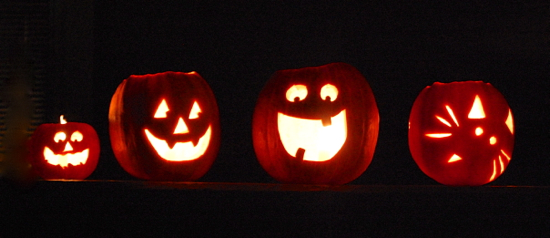
Between carving pumpkins and helping with costumes (a bat and a superhero) my girls have dibs on what’s left of my free time this week. More from me soon!
READ ON
Between carving pumpkins and helping with costumes (a bat and a superhero) my girls have dibs on what’s left of my free time this week. More from me soon!
READ ONGreat question, reader Pip, if that IS your real name. Silly of me not to post about it before. In general you want to use the same sorts of apples you use for other baking baking applications: firm, crispy and flavorful. I think red apples are best for candying: gala, fuji, cameo, pink lady, Jonathans. For caramel apples, the Granny Smith is the ultimate in my book, but Golden Delicious and Jonagold work well if tartness isn’t your thing. Really any of the red candy apple varieties work too.
READ ON
Most caramel apples are made using melted caramel candy for the coating, or a home made version thereof. Personally I prefer caramel sauce as starting point. You get a lot more flavor nuances when you cook the sugar to the breaking point, or at least that’s how I see it. That’s where the fun is. Cooking the syrup to the caramel stage is also a lot easier to my mind, as you don’t have to measure temperature. You just swirl it over the heat until it’s nut brown…easy.
READ ONWell, reader Marti, I expect I’ll do what I usually do: hang out while the ladies are trick-or-treating, hand out candy and watch my favorite campy horror movie: Phantom of the Paradise. If you’ve never seen it, it’s a goofy 70’s rock-and-roll blend of Faust and Phantom of the Opera with Paul Williams as the devil. I recommend it highly.
READ ON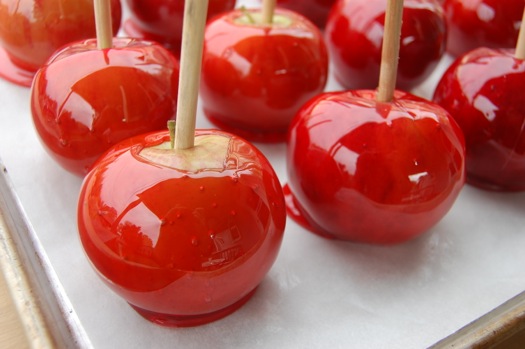
Much as I love caramel apples, given a choice I’ll go for the candy apple every time. That’s because no one makes them much anymore. There’s a perception that they’re more difficult to make than caramel apples, but it ain’t so. If you can heat syrup in a pan and take its temperature, you can make a candy apple. Here, let me show you how easy it is.
READ ONMusic lovers are all feeling a little blue today having lost Lou Reed yesterday. None are feeling bluer than Mrs. Pastry who’s been a Lou Reed fan since long before we ever met. His records were the soundtrack of her years in Manhattan, which she regards as some of the best of her life. She hadn’t met me yet, so that only stands to reason. Do yourself a favor and listen to a little Lou today. This is my favorite track of his, off of Rock n’ Roll Animal. Not only is it a trademark tune, it’s a vivid illustration of what great musicians Lou always had playing with him. Notice how they all have fun strutting their stuff, jamming for the first few minutes, then they all lock in together just as Lou takes the stage. That’s rock n’ roll, baby!
READ ONReader Mark writes:
i am a vegetarian, i bought a nutri grain bars, after i had one i looked at the ingredients and found that is contains glycerin. i have heard that glycerin comes from the fat of pigs. is that true, or not
Hey Mark! Good question. It’s gelatin that comes from pigs and bovines (skins mostly). Glycerine is completely vegetarian. It comes from a couple of sources. It is the main by-product of biofuel (ethanol) production, which means that assuming ethanol continues to be mandated in auto fuel blends we’ll be seeing a lot more of it. But biofuel glycerine isn’t the type we typically eat, since in its raw state it contains a fair amount of water plus a few residual whatsits.
READ ONWhat discussion of apple agriculture in nineteenth century America would be complete without at least a couple of paragraphs devoted to Johnny Appleseed? Oh yes, he was a real person, proper name Jonathan Chapman, born in 1774 in Leominster, Massachusettes, and one of the most eccentric characters ever to set a bare foot on the American frontier. Part freelance nurseryman, part missionary, part real estate speculator, he was ALL kook, known to wear a tin pot on his head, put out camp fires to keep from burning mosquitoes and punish his feet for treading on worms (for instance, by throwing his shoes away). For all that he was also a canny businessman who traveled Ohio, Indiana, Illinois and parts beyond planting makeshift nurseries for Westward-heading settlers.
READ ONLots of responses to the Fruit with a Checkered Past post below. Many asking: are you pulling our legs, Joe? Did frontier children really drink? Oh yes they did, and for one simple reason: because alcoholic beverages were frequently safer than water.
The reason should be fairly clear: microbes can’t survive in an environment that’s 10-15% alcohol. This is a reality that peoples all over the Eurasian continent and the Mediterranean discovered millennia ago, even though they had no concept of microbes: people who drank beer, wine and other alcoholic drinks (like kefirs) stayed healthier than those who drank ground water. Sure, in time
READ ON
Speaking of chopping down apple trees, meet Carrie A. Nation. Nation was the most well-known of the Women’s Christian Temperance Union’s, er…activists. A real-life hatchet man is what she was. And if you think that’s an uncharitable thing to call a woman, what would you call a 6-foot, 180-pound, ax-wielding bull, all dressed in black? Even the Boston Strong Boy, prize fighter John L. Sullivan is said to have dashed for the exits when Nation burst through the doors of his Manhattan bar round about 1905. They say he screamed like a girl all the while…wouldn’t you?
But that was Nation’s style. Never shy when it came to speaking her mind, she nevertheless believed that actions — especially those that involved hatchets, rocks, bricks, clubs and lots of smashing glass — spoke much louder than words. No question she had a point there. You might say she was a pioneer of the if-persuasion-fails-there’s-always-violence school of political activism.
READ ON