How important are fresh eggs for cake baking?
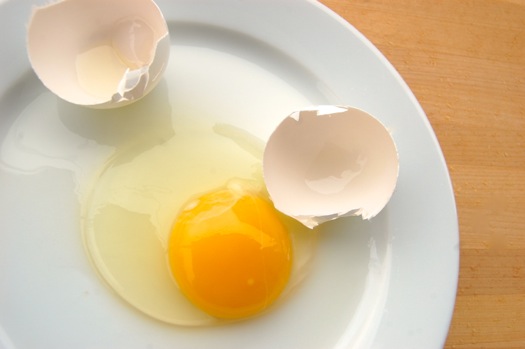
Good question, reader Debbie. I once thought that fresh eggs were important for good layer cakes. That was good ol’ farm wife wisdom. However I’ve since come to see that very fresh eggs are not important to a cake’s taste or texture and are indeed a little more of a hindrance than a help when it comes to mixing a batter. Pictured above is a fairly fresh egg. You can tell by the high-standing and gelatinous albumen (white). It’s lovely for a fried egg, where the runny white of an older egg makes a much less appetizing presentation, but when you’re trying to incorporate it evenly into a liquid batter, its firmness makes it rather difficult to blend in. Is it a big deal? No. You just have to be a little careful that you’re not whipping the eggs and milk (if you’re making a one-bowl or creaming method cake) so much that you’re creating lots of extra air bubbles.

READ ON

What’s so great about the one-bowl method?

First, reader Glenn, let me just say that I’m still baffled as to why it’s called the “one bowl” method since I’ve never succeeded in using less than two bowls for a one-bowl cake. So right there I’m a little down on it. But there’s no denying that one-bowl layer cakes are very moist and tender devices, I dare say more so than cakes made via any other method. But why is that?

It all has to do with the manner in which the fat is introduced to the batter. A cake mixed via the creaming method — which is the standard for most layer cakes — starts out as a well-beaten mixture of fat and sugar. Doses of dry and wet ingredients are added alternately until all is combined and ready to bake. With the one-bowl method all the dry ingredients including the sugar and mixed together first, then the fat is added before any liquid touches the mixture.

READ ON

Wanted: A Good Cuppa

This is a personal plea from a tea drinker. Many years a go I lived in Britain and was spoiled by their ordinary, garden-variety Twinings tea. It’s excellent and sadly much, much better than the Twinings we get on this side of the Big Drink. I’ve been to those British specialty goods stores and not […]

READ ON

Will acid help?

So asks reader LML, and it’s a fascinating question. As you may recall egg white whippers are frequently counseled to add acid to their whites as they first start to foam up. But why exactly is that? Well you’ll recall from the post below that whipping causes egg white proteins to unfold and begin collecting around air bubbles. The trouble is that this same action, if carried too far, will cause the proteins to clump back up again. It’s the excess agitation you see. It causes the protein molecules to bond excessively to their neighbors, and when that happens they coagulate in much the same way they do when they’re exposed to too much heat.

READ ON

Why do egg white foams cause dryness?

That’s a great question, reader Bobbi, for in fact they often do cause dryness when they’re incorporated into something baked: a cake, cookie or scone. I can think of a couple of reasons why that would be. As you may recall from past discussions of egg white foams, the act of whipping causes proteins in the mostly-water egg white to denature (“get wrecked” in science-speak). In their natural state these proteins — lots of globulin and ovotransferrin — are found gently curled in bunches. The force of whipping pulls those bunches apart, and once they’re apart the individual protein molecules start collecting on the surface of the air bubbles that have been created by all the agitation. They do that because those proteins have both water-loving parts and water-hating parts along their length. The surface of an air bubble is therefore a perfect place for them. The water-loving parts can stay in the water, the water-hating parts can protrude into the air, both sides of their split personality are happy. They’ll also bond side-to-side with each other just for good measure. The result is a protein mesh that reduces the bubble’s surface tension, reinforces its walls and keep the bubble from popping. In other words: foam.

READ ON

On a Related Note…

Yet more evidence — in this case a meta-study — disproving the link between dietary fats, especially saturated fats, and heart disease. The study found no increases in heart disease among people who consumed more saturated fat. More interesting still, the study found no decreases in heart among people who consumed more unsaturated fats. Very interesting indeed, and a bolster to those who believe that heart disease is more a factor of our genes than our diets.

READ ON

America’s Baker-in-Chief to Resign

Pastry Chefs, fire up those resumés. Bill Yosses, White House Pastry Chef since 2007, is moving on, citing a desire to relocate to New York to teach children and adults about the relationship between food and health. Just how and where he’ll do that is something of a mystery as of right now, but I’m sure there’ll be no end of opportunities in the Big Apple for the America’s former First Baker.

READ ON

White Layer Cake Recipe

White cake lovers treasure the image of grandma gently folding a mound of whipped egg whites into a rich, buttery batter. Unfortunately it’s whipped whites that are the cause of what a lot of people don’t like in white cake: dryness. Or, if those egg white bubbles pop en masse, density. Plus dryness. Which is really no good for anybody. Nope, when it comes to white cake the “two-stage” or “one bowl” method is really the only way to go. You’ll need:

10 ounces (scant 2 1/4 cups) cake flour
10.5 ounces (1 1/2 cups) granulated sugar
4 teaspoons baking powder
1 teaspoon salt
6 ounces (12 tablespoons) soft butter
5 egg whites
8 ounces (1 cup) milk, room temperature
2 teaspoons vanilla extract (or for fun, 1 tsp. vanilla and 1 tsp. almond)

READ ON

10 Proven Ways to Get His Attention — NOW!

Just kidding. I got a promotional email this morning telling me that if I didn’t learn to write headlines that resemble Cosmopolitan magazine I’ll go nowhere as a blogger. So consider this a warm-up as I steadily work the Cosmo aesthetic into my day-to-day routine. Here’s a list of posts I’m currently working on:

Folding Techniques That Will Absolutely Blow His Mind!
Making the Génoise He Secretly Wants But is Too Shy to Ask For
Five Things Other Bakers Say About You Behind Your Back

READ ON

So what now?

I’m back tan, rested and ready, but with few ideas for projects, so I thought I’d solicit some suggestions from you, my faithful readership. So hit me! I’ll do my best to get to everything before Q3 of 2019.

READ ON