Bienenstich Recipe

Lovers of pastry will notice that bee sting cake bears a striking resemblance to tarte Tropézienne. That makes sense since tarte Tropézienne is really a German cake adapted to French resort town living. What are the differences? The bee sting cake filling isn’t as rich, being more custard-y than buttercream-y. Then there’s the matter of the topping: a caramel and sliced almond combo that gives the appearance of a mass of bees on a honeycomb. Here’s what you need:

READ ON

Action and More Action

Reader Dan, who is working on financiers this week, has a very interesting question about baking powder:

If you’re using [baking powder], why rest the mix in the fridge? Surely the [baking powder] is activated, and loses its potency before you actually come to baking?

It’s very reasonable to assume that, Dan. Conventional wisdom holds that whenever you get baking powder wet you need to hurry it into the oven so you don’t lose any volume. That actually isn’t the case. It’s certainly true that you get a gas-producing “pop” when the baking powder gets wet. That’s the first “action” of double-acting baking powder. The second action happens when the baking powder gets hot.

READ ON

Are things feeling a little cozy in here?

March is always hell on my numbers, I assume because of spring break (if not I’m seriously losing my edge). I generally check analytics around the first of the month, and this morning I laughed out loud when I saw the trend line since the 8th. Given how few of us there are here today, […]

READ ON

Next up: Bienenstich

German “bee sting” cake is what this is, and I’ve been wanting, then forgetting, then wanting, then forgetting again to do this cake for years. Thankfully reader Bina got on may case about it a couple of weeks back. It’s high time I got this thing done!

READ ON

Making Pan de Ramerino

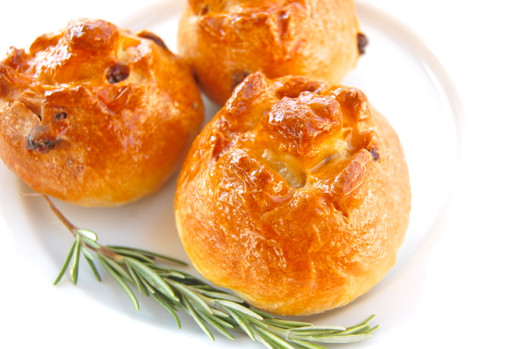
These little Tuscan breads are ingenious. Neither completely savory nor sweet they’re scattered with raisins, perfumed with rosemary and olive oil and lightly painted with an apricot glaze. They’re a variation on the hot cross bun, and as such appear around Easter in Florence. Traditionally this bread was made in loaves on Holy Thursday for the observance of the Last Supper. The loaves would be baked, taken to church for a blessing then eaten after mass. Nowadays I’m told this bread is mostly baked up in buns, and no longer just for Holy Thursday. You’ll want to eat yours all year round as well. Begin by assembling your ingredients.

READ ON

Pan de Ramerino

“Rosmarino” is how you say “rosemary” in Italian, but in the Tuscan dialect it’s “ramerino”. The formula has a few extra steps compared to a typical herbed bread as the aim is to infuse the oil with rosemary flavor instead of adding chopped herb to the dough. The results is a very light and elegant flavor. If you like a stronger rosemary flavor, add a tablespoon of finely chopped fresh rosemary leaves at the same time you add the raisins to the dough. The bread goes like this:

2 ounces (1/4 cup) olive oil
3 sprigs fresh rosemary
3.5 ounces (2/3 cup) raisins
3 1/2 teaspoons instant yeast
1 ounces (scant 2 tablespoons) sugar
17.5 oz (3 1/4 cups) bread flour
1 teaspoon salt
¾ cup water
2 eggs
egg wash
apricot glaze

READ ON

How to Make Hot Cross Buns

These come together so quickly and easily you’ll want to bake up a batch every Friday (or Saturday, or Sunday, or Monday…). They’re light, slightly sweet with a hint of spice and candied fruit. Delicious but not so much of a Lenten indulgence that you’ll have to go to confession afterward. Use whatever dried fruit is handy. Raisins are very common, currents are very English, citron is very hip, dried apricot is very, um…Louisville. Mix and match them to your heart’s content. Start by

READ ON

Hot, Cross II

Pagans and pagan symbolism are just the thin end of the wedge when it comes to hot cross bun buffoonery. There are all kinds of other made-up stories that have found currency over the years. Let’s see…there’s the one about the medieval monks who put crosses on their bread to ward off evil spirits. There’s the one about English housewives, so dissatisfied (i.e. “hot” and “cross”) with the output of their local bakery, they were forced to make their own rolls at home.

READ ON

Lent: Austerity vs. Indulgence

Funny thing about Lent, on the one hand it means abstinence (along with prayer and giving to charity). On the other it means it’s pig-out time, at least for some Catholics. The way I grew up in the Chicago area, Lent was always a fairly austere period, when gratuitous eating of any kind was frowned upon. But just try telling that to the more exuberant Catholics down here in Louisville. Lenten Fridays here may be meatless, but they’re host to high-spirited fish fries that would make many northern Catholics blush. Are we really supposed to be having this much fun this time of year?

READ ON

What about Vienna?

Got a few emails overnight in regard to yesterday’s post Remember Tacubaya!, among them this note from an attentive (and apparently long-time) reader Eric:

Hey Joe! Got a kick out of your Pastry war post, but I was surprised to hear you call it the world’s most famous baking-related conflict. I thought that distinction belonged to the siege of Vienna!

READ ON