Next Up: Mud Cake

Here’s something that I confess I’d never heard of before reader Nokanen in Finland requested it back in March. A few other readers in the region of Northern Europe weighed in just afterward on the subject, so for a while I was thinking that this was some sort of exotic European device. I’ve since discovered […]

READ ON

Is it possible to make custard with water?

Wooohooo!! Now THAT’s the kind of super-nerdy question that really kicks a Joe week off right! I thank you for it, reader Denny! The answer is no, you can’t make a custard with beaten egg and water in the way that you can with, say, beaten egg and milk. All that happens when you heat it is, well, egg drop soup. The question is: why?

The answer is because egg protein molecules repel each other. They’re negatively charged and as a result they naturally push away from each other like two same-sided magnets. In order for a gel network to form, those proteins need to attract — or at least not repel — one another as they uncoil. They’re then free to bond with each other side-to-side to create a molecular mesh. That mesh reduces the flow of the water and the result is

READ ON

How does cornstarch prevent curdling?

Love that question, Susanna! The lemon meringue pie recipe below has cornstarch in both the filling and the meringue, to serve as both a thickener as well as a stabilizer in the event the egg proteins get too hot. But how exactly does that work? Well you may remember me talking about “the clenching fist” in the past, a metaphor that describes what happens when intertwined egg proteins get too hot and curl up…squeezing out water as they tighten into little clumps. That’s curdling. It can’t ultimately be prevented but it can be forestalled by the addition of starch to the mixture. Starch molecules do a couple of things in a custard. First, they absorb some of the heat energy, thus protecting the more delicate proteins. Second, they get in between

READ ON

Why not keep the custard simmering?

Reader Nick asks:

[When making lemon meringue pie] why can’t the filling just be left on a low simmer while I’m making the meringue? Since there’s a lot of cornstarch in it the odds of it curdling seem remote. Wouldn’t that be a better solution for keeping it hot?

Hey Nick! I like that thinking! However I don’t think it would work for a couple of reasons. Firstly, despite the amount of cornstarch in the filling you still run the risk of curdling the filling the simmering goes on for more than a minute or so. The mixture is so thick there isn’t much convection in the pan, so the filling on the bottom absorbs a whole lot of heat if you aren’t whisking it constantly. And even assuming you have a third hand to whisk with

READ ON

Making Lemon Meringue Pie

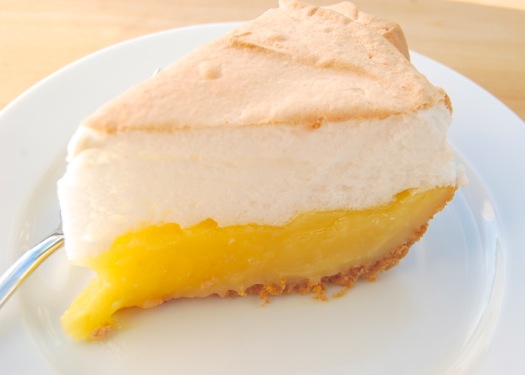
This is what you call a classic American lemon meringue pie: a light, frothy-sweet baked egg foam above, a tart and creamy curd filling below, all heaped up on a delicate crumb (or traditional) pie crust. Not much not to like here in my opinion. Indeed lemon meringue consistently ranks about fifth on the list of the America’s favorite pies. It would probably rank higher if more people made this pie at home, but its reputation for fussiness scares a lot of home bakers away.

That reputation is deserved to some extent. Under-baked meringue toppings often cause weeping, and are quite common as the very center of the pie is hard to fully heat without breaking the lemon custard (which causes another kind of weeping). Large pools of syrup are commonly found in pie plates, either upon cutting or the next day after any leftovers have had a chance to sit. The process below is designed to avoid that problem, and it works very well. However it is something of a dance, so I strongly encourage you to have all of your ingredients and component parts prepared and laid out on the counter before you begin. There’ll be much less confusion that way.

READ ON

“It’s the dogs, JB.”

Whenever I engage in a discussion like this on the blog I always get a few notes — some more civil than others — saying: Open your eyes, Joe! It really is big, greedy, soulless mega-corporations that do things like take our lard away. That dark art known as marketing is to blame!

Speaking as a longtime food, ingredient and restaurant marketer all I can say is I wish it were true. I’d have a much bigger house. Sadly a food product’s success really does depend on humdrum market factors like quality, price, value, difference, shelf life and convenience. A product that doesn’t offer the right mix of those things can never succeed, no matter how much money you pump into marketing or what Madison Avenue genius is writing your headlines. Which reminds me of an age-old marketing joke that I occasionally tell. It goes something like this: JB, a big company CEO decides to launch a new miracle dog food. He calls in his marketing director.

READ ON

Lard vs. Butter

There’s good news and bad news here, though overall it seems the scales tip in lard’s direction. Calorie-wise, lard has more of them, about 15% more, which makes a lot of sense when you consider that butter is about 15% water. Compositionally, though, there are certain factors that make lard more desirable, at least based on the (ehem) current thinking of many researchers and nutritionists.

Fat, you see, is not a uniform substance. It’s made up of lipid molecules of many different configurations. As I’ve mentioned many times before, lipids are basically “E”-shaped molecules, consisting of a “backbone” of glycerol and three fatty acids. The fatty acids attached to the backbone are all different from one another, and more than that, vary from molecule to molecule. Where molecules in a fat have similar structures, they will often form solid crystals. Others won’t. It’s this mixture of solids and liquids that gives fats like butter and lard their semi-solid consistency.

READ ON
Blatant Lardism

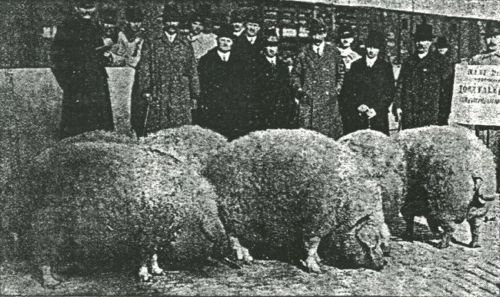
What do so many people have against lard? Commenters have pointed out that a big reason lard fell into disrepute in the middle of the last century was because of its association with poverty. I think that’s at least partly true. If you look around at all the places where lard was popular in the early 20th century (the American south, rural Mexico, Hungary, Italy, Spain, the list goes on…), one thing that was common to them all was poverty. As I’ve written before, pigs are terrific poor peoples’ food. They’re easy to take care of, they grow quickly, breed prolifically and eat just about anything.

READ ON