Mexican Getaway

No, not me: Mrs. Pastry. She’s on a research project in Mexico City all week. What a time for my biggest client to demand a presentation! So I’m packing up the girls and we’re hitting the road for Chicago. I figure I’ll do the talking, my 7-year-old can run the powerpoint and my 4-year-old will […]

READ ON

Making Gâteau St. Honoré

Every so often a pastry comes along that makes even the most jaded sweet-eater throw down his fork, stomp his foot and shout out loud:
my GOD that’s good. Gâteau St. Honoré is that pastry. Yes, you may think you know what it tastes like: cream puff dough, pastry cream, meringue and caramel. But I’m telling you friends, until you actually prepare and serve one of these you won’t understand the impact that all those components can have when they’re delivered together. The uninitiated are always, always stunned.

READ ON

Making Chiboust

Call it chi-BOOST, call it she-BOO, it’s a sweet, light and delicate filling either way. Pastry cream lightened with Italian meringue is what it is, and it works well in just about any context where you want a large volume of filling, but don’t want to overwhelm the eater with richness or heaviness. A Paris-Brest is a good example, or a Gâteau St. Honoré. Bear in mind that chiboust — like most meringues — doesn’t like humidity. And while it can be piped, pipe it only through large-bore nozzles, since constriction and pressure causes it to deflate and go runny. Here I have about a cup of the firmer of the two pastry creams that are up on the site.

READ ON

Church of the Sacred Spatula

St. Honoratus (and/or the urn containing his relics) was well-known by 1202. That was the year a baker by the name of Renold Theriens donated a plot of land in Paris so that a chapel might be built in the saint’s honor. Though I haven’t seen anything to back this conjecture up, it seems that this was the time that Honoratus became formally associated with baking.

READ ON

The Amazing, Colossal Baptist

Reader Mara writes in to ask: what’s happened to all the saint relics from the Middle Ages? Are they in museums? Do you guys trade them or sell them to each other?

Oh goodness me, no. In fact there’s a special sin on the books for that very thing: paying money — or trading for — sacred objects or spiritual services. It’s called simony, and it’s the only sin I’m aware of that’s actually named for a person. Simon Magus was the fellow’s name, a magician of sorts from the days just after the crucifixion of Jesus. He observed St. Peter and St. John laying their hands on believers and imbuing them with the Holy Spirit. Seemed to him like a pretty good racket — something he could charge a good buck for — so he offered to pay Peter and John in exchange for teaching him the trick. You can judge for yourself how well that worked out for Simon.

READ ON

How did St. Honoratus get famous?

Getting canonized doesn’t automatically make you famous, just so you know, all of you out there who aspire to the honor. Catholicism has too many saints for that. How many are there? More than 10,000 (nobody knows the exact number…there’s never been a head count). So suffice to say that only a very few saints’ names roll off the tongue of your typical Catholic. Just ask St. Guy of Anderlecht, patron saint of sheds and outhouses, St Gertrude of Nivelles, patron saint of suriphobia (the fear of mice) or St. Fiacre, patron saint of STD’s. None of them have popularly-celebrated feast days or fancy sterling silver medallions. What a rip.

READ ON

Was there a real Saint Honoré?

Yes there was. To most people outside France he’s known as St. Honoratus of Amiens. He’s the patron saint of bakers and confectioners (also florists, millers, candle makers, chandlers and oil refiners). For those of you who didn’t grow up Catholic and don’t know what patron saints are, they’re the people you call on when you need someone to intervene on something small, something you wouldn’t want to pester The Big Guy with. Like when you’re putting a soufflé in the oven and company is due. St. Honoratus, pray for me. Sorta like that.

READ ON

What’s chiboust and how do you pronounce it?

Shi-BOOST is, I believe, the correct pronunciation. It’s a simple mixture of 3 parts pastry cream to 1 or 2 parts Italian meringue. The two are gently folded together and the resulting cream is used mainly as a filling for large pastries like Paris-Brest or Gâteau St. Honoré. It’s usually piped, but only through large nozzles since lots of pressure has a way of breaking it.

Chiboust was supposedly invented by a pastry chef of the same name, who supposedly lived in Paris in the mid-1800’s. Supposedly. By no coincidence whatsoever it is he who is credited with inventing Gâteau St. Honoré. Why did he call it that? Because his shop was on Rue St. Honoré. Supposedly. However that’s all I know and I can’t find a thing that’s authoritative on the mysterious M. Chiboust. Anyone who does know something about him, please weigh in.

READ ON
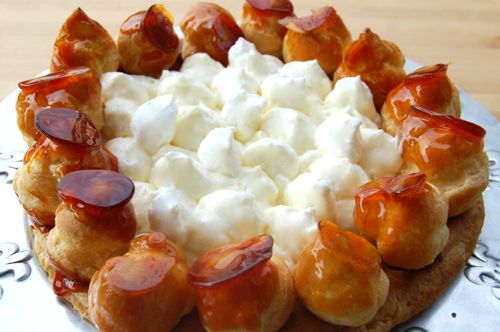
Gâteau St. Honoré Recipe

Gâteau St. Honoré can be made in lots of different ways. The foundation is usually made of puff pastry, short crust, pâte à choux or a combination thereof. Huh? A combination? Yup. The most typical combo is a base of puff pastry with a layer of choux on the top, which is what I’m going to do. I happen to have a large ball of puff pastry scraps in the freezer and they’ll be perfect for the job (since I want the richness but not necessarily all the height). A normal sheet of puff pastry will work great, too. You’ll just need to prick it (“dock” it) with a fork.

READ ON

This Week: Gâteau St. Honoré

Here’s a classic that strikes fear in to the hearts of many, but is actually a not-too-difficult thing. You’ve probably seen it before in a pastry case. It looks like a cream-filled tart with caramel-covered cream puffs all around the edge. As with a lot of classic preparations, there are many, many variations on the […]

READ ON