How does a brine work?

Quite a few readers out there have written in asking whether a salt crust gives a result similar to a brine when it comes to roast chicken. It’s a good question. Both methods surround the bird with a salty medium. Intuitively, they should produce a chicken that’s about the same in terms of taste and texture. But in fact that isn’t so.

The critical difference is water. A solution of just 3% salt will penetrate chicken muscle much more readily than the salt in a salt crust will, even though there’s a lot more salt in the crust. Which begs the question: why?

READ ON

Cockfighting, Academic Style

Want to see a really good fight? Get a few anthropologists together in a room and ask them when chickens first arrived in the New World. Then back away and start placing your bets.

How chickens came to the Americas is one of the great unresolved anthropological debates. On the one hand you have those who believe chickens arrived in the New World with the Spaniards and/or Portuguese. On the other you have those who contend that chickens arrived far earlier and from the other direction, via the Polynesians. A few outliers claim ancient Egyptian seafarers brought them, but most of those types also believe in the Loch Ness Monster.

READ ON

How to Truss a Chicken

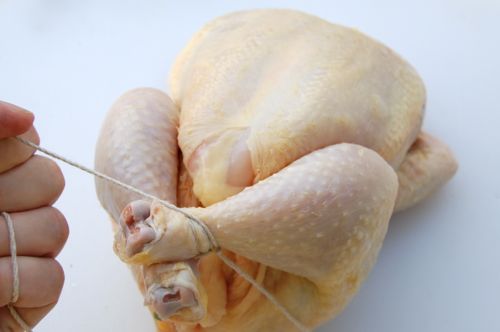
Trussing a chicken is an easy thing to do and it vastly improves the texture of your roast. Why? Because the more you can draw any large piece of meat — not just a chicken — into a compact, ball-like shape, the more evenly it will cook. Extremities like legs drastically overcook when they simply stick out there in the oven’s heat. A little twine around the meat prevents all this.

READ ON

You mean you actually EAT those things?

Not everyone in the ancient world ate chicken. While just about every ancient culture valued chickens for their eggs, by no means all were excited about their meat (the Japanese eschewed both and mostly kept chickens as exotic pets). The Romans are an excellent example. Avid egg eaters, they were extremely practical. They considered the eating of hens to be wasteful, an act only fussy, decadent pantywaists like, say, the Greeks would be capable of (here I should insert that there are notable parallels between the way the Romans viewed the Greeks and the way some Americans view the French). The Roman author and naturalist Pliny the Elder wrote this about the inhabitants of the Greek island of Delos:

READ ON

How to Hatch 15,000 Eggs

Modern chicken and/or egg production horrifies some, and I’ll admit that it can be an ugly (certainly smelly) process. What most people don’t know is that mass egg hatching isn’t a strictly modern practice. The ancient Egyptians perfected it as long as 3,500 years ago. That makes sense when you consider how adept the Egyptians were at scaling.

READ ON

Come for dinner, stay for the show.

There are lots of edible birds in the world. Ducks spring to mind. Geese are another. But really I can’t think of any birds you can’t eat. I can think of plenty of birds I’d just as soon not eat, but none that would, say, poison me in the event I needed to eat one in a pinch. But of all those edible birds — especially the really, really toothsome ones — why have we humans elevated chickens above all other possible choices? A big part of the answer is cockfighting.

READ ON

The Long (Chicken) Walk

It took a surprisingly long time for chickens to make it from the region we now know as Thailand to the Western World. Thousands of years in fact. Though some historians dispute this (of course), most evidence suggests that chickens didn’t arrive in the Middle East/Mediterranean until about 500 BC, some 7,000 years after they were first domesticated.

It was the Persians under Darius the Great who first “discovered” the chicken for the West when he invaded what is now Pakistan in 520 BC. Long time readers may remember Darius as the man who lost to the Greeks at the Battle of Marathon during the first of the Greco-Persian Wars.

READ ON

Where do chickens come from?

Is that a trick question, reader Hanna? Because I’ve been down that road before. The whole chicken-egg thing only ends in headache and frustration. But if you want to know where — geographically — chickens come from, the answer is Thailand (or thereabouts). That’s where they were originally domesticated, sometime around 7500 BC.

Chickens are descended from junglefowl, medium-sized ground-dwelling creatures related to pheasants, which inhabit open spots in jungles and forest edges in southeast Asia. That’s about as specific as I can get without inciting argument. For chickens, it turns out, are a highly contentious subject.

READ ON